


Customer retention in aviation is an important part of long-term success in the aviation industry. Airlines operate in a highly competitive market where passengers have many choices when selecting flights, destinations, prices, and travel services. Attracting new passengers is important, but encouraging existing customers to book again is equally valuable.
Customer Retention in Aviation analytics in aviation helps airlines understand passenger behavior, identify customer satisfaction issues, measure loyalty, and predict which customers may stop using their services. By analyzing booking histories, passenger feedback, frequent flyer activity, complaints, and service performance, airlines can make better decisions and improve the overall travel experience.
This guide explains how Customer Retention in Aviation analytics works, which metrics matter, how airlines can use passenger data, and which strategies help build long-term customer loyalty.
Table of Contents
Introduction for Customer Retention in Aviation

The aviation industry is much more than transporting passengers from one destination to another. Modern travelers expect convenient booking systems, comfortable journeys, reliable flight schedules, efficient airport services, professional staff, and timely communication.
A passenger’s experience begins when they search for a flight and continues through booking, check-in, boarding, the flight itself, baggage collection, and arrival at their destination. Every interaction can influence how passengers feel about an airline.
For example, a passenger may choose an airline because it offers an affordable ticket. However, if the airline provides poor customer service, regularly delays flights, or fails to resolve baggage problems, the passenger may choose a competitor for their next journey.
This is where Customer Retention in Aviation analytics becomes important.
Airlines can use data analytics to understand what passengers value, identify recurring problems, and develop services that encourage repeat bookings. Rather than relying only on assumptions, managers can use measurable information to improve customer relationships.
According to the International Air Transport Association (IATA), understanding passenger behavior and preferences across the complete travel journey is essential to improving customer experience. Its Global Passenger Survey examines passenger expectations, satisfaction, and travel preferences.
In this article, we explore how aviation businesses can use Customer Retention in Aviation analytics to strengthen passenger relationships, improve service quality, and support sustainable business growth.
1. What Is Customer Retention in Aviation Analytics in Aviation?

Customer Retention in Aviation analytics in aviation refers to collecting, measuring, and analyzing passenger information to understand customer loyalty and encourage repeat business.
It helps airlines identify patterns in passenger behavior, evaluate service performance, measure customer satisfaction, and recognize potential customer losses.
Airlines can analyze different types of information, including:
- Passenger booking and travel history.
- Ticket purchasing frequency.
- Frequent flyer program activity.
- Customer complaints and feedback.
- Flight cancellation and delay experiences.
- Baggage handling performance.
- Customer service interactions.
- Passenger preferences and travel patterns.
- Website and mobile application activity.
For example, an airline may notice that a group of frequent passengers has reduced its booking activity over the last six months.
By examining customer feedback, the airline might discover that these passengers experienced repeated schedule changes or poor communication during flight disruptions.
The airline can then investigate the problem, improve communication, and introduce appropriate customer recovery measures.
The purpose is not simply to collect information. It is to turn that information into practical decisions that improve the passenger experience.
Customer Retention in Aviation Analytics vs Customer Acquisition Analytics
These two concepts are connected but have different objectives.
Customer acquisition analytics focuses on understanding how businesses attract new customers through marketing, advertising, pricing, and promotional activities.
Customer Retention in Aviation analytics focuses on understanding how businesses maintain existing customer relationships and encourage customers to continue using their services.
Both are important for airline business development. However, a successful retention strategy helps an airline build a stronger relationship with passengers beyond their first booking.
2. Why Customer Retention in aviation Matters in the Aviation Industry

Customer Retention in Aviation plays an important role in airline profitability, brand reputation, and business stability.
Airlines invest significant resources in marketing, distribution, customer service, aircraft operations, and route development. Building relationships with existing passengers can help them generate repeat bookings and maintain a more predictable customer base.
Here are some major reasons why Customer Retention in Aviation matters.
2.1 Encourages Repeat Bookings
Satisfied passengers are more likely to consider the same airline for future journeys.
For example, a business traveler who regularly flies between two international destinations may continue selecting an airline that offers reliable schedules, convenient connections, and professional service.
Repeat bookings help airlines develop long-term relationships with customers.
2.2 Improves Brand Reputation
Passengers frequently share their experiences with family, friends, colleagues, and online communities.
Positive experiences can strengthen an airline’s reputation, while unresolved complaints may discourage potential customers.
Consistent service quality, transparent communication, and effective complaint management can help build passenger confidence.
2.3 Supports Revenue Growth
Loyal passengers may purchase additional services such as extra baggage, preferred seating, lounge access, priority services, and upgraded travel options.
Airlines can use customer insights to offer relevant services based on passenger preferences.
These opportunities can contribute to additional revenue while improving customer convenience.
2.4 Reduces Customer Churn
Customer churn occurs when customers stop using a company’s services.
In aviation, passengers may move to competing airlines because of high prices, poor service, frequent disruptions, inconvenient schedules, or better loyalty benefits elsewhere.
Retention analytics helps airlines identify warning signs and investigate why customers are reducing their bookings.
2.5 Strengthens Competitive Advantage
Airlines often compete on similar routes and offer comparable ticket prices.
A consistently positive passenger experience can help an airline differentiate itself from competitors.
Efficient airport operations, helpful staff, reliable baggage handling, and responsive customer support can become important reasons for passengers to return.
3. How Airlines Use Customer Data Analytics

Airlines generate large amounts of operational and customer-related information every day.
When this information is collected and analyzed responsibly, it can provide useful insights into passenger expectations and business performance.
Here are some important ways airlines use customer data analytics.
3.1 Analyzing Passenger Booking History
Booking history helps airlines understand how frequently passengers travel, which routes they prefer, and when they usually make reservations.
For example, an airline may identify passengers who regularly travel between Jeddah and Karachi.
It can use this information to understand demand patterns and develop relevant promotional offers, subject to customer preferences and applicable marketing permissions.
3.2 Monitoring Customer Feedback
Passenger feedback provides valuable information about the quality of airline services.
Airlines can collect feedback through:
- Post-flight surveys.
- Email questionnaires.
- Mobile applications.
- Website feedback forms.
- Social media platforms.
- Customer service centres.
- Airport service desks.
Analyzing this feedback helps management identify recurring issues.
For instance, if several passengers report long queues at check-in counters, the airline can investigate staffing levels, passenger processing times, and operational procedures.
3.3 Monitoring Frequent Flyer Programs
Frequent flyer programs provide information about passenger engagement and travel behaviour.
Airlines can analyze:
- Membership activity.
- Miles earned and redeemed.
- Travel frequency.
- Membership tier changes.
- Redemption preferences.
- Program engagement.
These insights help airlines understand whether loyalty program members remain active and which benefits they value most.
3.4 Analyzing Customer Complaints
Customer complaints can reveal operational weaknesses that may not appear in general performance reports.
Common complaints include:
- Flight delays and cancellations.
- Lost or delayed baggage.
- Poor communication.
- Long check-in queues.
- Unprofessional staff behavior.
- Refund and ticketing problems.
- Difficult rebooking procedures.
Airlines should classify complaints by category, location, department, and severity.
This makes it easier to identify repeated problems and assign responsibility for corrective action.
3.5 Tracking Digital Customer Behavior
Airline websites and mobile applications provide useful information about customer interactions.
With appropriate consent and privacy controls, airlines can analyze:
- Flight searches.
- Booking completion rates.
- Abandoned reservations.
- Mobile application engagement.
- Customer service requests.
- Online check-in usage.
For example, if passengers frequently abandon bookings during the payment process, the airline can investigate technical problems, payment options, or unclear pricing.
4. Key Customer Retention in Aviation Metrics in Aviation
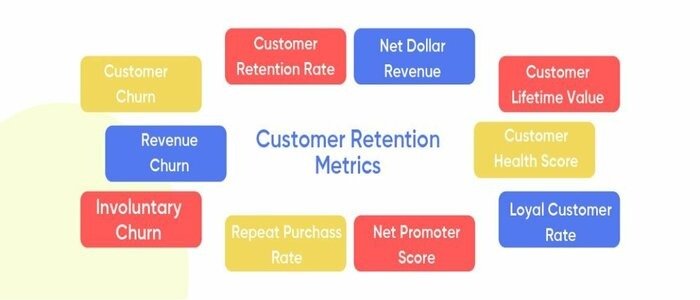
Customer Retention in Aviation analytics depends on measurable performance indicators.
Airline managers can use these metrics to evaluate customer relationships and identify opportunities for improvement.
4.1 Customer Retention Rate (CRR)
Customer Retention Rate measures the percentage of customers who continue using a company’s services during a specific period.
The formula is:
Customer Retention Rate = [(Customers at the End of the Period − New Customers Acquired) ÷ Customers at the Start of the Period] × 100
Example:
An airline starts the year with 10,000 existing customers. During the year, it has 2,000 new customers and finishes with 9,000 customers.
Retention rate:
[(9,000 − 2,000) ÷ 10,000] × 100 = 70%
This means the airline retained 70% of its original customer group.
The calculation should use a consistent definition of an active customer and an appropriate measurement period.
4.2 Customer Lifetime Value (CLV)
Customer Lifetime Value estimates the total financial value a customer may generate throughout their relationship with an airline.
For example, a passenger who regularly books international flights and purchases additional services may have a higher customer lifetime value than someone who makes only one occasional booking.
Airlines can use CLV estimates to understand customer segments and develop suitable retention strategies.
A simplified formula is:
CLV = Average Revenue per Customer × Purchase Frequency × Customer Relationship Duration
For more accurate financial analysis, airlines should also consider contribution margins, servicing costs, acquisition costs, and the time value of money.
4.3 Net Promoter Score (NPS)
Net Promoter Score measures how likely customers are to recommend an airline to others.
Passengers are asked a question such as
“How likely are you to recommend our airline to a friend or colleague?”
Responses are given on a scale from 0 to 10.
Customers are classified into three groups:
- Promoters: Scores of 9–10.
- Passives: Scores of 7–8.
- Detractors: Scores of 0–6.
NPS = Percentage of Promoters − Percentage of Detractors
A higher NPS generally indicates stronger willingness to recommend the airline.
However, NPS should not be treated as a complete measure of customer loyalty. It is most useful when analyzed alongside booking behavior, complaints, and satisfaction data.
4.4 Customer Churn Rate
Customer Churn Rate measures the percentage of customers who stop using an airline’s services during a defined period.
Formula:
Customer Churn Rate = (Customers Lost During the Period ÷ Customers at the Start of the Period) × 100
For example, if an airline begins a quarter with 5,000 active customers and loses 400 of them, the churn rate is:
(400 ÷ 5,000) × 100 = 8%
A high churn rate may indicate problems with pricing, service quality, route availability, or customer satisfaction.
Airlines must define customer inactivity carefully because some passengers naturally fly only once or twice a year.
4.5 Repeat Booking Rate
Repeat Booking Rate measures the proportion of customers who make another booking after their initial purchase within a specified period.
For example, if 1,000 passengers book with an airline and 350 make another booking within the following 12 months, the repeat booking rate is 35%.
This metric helps airlines understand whether their services encourage customers to return.
4.6 Customer Satisfaction Score (CSAT)
Customer Satisfaction Score measures how satisfied passengers are with a particular service or experience.
Airlines may ask passengers to rate their satisfaction with:
- Check-in services.
- Boarding procedures.
- Cabin services.
- Baggage delivery.
- Customer support.
- Flight disruption management.
CSAT can help identify specific areas requiring operational improvement.
5. Seven Effective Customer Retention in Aviation Strategies for Airlines

Customer analytics becomes valuable when airlines use the findings to improve their services.
Here are seven practical strategies that can help airlines strengthen passenger loyalty.
5.1 Develop Effective Frequent Flyer Programs
Frequent flyer programs are widely used to encourage repeat travel.
Passengers can earn miles or points through eligible flights and partner services. These rewards may be exchanged for flight tickets, upgrades, additional baggage, lounge access, or other benefits.
An effective program should offer clear benefits and recognize different passenger needs.
Airlines should regularly review program participation and redemption patterns to understand which benefits encourage continued engagement.
5.2 Provide Personalized Customer Experiences
Passengers have different travel requirements.
A business traveler may prioritize punctuality, flexible tickets, and convenient connections. A family may value additional baggage, seating arrangements, and assistance with children.
Using customer preferences responsibly, airlines can offer relevant services and communication.
Personalization should improve convenience rather than overwhelm passengers with unnecessary marketing messages.
5.3 Improve Customer Service Quality
Customer service is one of the most visible parts of the passenger experience.
Airline employees should be trained to communicate professionally, understand customer concerns, and provide accurate information.
Staff should also know how to manage difficult situations, including missed connections, delayed baggage, flight cancellations, and passenger complaints.
A helpful and respectful response can make a difficult travel experience easier to manage.
5.4 Improve Flight Punctuality and Operational Reliability
Passengers expect airlines to operate according to published schedules.
Frequent delays, cancellations, and missed connections can reduce customer confidence.
Airlines should monitor operational performance, identify the causes of disruption, and improve coordination between departments.
Clear communication is equally important. Passengers should receive timely updates and practical assistance when schedules change.
5.5 Introduce Effective Complaint Management
A complaint should be treated as an opportunity to understand and correct a service failure.
Airlines should establish clear procedures for receiving, recording, investigating, and resolving complaints.
A good complaint management process includes
- Listening carefully to the passenger.
- Understanding the nature of the problem.
- Recording accurate details.
- Coordinating with the responsible department.
- Providing an appropriate solution.
- Following up when necessary.
- Analyzing recurring complaints.
The objective is not only to resolve individual cases but also to prevent similar problems in the future.
5.6 Offer Relevant Rewards and Promotions
Airlines can use customer segmentation to develop suitable offers.
For example:
- Frequent travelers may receive additional loyalty benefits.
- Families may appreciate baggage or seating packages.
- Seasonal travelers may respond to destination-specific promotions.
- Inactive customers may receive carefully targeted re-engagement offers.
Promotions should be relevant, transparent, and financially sustainable.
5.7 Strengthen Digital Passenger Services
Modern passengers increasingly expect convenient digital services.
Airlines can improve customer experience through:
- Online booking.
- Mobile check-in.
- Digital boarding passes.
- Real-time flight notifications.
- Online baggage tracking.
- Digital customer support.
- Self-service rebooking options.
These services reduce unnecessary waiting and make it easier for passengers to manage their journeys.
6. Role of AI and Predictive Analytics in Passenger Retention

Artificial intelligence and predictive analytics are creating new opportunities for airlines to understand passenger behavior.
Traditional analytics mainly examines historical information. Predictive analytics uses historical and current data to estimate what may happen in the future.
For example, an airline may develop a model that identifies passengers who have a higher probability of becoming inactive.
The airline can then investigate the reasons and decide whether a suitable retention action is appropriate.
6.1 Predicting Customer Churn
AI models can analyze booking frequency, complaints, customer feedback, service experiences, and other relevant information.
These models can identify patterns associated with reduced customer activity.
For example, repeated service complaints combined with declining booking frequency may indicate a potential retention risk.
Predictions should be tested against real outcomes and regularly monitored for accuracy.
6.2 Personalized Recommendations
AI can help airlines identify services that may be relevant to individual passengers.
Examples include
- Preferred seating options.
- Suitable travel packages.
- Destination recommendations.
- Loyalty program benefits.
- Additional baggage services.
These recommendations should be based on relevant information and customer consent.
6.3 Sentiment Analysis
Sentiment analysis uses language-processing technology to examine customer feedback and identify positive, negative, or neutral opinions.
Airlines can analyze survey responses, reviews, and support messages to identify common concerns.
For example, repeated negative comments about baggage delivery may indicate an operational problem requiring investigation.
6.4 Improving Customer Support
AI-powered chatbots and virtual assistants can help passengers access basic information about flight schedules, baggage policies, booking procedures, and travel requirements.
However, complex complaints and sensitive cases should have an appropriate route to trained human staff.
Technology should support customer service teams, not replace the judgment and empathy needed to handle difficult situations.
7. How Airport Services and Ground Handling Affect Customer Loyalty

Customer Retention in Aviation is not only the responsibility of airline marketing or customer relationship departments.
Airport operations and ground-handling services also play an important role in shaping passenger experiences.
Passengers interact with several service teams throughout their journey, including check-in agents, boarding staff, baggage teams, airport representatives, and customer service personnel.
A problem at any stage can influence how passengers evaluate the airline.
7.1 Efficient Check-In Operations
Long queues and slow check-in procedures can create frustration before passengers even board the aircraft.
Airlines and ground-handling companies should monitor passenger processing times, counter availability, staffing levels, and service quality.
Efficient check-in operations help create a positive first impression.
7.2 Professional Boarding Services
Boarding is an important operational stage that requires coordination between airline staff, ground handlers, ramp teams, and airport authorities.
Clear announcements, organized boarding procedures, and professional passenger assistance can improve the overall experience.
7.3 Effective Baggage Handling
Baggage problems are among the service issues that can seriously affect passenger confidence.
Airlines and ground-handling companies should monitor baggage loading, unloading, transfer procedures, delivery performance, and mishandled baggage reports.
Accurate baggage information and prompt assistance can help reduce passenger frustration.
7.4 Staff Training and Supervision
Frontline employees represent the airline during many important passenger interactions.
Regular training should cover:
- Customer service standards.
- Communication skills.
- Complaint handling.
- Passenger assistance.
- Safety and security procedures.
- Disruption management.
- Professional behavior.
Supervisors should monitor service delivery, provide feedback, and ensure that staff follow operational procedures.
7.5 Coordination During Flight Disruptions
Flight delays and cancellations require effective communication between several departments.
Ground-handling staff, airline operations, customer service, check-in teams, and boarding personnel should coordinate their responsibilities.
Passengers should receive accurate information about revised schedules, connections, baggage, and available assistance.
Good disruption management may not eliminate passenger dissatisfaction, but it can demonstrate professionalism and help preserve trust.
8. Challenges in Customer Retention in Aviation Analytics in Aviation

Although analytics offers many benefits, airlines face several challenges when implementing retention programs.
8.1 Data Quality and Accuracy
Incomplete or outdated customer information can lead to misleading results.
Airlines should establish procedures to maintain accurate booking records, feedback information, and customer profiles.
8.2 Data Privacy and Security
Airlines handle personal and travel-related information that must be protected.
Customer data should be collected and processed according to applicable privacy laws, security requirements, and organizational policies.
Passengers should receive clear information about how their data is used.
8.3 Integration of Different Systems
Airline information may be stored across reservation systems, departure control systems, CRM platforms, loyalty programs, websites, and customer service applications.
Integrating information from these systems can be technically challenging.
Proper integration helps create a more complete understanding of the passenger journey.
8.4 Understanding Different Passenger Segments
Not all passengers have the same expectations.
Business travelers, leisure passengers, families, students, and frequent international travelers may value different services.
Airlines should avoid using a single retention strategy for every customer group.
8.5 Measuring the Real Impact of Retention Strategies
An increase in customer satisfaction does not automatically mean an increase in repeat bookings.
Airlines should compare customer behavior before and after introducing new initiatives.
They should also consider seasonal travel patterns, ticket prices, route availability, and external market conditions.
8.6 Investment and Technical Skills
Advanced analytics systems require financial investment, skilled employees, and effective management.
Smaller airlines may begin with basic reporting tools, customer surveys, and CRM systems before investing in more advanced AI solutions.
9. Future Trends in Aviation Customer Retention in Aviation Analytics

The future of Customer Retention in Aviation will increasingly depend on connected technology, passenger insights, and personalized services.
Several developments are likely to influence aviation customer analytics.
9.1 Greater Use of Artificial Intelligence
AI will help airlines analyze large amounts of customer information, identify patterns, and support faster decision-making.
Predictive models may become more useful for identifying customer churn risks and evaluating service improvements.
9.2 Biometric Passenger Processing
Biometric technology can support identity verification and smoother airport processing.
When implemented with appropriate privacy safeguards, it may reduce repeated document checks and improve passenger convenience.
9.3 Real-Time Passenger Information
Passengers increasingly expect immediate updates about flight status, gate changes, boarding times, and baggage information.
Airlines that provide accurate and timely notifications can reduce uncertainty and improve customer confidence.
9.4 Integrated Digital Travel Experiences
Passengers want convenient digital tools that support different stages of their journeys.
Integration between booking platforms, digital identity services, payment systems, and airport processes may make travel more seamless.
9.5 More Responsible Data Management
As airlines use more customer information, transparency and data protection will become increasingly important.
Passengers are more likely to trust services when they understand how their personal information is collected, used, and protected.
9.6 Sustainability and Customer Expectations
Environmental responsibility is becoming an increasingly visible part of the travel industry.
Some passengers consider an airline’s sustainability practices when making travel decisions.
Airlines can analyze passenger feedback and preferences to understand how sustainability initiatives influence customer perceptions and loyalty.
10. How Airlines Can Build a Practical Customer Retention in Aviation Analytics Program

Airlines do not need to implement every advanced technology at once.
A structured approach can help organizations establish an effective retention program.
Step 1: Define retention objectives
Identify what the airline wants to improve, such as repeat bookings, customer satisfaction, loyalty program engagement, or complaint resolution.
Step 2: Collect relevant customer data
Gather information from booking records, surveys, customer service interactions, loyalty programs, and operational reports.
Step 3: Segment passengers
Group passengers according to relevant characteristics such as travel frequency, route preferences, travel purpose, and loyalty program activity.
Step 4: Establish performance indicators
Select measurable indicators such as retention rate, churn rate, repeat booking rate, NPS, and customer satisfaction.
Step 5: Identify service problems
Analyze complaints, operational disruptions, passenger feedback, and changes in booking behavior.
Step 6: Introduce targeted improvements
Develop suitable actions, including better communication, staff training, digital improvements, and relevant loyalty benefits.
Step 7: Monitor and evaluate results
Review performance regularly and compare results against the original objectives.
Step 8: Improve continuously
Use new customer feedback and operational information to refine retention strategies.
This process helps airlines turn customer information into practical improvements rather than collecting data without a clear purpose.
Conclusion for Customer Retention in Aviation

Customer Retention in Aviation analytics in aviation is an important approach to understanding passenger behavior, improving customer satisfaction, and building long-term airline loyalty.
By analyzing booking history, customer feedback, frequent flyer activity, service performance, and operational information, airlines can identify customer needs and address problems before they become larger concerns.
However, successful Customer Retention in Aviation requires more than technology and data collection. It also depends on professional employees, reliable operations, effective communication, efficient baggage handling, and a genuine commitment to customer service.
Airport operations and ground-handling teams also contribute to passenger satisfaction because every interaction influences the overall travel experience.
As artificial intelligence, predictive analytics, biometric technology, and digital passenger services continue to develop, airlines will have more opportunities to understand their customers and improve their services.
Ultimately, the goal is simple: provide passengers with a reliable, convenient, and positive travel experience that gives them a good reason to choose the same airline again.
Frequently Asked Questions (FAQs)

1. What is Customer Retention in Aviation analytics in aviation?
Customer retention analytics in aviation is the process of analyzing passenger data, booking behavior, customer feedback, and service performance to understand loyalty and encourage repeat bookings. It helps airlines identify customer needs and improve their services.
2. Why is Customer Retention in Aviation important for airlines?
Customer Retention in Aviation is important because it encourages repeat bookings, strengthens brand reputation, supports revenue growth, and helps airlines maintain long-term customer relationships. It also helps businesses understand why passengers may choose competing airlines.
3. What are the most important customer retention in aviation metrics in aviation?
Important metrics include Customer Retention Rate (CRR), Customer Lifetime Value (CLV), Customer Churn Rate, Net Promoter Score (NPS), Repeat Booking Rate, and Customer Satisfaction Score (CSAT).
4. How does AI help airlines improve customer retention?
AI helps airlines analyze passenger behavior, identify potential customer churn, personalize recommendations, examine customer feedback, and improve customer support. Predictive analytics can also help airlines identify service issues and make informed decisions.
5. How do ground-handling services affect airline customer retention?
Ground-handling services influence passenger experiences through check-in, boarding, baggage handling, and disruption assistance. Efficient operations, professional staff, and effective communication can improve passenger satisfaction and strengthen confidence in the airline
Facebook: https://www.facebook.com/rehan.ghauri
Instagram: https://www.instagram.com/contentflyers0/
Twitter: https://www.twitter.com/contentflyers0/
Pinterest: https://www.pinterest.com/contentflyers0/
