


Airport passenger growth is reshaping the global aviation industry, creating new opportunities and challenges for airports, airlines, and ground-handling companies. Increasing demand for air travel, expanding airport infrastructure, smart technologies, and changing passenger expectations are transforming how airports operate. As passenger numbers continue to rise, aviation businesses must improve operational efficiency, invest in modern facilities, and deliver better customer experiences. This article explores seven major airport passenger growth trends that will shape the future of aviation, along with the challenges and opportunities airports should prepare for by 2035.
Table of Contents
Introduction

The global aviation industry is entering an important period of transformation. More people are traveling by air for business, tourism, education, and personal reasons. As international connectivity improves and emerging economies develop, airports are experiencing increasing passenger demand. This continuous increase in airport passenger growth is influencing airport infrastructure, airline operations, customer service, and ground-handling activities worldwide.
Airports are no longer simply transportation facilities where passengers arrive and depart. They have become complex operational environments that require advanced technology, efficient workforce management, effective communication, and excellent customer service.
According to Airports Council International (ACI) World, global airports handled approximately 9.8 billion passengers in 2025, representing an increase of 3.7% compared with 2024 and 6.5% above 2019 levels. International passenger traffic increased faster than domestic traffic, demonstrating the importance of international connectivity in aviation development.
This growth creates opportunities for airlines, airport operators, ground-handling companies, and other aviation service providers. However, it also increases pressure on airport infrastructure, baggage systems, passenger processing facilities, and operational teams.
Understanding airport passenger growth is therefore essential for aviation professionals, airport managers, and industry stakeholders.
In this article, we will explore seven important trends shaping the future of aviation, explain their impact on airport operations, and discuss how airports can prepare for increasing passenger demand.
Understanding Airport Passenger Growth and Its Importance

Airport passenger growth refers to the increase in the number of passengers traveling through airports over a particular period. It is an important indicator of aviation demand, airport performance, and the development of the wider travel industry.
Passenger growth can be measured through several indicators, including:
- Total annual airport passengers.
- Domestic passenger traffic.
- International passenger traffic.
- Transit and connecting passengers.
- Passenger growth rates compared with previous years.
- Peak-hour passenger movements.
For airport operators, these statistics help determine whether existing infrastructure and operational resources can accommodate future demand.
For example, an airport handling five million passengers annually may need additional check-in counters, security screening facilities, baggage belts, and customer service staff when passenger numbers increase significantly.
Similarly, airlines must evaluate their aircraft capacity, flight schedules, and route networks to accommodate growing passenger demand.
Ground-handling companies also need to prepare for increased operational workloads, including passenger handling, baggage loading, aircraft turnaround, and ramp coordination.
Therefore, airport passenger growth is not simply about increasing traveler numbers. It directly influences the efficiency, safety, capacity, and profitability of the aviation industry.
7 Major Airports Passenger Growth Trends Shaping the Future of Aviation
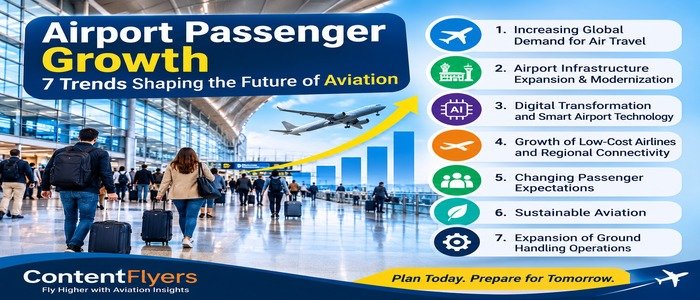
Several developments are changing how airports manage increasing passenger volumes. The following seven trends are particularly important for the future of global aviation.
1. Increasing Global Demand for Air Travel
One of the biggest factors driving airport passenger growth is the increasing demand for air travel worldwide.
People are traveling more frequently for tourism, business, education, employment, and family visits. Improved international connectivity and the availability of more flight options have also made air transportation accessible to a wider population.
Several factors are contributing to this trend.
Growing middle-class populations
Economic development in emerging markets is creating new opportunities for air travel. As household incomes increase, more people can afford domestic and international flights.
Countries across Asia-Pacific, the Middle East, and Africa are important markets for future aviation development.
Expansion of international tourism
Tourism is another major contributor to airport passenger growth. Popular destinations attract millions of international visitors every year, increasing demand for flights and airport services.
Countries investing in tourism infrastructure, hotels, entertainment, and international connectivity are creating additional opportunities for airlines and airports.
Increasing business travel
Despite the growth of virtual meetings, business travel continues to play an important role in international aviation.
Corporate meetings, exhibitions, conferences, and international business partnerships generate passenger demand across major aviation hubs.
Improved international connectivity
Airlines are continuously developing new routes and increasing flight frequencies to connect cities and countries.
Better connectivity allows passengers to reach destinations that previously required multiple connections or longer journeys.
As a result, airports must continuously evaluate passenger forecasts and operational capacity to accommodate changing travel demand.
2. Airport Infrastructure Expansion and Modernization
Increasing airport passenger growth requires modern infrastructure that can accommodate larger passenger volumes without compromising operational efficiency.
Many airports are investing in terminal expansion, runway development, baggage systems, and improved passenger facilities.
Airport infrastructure development is becoming one of the most important priorities for the aviation industry.
Terminal expansion
Airport terminals must provide sufficient space for check-in, immigration, security screening, boarding gates, and passenger waiting areas.
When passenger numbers increase, existing terminal facilities can become overcrowded, particularly during peak departure and arrival periods.
Expanding terminal capacity helps airports manage passenger movements more efficiently.
Runway and apron development
Additional runway and apron capacity can help airports accommodate increasing aircraft movements, subject to airspace, safety and operational constraints.
Apron development is particularly important because aircraft require suitable parking stands, ground support equipment, and access to operational facilities.
Modern baggage handling systems
Baggage handling is a critical component of airport operations.
Increasing passenger numbers create additional baggage volumes, requiring reliable conveyor systems, automated sorting facilities, and efficient baggage reconciliation processes.
Modern baggage systems help reduce delays, improve baggage tracking, and support smoother aircraft turnaround operations.
Improved passenger facilities
Modern airports are also investing in:
- Additional check-in counters.
- Automated immigration facilities.
- Comfortable departure lounges.
- Better passenger information systems.
- Improved accessibility facilities.
- Modern security screening equipment.
Infrastructure investment must be supported by proper operational planning. Building a larger terminal alone does not guarantee better performance. Airports also need sufficiently trained employees, reliable equipment, and effective coordination between all stakeholders.
3. Digital Transformation and Smart Airport Technology
Technology is transforming how airports manage passengers, aircraft movements, and daily operations.
Smart airport technology is becoming increasingly important because traditional manual processes may struggle to handle growing passenger volumes efficiently.
Digital transformation helps airports improve passenger processing, reduce waiting times, and optimize operational resources.
Self-service check-in kiosks
Self-service check-in kiosks allow passengers to complete check-in procedures independently.
Passengers can select seats, print boarding passes, and, at equipped airports, complete baggage-tagging procedures without waiting for traditional counter services.
This helps reduce pressure on check-in counters and improves passenger convenience.
Biometric passenger processing
Biometric technology uses facial recognition and other identity verification methods to support passenger processing.
Depending on local regulations and airport implementation, biometric systems can simplify identity checks at selected points, including check-in, security, and boarding.
However, privacy protection, data security, and passenger consent remain important considerations.
Artificial intelligence in airport operations
Artificial intelligence (AI) can help airport operators analyze passenger traffic patterns, predict congestion, and improve resource allocation.
For example, predictive analytics can help management identify expected peak periods and arrange additional staff at check-in counters or security screening areas.
AI can also support maintenance planning, customer service chatbots, and operational decision-making.
Real-time passenger information
Digital displays and mobile applications provide passengers with information about flight schedules, boarding gates, baggage collection, and operational disruptions.
Accurate information helps reduce confusion and improves the overall airport experience.
Smart airport technology will play an increasingly important role in managing airport passenger growth while improving efficiency and service quality.
4. Growth of Low-Cost Airlines and Regional Connectivity
Low-cost airlines have significantly influenced the development of global air travel.
By offering affordable fares and flexible route options, these airlines have made air transportation accessible to more passengers.
Their expansion is contributing to airport passenger growth, particularly in emerging and regional aviation markets.
Affordable air travel
Low-cost carriers generally operate business models designed to reduce operating costs and offer competitive ticket prices.
This makes air travel more accessible to passengers who previously relied on road or rail transportation.
Development of regional airports
Low-cost airlines often operate services to secondary cities and regional airports.
These routes improve connectivity, encourage tourism, and support local economic development.
Regional airports can benefit from increased passenger traffic, new airline partnerships, and additional commercial opportunities.
Increased flight frequencies
When passenger demand increases on a particular route, airlines may introduce additional flights or larger aircraft, depending on commercial and operational conditions.
This creates additional workload for airport operations and ground-handling teams.
Impact on airport operations
Higher flight frequencies require efficient coordination between:
- Passenger check-in teams.
- Boarding gate staff.
- Baggage handling teams.
- Ramp operations.
- Aircraft cleaning services.
- Fueling and catering providers.
- Airport authorities and airline operations teams.
Efficient coordination is essential to maintain safe and timely aircraft turnaround.
As low-cost airlines continue expanding their networks, airports must improve operational planning to accommodate increasing passenger traffic.
5. Changing Passenger Expectations and Customer Experience
Modern passengers expect more than simply reaching their destinations.
They want convenient check-in procedures, shorter waiting times, accurate flight information, comfortable airport facilities, and professional customer service.
As airport passenger growth increases, maintaining service quality becomes more challenging.
Airport operators must therefore focus on improving the complete passenger journey.
Faster passenger processing
Passengers generally prefer efficient check-in, security screening, and boarding procedures.
Airports can improve processing times through additional service counters, better queue management, and automated facilities.
Improved customer service
Customer service remains an essential part of airport operations.
Passengers may require assistance with flight changes, baggage problems, missed connections, special assistance, or boarding information.
Well-trained airport employees can resolve these issues professionally and reduce passenger frustration.
Better baggage services
Baggage delays and mishandling can negatively affect passenger satisfaction.
Airports and ground-handling companies must maintain effective baggage tracking, reconciliation, and communication procedures.
Personalized passenger experiences
Digital platforms can provide relevant flight information, airport navigation assistance, and selected personalized services.
For example, passengers can receive notifications about gate changes, boarding times, and baggage collection through mobile applications.
Accessibility and special assistance
Airports must also ensure that elderly passengers, passengers with reduced mobility, and families travelling with children receive appropriate assistance.
Passenger experience should remain a priority even when airport facilities are operating at high capacity.
The future of aviation will depend not only on how many passengers airports can handle but also on how effectively they serve those passengers.
6. Sustainable Aviation and Environmentally Friendly Airports
Environmental sustainability is becoming an important priority for the aviation industry.
Increasing airport passenger growth can create additional pressure on energy consumption, ground transportation, aircraft movements, and airport infrastructure.
Airports are therefore exploring sustainable solutions to support long-term development while reducing their environmental impact.
Energy-efficient airport buildings
Modern airport terminals are increasingly designed with energy-efficient lighting, improved insulation, and advanced building management systems.
These measures can reduce energy consumption and operational costs.
Electric ground support equipment
Ground-handling companies are gradually introducing electric ground support equipment (GSE), including selected baggage tractors, belt loaders, and passenger service vehicles.
Electric equipment can reduce local emissions and noise around airport aprons.
However, successful adoption requires suitable charging infrastructure, equipment availability, and workforce training.
Renewable energy
Some airports are investing in solar energy and other renewable energy solutions to support their electricity requirements.
Renewable energy can help reduce dependence on conventional energy sources.
Sustainable aviation fuel
Sustainable aviation fuel (SAF) is another important development in aviation decarbonization.
SAF can help reduce lifecycle greenhouse gas emissions compared with conventional jet fuel, depending on its production pathway and supply chain.
However, wider adoption requires increased production, supportive policies, and improved availability.
Waste and water management
Airports also need effective waste reduction, recycling, and water conservation programs.
These initiatives help create more sustainable airport environments.
Sustainable development will be essential for airports seeking to accommodate future passenger demand while meeting environmental responsibilities.
7. Expansion of Ground Handling and Airport Operations
Ground handling is one of the most important areas directly affected by airport passenger growth.
As passenger numbers and flight frequencies increase, ground-handling companies must manage larger operational workloads while maintaining safety, service quality, and on-time performance.
Ground handling includes several essential services that support aircraft and passenger operations.
Passenger handling operations
Passenger handling teams manage check-in, boarding, arrivals, transfer assistance, and special passenger services.
When passenger volumes increase, these teams must manage queues, documentation checks, and boarding activities efficiently.
Proper manpower planning is essential to prevent delays and maintain service standards.
Baggage handling operations
Increasing passenger numbers generally create additional baggage volumes.
Ground-handling teams must ensure accurate baggage acceptance, sorting, loading, unloading, and delivery.
Effective baggage reconciliation is also necessary to ensure that baggage is correctly matched with the relevant flight.
Ramp operations and aircraft turnaround
Aircraft turnaround involves several activities that must be completed safely and efficiently while an aircraft is on the ground.
These activities may include:
- Aircraft parking and chocking.
- Ground support equipment positioning.
- Baggage and cargo loading.
- Passenger boarding and disembarkation.
- Aircraft cleaning.
- Cabin servicing.
- Refueling coordination.
- Pushback preparation.
Increasing flight activity can create additional pressure on ramp teams, particularly during peak operational periods.
Effective coordination between ramp staff, load control, passenger services, and airline representatives is essential.
Workforce planning and staff training
Ground-handling companies must ensure that sufficient trained employees are available to support operational requirements.
Manpower planning should consider flight schedules, passenger volumes, aircraft types, and expected workload.
Regular staff training is equally important.
Employees should understand safety procedures, service standards, baggage handling requirements, and emergency response responsibilities.
Operational management and coordination
Airport operations managers and duty officers play an important role in managing daily activities.
They monitor flight operations, coordinate with stakeholders, resolve operational problems, and ensure that service delivery meets required standards.
As airport passenger growth continues, experienced operational management will become increasingly important for maintaining efficient airport services.
Major Challenges Associated with Airport Passenger Growth

Although increasing passenger traffic creates business opportunities, it also introduces several operational challenges.
Airports must identify these challenges early and develop practical solutions.
1. Airport Congestion and Overcrowding
Increasing passenger numbers can create congestion in check-in areas, security screening facilities, immigration halls, and departure lounges.
Overcrowding can negatively affect passenger experience and operational efficiency.
Airports need effective queue management, passenger flow planning, and sufficient processing capacity.
2. Limited Airport Infrastructure
Some airports operate with limited terminal space, runway capacity, or aircraft parking stands.
When passenger demand increases faster than infrastructure development, airports may experience operational bottlenecks.
Long-term infrastructure planning is therefore essential.
3. Flight Delays and Operational Disruptions
Higher aircraft movements can increase pressure on airport resources.
Weather conditions, airspace restrictions, equipment failures, and staffing shortages can further affect flight schedules.
Strong coordination between airlines, airport authorities, and ground-handling companies is necessary to manage disruptions.
4. Increasing Baggage Handling Requirements
More passengers generally mean more checked baggage.
Airports must ensure that baggage systems, loading teams, and reconciliation procedures can accommodate increasing workloads.
Poor baggage management can lead to delays, mishandled baggage, and passenger complaints.
5. Shortage of Trained Aviation Professionals
Airport operations require trained and experienced employees.
Increasing passenger traffic creates additional demand for passenger service agents, ramp staff, baggage handlers, load controllers, supervisors, and operational managers.
Continuous training and workforce development are essential to support future aviation demand.
6. Rising Operational Costs
Airport expansion, equipment maintenance, staffing, energy consumption, and technology investments can increase operational expenses.
Airport operators must balance investment requirements with financial sustainability.
7. Environmental Pressure
Increasing aircraft movements and ground activities can increase energy consumption, emissions, and noise.
Airports must introduce practical environmental initiatives while maintaining operational reliability.
How Airports Can Prepare for Future Passenger Growth

Preparing for future airport passenger growth requires a coordinated approach involving airport authorities, airlines, ground-handling companies, and government agencies.
The following strategies can help airports improve their readiness.
1. Invest in modern airport infrastructure
Airport operators should regularly evaluate terminal capacity, runway requirements, baggage systems, and aircraft parking facilities.
Infrastructure development should be based on realistic passenger forecasts and long-term operational requirements.
2. Adopt advanced technology
Automation, biometric processing, digital passenger information, and predictive analytics can improve airport efficiency.
Technology investments should address actual operational challenges rather than simply introduce new systems.
3. Improve workforce planning
Airport management should evaluate staffing requirements according to flight schedules, passenger volumes, and seasonal demand.
Proper shift planning and resource allocation can help reduce operational pressure.
4. Strengthen ground-handling operations
Ground-handling companies should improve coordination, equipment availability, operational supervision, and staff training.
Efficient aircraft turnaround and baggage operations are essential for maintaining airport performance.
5. Focus on passenger experience
Airports should continuously evaluate customer feedback, waiting times, complaints, and service quality.
Improving the passenger journey can strengthen customer satisfaction and airport reputation.
6. Improve stakeholder coordination
Airport operations involve multiple stakeholders, including airlines, airport authorities, security agencies, immigration departments, and service providers.
Effective communication and clear operational responsibilities help prevent unnecessary delays.
7. Introduce sustainable operational practices
Airports should explore energy-efficient infrastructure, electric ground support equipment, renewable energy, and responsible waste management.
Sustainability should be included in long-term airport development strategies.
The Future of Airport Passenger Growth by 2035

The future of aviation will be influenced by technological innovation, economic development, changing travel preferences, and investment in airport infrastructure.
Long-term industry forecasts indicate that global passenger demand is expected to continue increasing, although the pace of growth will vary across regions.
ACI World’s January 2026 World Airport Traffic Forecasts projected global airport passenger traffic to reach 10.2 billion in 2026 and 18.8 billion by 2045. These are forecast figures, not guaranteed outcomes, and future results depend on economic, geopolitical, and operational conditions.
Several developments are likely to shape the aviation industry through 2035.
Greater use of automation
Automated check-in, biometric processing, baggage systems, and digital passenger services are expected to become more widely adopted.
Expansion of emerging aviation markets
Asia-Pacific, the Middle East, and Africa offer important opportunities for airport development and improved international connectivity.
More efficient airport operations
Airports will increasingly use data analytics and integrated operational systems to improve resource allocation and reduce delays.
Growing importance of sustainability
Environmental performance will remain an important consideration in airport construction, equipment selection, and daily operations.
Increasing demand for skilled aviation professionals
Technology will change the way airports operate, but trained employees will remain essential for safety, supervision, customer service, and operational decision-making.
For aviation professionals, these developments also create opportunities in airport management, ground handling, passenger services, operational planning, and aviation technology.
Airports that combine modern infrastructure with skilled employees and efficient management will be better prepared for future passenger demand.
Conclusion: Preparing for the Future of Airport Passenger Growth

Airport passenger growth is transforming the aviation industry and creating new opportunities for airports, airlines, and ground-handling companies.
Increasing demand for air travel, infrastructure expansion, digital transformation, low-cost airlines, changing passenger expectations, sustainability, and ground-handling development are among the seven major trends shaping the future of aviation.
However, increasing passenger numbers also bring challenges involving airport congestion, operational capacity, workforce requirements, baggage handling, and environmental responsibilities.
To remain competitive, airports must invest in modern infrastructure, adopt appropriate technology, develop skilled employees, and improve operational coordination.
Ground-handling companies must also focus on safety, service quality, manpower planning, and efficient aircraft turnaround.
Ultimately, the future of aviation will not depend only on how many passengers airports can accommodate. It will also depend on how safely, efficiently, and professionally they manage the complete passenger journey.
As the aviation industry continues to evolve, airports that prepare today will be better positioned to meet the passenger demands of tomorrow.
Frequently Asked Questions About Airport Passenger Growth

1. What is airport passenger growth?
Airport passenger growth refers to the increase in the number of passengers travelling through an airport over a specific period. It is generally measured by comparing annual, monthly, or quarterly passenger traffic figures.
2. What are the main factors driving airport passenger growth?
The main factors include population growth, increasing household incomes, international tourism, business travel, low-cost airlines, improved connectivity, and economic development.
3. How does airport passenger growth affect airport operations?
Increasing passenger traffic creates additional demand for check-in, baggage handling, security screening, boarding, aircraft turnaround, and customer service. Airports must improve infrastructure, staffing, and operational coordination to manage these requirements.
4. How can airports manage increasing passenger traffic?
Airports can manage increasing passenger volumes through terminal expansion, automation, improved passenger flow management, workforce planning, modern baggage systems, and better coordination between operational stakeholders.
5. What is the future of airport passenger growth?
The long-term outlook indicates continued growth in global air travel. Technology, emerging aviation markets, airport infrastructure investment, and sustainable operations are expected to play important roles in shaping the industry through 2035 and beyond.
Facebook: https://www.facebook.com/rehan.ghauri
Instagram: https://www.instagram.com/contentflyers0/
Twitter: https://www.twitter.com/contentflyers0/
Pinterest: https://www.pinterest.com/contentflyers0/
