

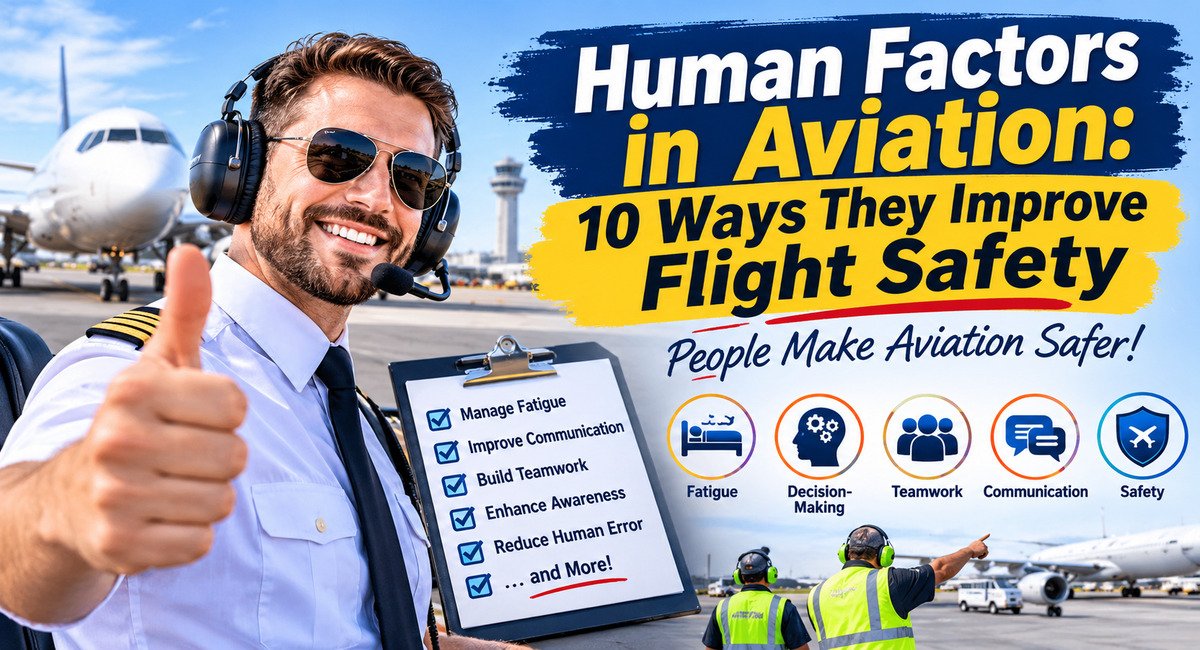
Human factors in aviation play a critical role in maintaining flight safety, preventing operational errors, and improving the overall performance of the aviation industry. From pilots and cabin crew to aircraft maintenance engineers, air traffic controllers, and airport ground-handling staff, every aviation professional contributes to safe and efficient operations.
Understanding human behaviour, communication, fatigue, stress, teamwork, decision-making, and situational awareness helps aviation organizations identify potential risks before they become serious incidents.
This comprehensive guide explores 10 important human factors in aviation, explains how they influence flight and airport safety, and discusses practical strategies that aviation professionals can use to reduce human error and improve operational performance.
Table of Contents
Introduction
Aviation is one of the most complex and highly coordinated industries in the world. Every flight requires the cooperation of numerous professionals, advanced technology, standardized procedures, and carefully planned operations.
Although modern aircraft are equipped with sophisticated systems and safety technologies, people remain at the center of aviation operations.
A pilot must make critical decisions during flight. An aircraft maintenance engineer must carefully inspect technical components. Cabin crew members must respond appropriately to emergencies, while ground-handling employees must coordinate aircraft turnaround activities safely and efficiently.
A small mistake, communication failure, or misunderstanding can sometimes create serious operational consequences.
This is where Human Factors in Aviation become essential.
Human factors examine how people interact with equipment, procedures, technology, working environments, and other individuals. The objective is not simply to identify human mistakes but to understand why they happen and how organizations can prevent or minimize their consequences.
According to the Federal Aviation Administration (FAA), human factors involve applying knowledge about human capabilities and limitations to equipment, systems, procedures, training, and operational environments to support safe and effective performance.
In today’s aviation environment, understanding human factors is essential for building a strong safety culture and achieving operational excellence.
1. What Are Human Factors in Aviation?
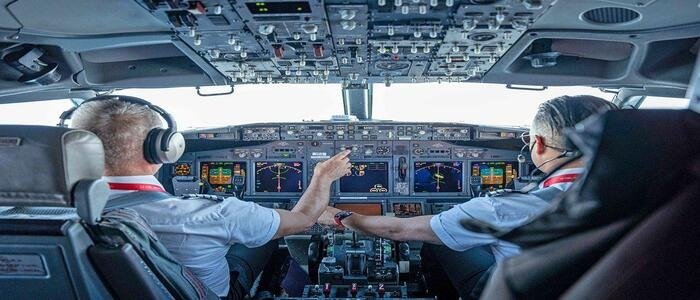
Human factors in aviation refer to the physical, psychological, behavioural, and organizational elements that influence how aviation professionals perform their responsibilities.
These factors determine how effectively individuals communicate, process information, respond to unexpected situations, operate equipment, and make safety-related decisions.
Human factors are not limited to pilots or cockpit operations. They influence almost every department within an airport and airline organization.
For example:
- Pilots: Manage aircraft systems, communicate with air traffic control, and make flight-related decisions.
- Cabin crew: Maintain passenger safety, manage emergencies, and provide customer service.
- Maintenance engineers: Inspect aircraft, identify technical problems, and complete maintenance tasks.
- Air traffic controllers: Coordinate aircraft movements and maintain safe separation.
- Ground-handling staff: Manage baggage, loading, aircraft servicing, and turnaround activities.
- Airport operations teams: Coordinate resources, manage disruptions, and maintain operational safety.
Human factors help organizations understand the relationship between employees and the systems in which they work.
The International Civil Aviation Organization (ICAO) recognizes human performance as an important element of aviation safety management.
One useful framework for understanding these interactions is the SHELL model.
Understanding the SHELL Model
The SHELL model is a human factors framework used to understand how people interact with different elements of an operational system.
It contains four main components:
- Software: Procedures, regulations, checklists, manuals, and training.
- Hardware: Aircraft, ground support equipment, tools, and technology.
- Environment: Weather, lighting, noise, temperature, and workplace conditions.
- Liveware: The human operator and interactions between individuals.
For example, a ground-handling employee may make an operational mistake because of unclear instructions, poorly maintained equipment, extreme weather, or inadequate coordination with colleagues.
The SHELL model encourages organizations to examine the entire working environment rather than automatically blaming the individual.
This approach is particularly useful when investigating incidents and identifying opportunities to improve operational safety.
2. Why Are Human Factors in Aviation Important?
Human factors in aviation are important because aviation safety depends on people, technology, communication, and organizational procedures working together.
Even the most advanced aircraft cannot eliminate every operational risk associated with human performance.
Understanding human factors provides several important benefits.
Improved Flight Safety
Recognizing human limitations helps pilots and other aviation professionals identify potential hazards before they develop into serious safety problems.
Reduced Human Error
Appropriate training, standardized procedures, effective supervision, and clear communication can reduce the likelihood of operational mistakes.
Better Decision-Making
Aviation professionals frequently make decisions under time pressure. Human factors training helps employees evaluate information, assess risks, and choose appropriate actions.
Stronger Teamwork
Aviation operations involve multiple departments. Effective coordination ensures that everyone understands their responsibilities and shares important information.
Improved Operational Efficiency
Well-trained employees who understand procedures and responsibilities can complete tasks more accurately and efficiently.
Stronger Safety Culture
Organizations that encourage employees to report hazards and communicate concerns can identify weaknesses before they result in accidents or incidents.
Human factors therefore contribute to both safety and operational performance.
3. Ten Major Human Factors in Aviation That Affect Flight Safety
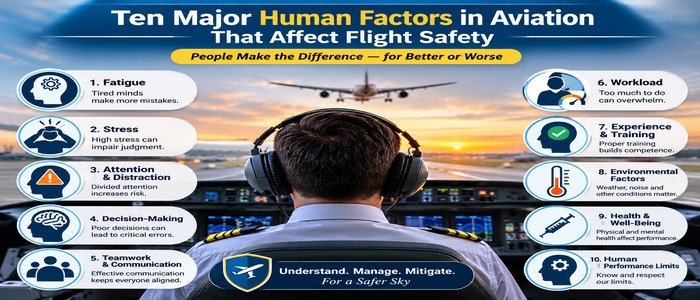
Several human factors influence aviation operations. Understanding these factors helps organizations develop effective safety strategies and improve employee performance.
Let’s explore the ten most important examples.
1. Human Error
Human error is one of the most widely discussed subjects in aviation safety.
It can occur when an individual performs an incorrect action, overlooks an important detail, misunderstands an instruction, or fails to follow an established procedure.
Examples include:
- Incorrect aircraft configuration.
- Failure to complete a required checklist.
- Incorrect baggage loading.
- Miscommunication during aircraft turnaround.
- Errors during aircraft maintenance.
- Incorrect entry of operational information.
However, human error should not automatically be treated as individual negligence.
Mistakes can be influenced by poor training, unclear procedures, excessive workload, inadequate supervision, fatigue, or poorly designed equipment.
Aviation organizations should investigate the circumstances surrounding an error to identify its underlying causes.
How to reduce human error:
- Introduce regular refresher training.
- Follow approved standard operating procedures.
- Use checklists for safety-critical activities.
- Encourage employees to report mistakes and hazards.
- Improve supervision and operational monitoring.
- Investigate incidents to identify root causes.
The objective should be to create systems that prevent mistakes and reduce their consequences.
2. Fatigue and Sleep Deprivation
Fatigue is a significant human factor affecting aviation professionals.
Airline and airport operations continue around the clock, requiring employees to work early mornings, overnight shifts, weekends, and extended duty periods.
Changing schedules and insufficient rest can affect physical and mental performance.
Fatigue may cause:
- Reduced concentration.
- Slower reaction times.
- Poor judgment.
- Memory problems.
- Reduced situational awareness.
- Difficulty making decisions.
- Increased likelihood of operational errors.
Fatigue is not limited to pilots. Cabin crew, air traffic controllers, maintenance engineers, airport operations teams, and ground-handling employees can also experience fatigue.
For example, a ground-handling employee working an extended night shift may struggle to maintain concentration during baggage loading or aircraft servicing.
Similarly, a tired maintenance engineer may find it more difficult to identify a technical issue during an inspection.
How to manage fatigue:
- Develop appropriate duty and rest schedules.
- Monitor excessive overtime.
- Provide sufficient recovery periods.
- Introduce fatigue awareness training.
- Encourage employees to report fatigue concerns.
- Assess fatigue risks during operational planning.
ICAO and EASA recognize fatigue management as an important part of aviation safety. Organizations should manage fatigue through appropriate policies, operational controls, and individual responsibility.
3. Stress and Workload Management
Stress is another important factor that can influence human performance in aviation.
Aviation professionals frequently work in demanding environments where decisions must be made quickly and accurately.
Flight delays, passenger complaints, equipment failures, weather disruptions, staffing shortages, and emergency situations can increase workplace pressure.
When stress becomes excessive, employees may experience difficulty concentrating and processing information.
For example, an airport duty officer managing several delayed flights may need to coordinate with airlines, ground handlers, airport authorities, security teams, and passenger service departments simultaneously.
Without proper workload management, important information may be overlooked.
Ways to manage stress and workload:
- Distribute responsibilities appropriately.
- Maintain sufficient operational staffing.
- Provide stress-management training.
- Establish clear reporting channels.
- Improve communication between departments.
- Encourage supervisors to identify signs of excessive workload.
Effective leadership is particularly important during irregular operations.
A capable supervisor should remain calm, prioritize safety, delegate responsibilities, and ensure that employees understand their immediate tasks.
4. Communication Failures
Communication is essential to aviation safety.
Pilots communicate with air traffic controllers, cabin crew, and other operational departments. Airport teams coordinate with airlines, maintenance providers, security personnel, and ground-handling companies.
When information is incomplete, delayed, misunderstood, or incorrectly communicated, operational risks can increase.
Examples of communication failures include:
- Incorrect information during shift handovers.
- Misunderstood instructions.
- Incomplete aircraft turnaround briefings.
- Failure to communicate operational hazards.
- Incorrect baggage or loading information.
- Poor coordination during emergency situations.
Consider an aircraft turnaround operation.
The ground-handling supervisor receives information about a last-minute aircraft change but fails to communicate it to the baggage loading team.
The employees may continue working according to the previous instructions, potentially resulting in incorrect loading or delays.
How to improve aviation communication:
- Use clear and standardized communication procedures.
- Conduct pre-operation briefings.
- Confirm important instructions.
- Maintain accurate shift handover records.
- Encourage two-way communication.
- Report safety-related information immediately.
A useful communication technique is closed-loop communication.
Under this approach, the receiver repeats or confirms an important instruction so the sender can verify that the message has been understood correctly.
Good communication is not simply about delivering information. It is about ensuring that the right information reaches the right person at the right time.
5. Poor Situational Awareness
Situational awareness means understanding what is happening around you, recognizing potential risks, and anticipating how a situation may develop.
In aviation, professionals must continuously monitor their surroundings and identify changes that could affect safety.
For pilots, situational awareness includes understanding aircraft position, weather conditions, fuel status, and surrounding air traffic.
For ground-handling employees, it includes monitoring aircraft movements, vehicle positions, equipment locations, weather conditions, and personnel working around the aircraft.
For example, a ramp employee who becomes distracted while operating ground support equipment may fail to notice another vehicle entering the aircraft safety area.
Similarly, an airport operations officer who does not monitor changing weather conditions may fail to anticipate operational disruption.
How to improve situational awareness:
- Maintain continuous observation.
- Follow established monitoring procedures.
- Avoid unnecessary distractions.
- Share operational updates.
- Conduct regular safety briefings.
- Encourage employees to report changing conditions.
Situational awareness is particularly important during aircraft turnaround, adverse weather, emergency response, and other safety-critical operations.
6. Lack of Teamwork and Coordination
Aviation is a team-based industry.
Even when employees have excellent technical knowledge, poor coordination can negatively affect operational safety.
A flight depends on cooperation between pilots, cabin crew, air traffic controllers, maintenance personnel, dispatchers, and ground-handling teams.
Similarly, airport operations require coordination between multiple departments.
A lack of teamwork can result in:
- Delayed operational decisions.
- Conflicting instructions.
- Incomplete task allocation.
- Poor emergency response.
- Increased turnaround times.
- Missed safety checks.
For example, during aircraft departure preparation, the baggage team, ramp staff, load control, and airline operations must exchange accurate information.
If one department does not communicate a loading issue, another department may continue with an incorrect operational assumption.
How to improve teamwork:
- Conduct regular team briefings.
- Define individual responsibilities.
- Encourage cooperation between departments.
- Provide cross-functional training.
- Develop strong supervisory practices.
- Promote mutual respect and accountability.
Good teamwork does not mean agreeing with every decision. Aviation employees must also feel comfortable raising safety concerns when something appears incorrect.
7. Lack of Knowledge and Inadequate Training
Aviation procedures, technology, equipment, and regulations continue to evolve.
Employees must maintain the knowledge and practical skills required to perform their responsibilities safely.
Inadequate training can result in operational mistakes, incorrect equipment handling, poor decision-making, and non-compliance with procedures.
For example, a newly recruited ground-handling employee may not fully understand the safety requirements for operating baggage tractors or approaching an aircraft with ground support equipment.
Similarly, a maintenance technician unfamiliar with a particular aircraft system may require additional training before performing an assigned task.
How to improve employee competency:
- Provide structured induction training.
- Conduct regular refresher courses.
- Introduce practical equipment training.
- Assess employee competency.
- Provide updated procedural guidance.
- Maintain training and qualification records.
Training should not be treated as a one-time activity.
Aviation organizations should regularly evaluate employee performance and identify areas where additional knowledge or practical experience is required.
8. Distraction and Complacency
Distraction occurs when an employee’s attention moves away from an important task.
Complacency develops when individuals become overly comfortable with routine activities and begin to underestimate potential risks.
Both factors can negatively influence aviation safety.
Examples include:
- Using mobile phones during operational activities.
- Interruptions during aircraft inspections.
- Ignoring unusual equipment sounds.
- Skipping checklist items because a task appears familiar.
- Assuming that an activity is safe because it has been performed many times.
Routine operations can create a false sense of security.
For example, a ramp employee who has completed hundreds of aircraft turnarounds may become less attentive to vehicle positioning or equipment clearance.
How to prevent distraction and complacency:
- Establish clear rules regarding distractions.
- Follow checklists consistently.
- Encourage active supervision.
- Rotate tasks where appropriate.
- Conduct regular safety awareness sessions.
- Treat every operation as potentially safety-critical.
Experience is valuable, but it should never replace attention, discipline, or compliance with established procedures.
9. Leadership and Decision-Making
Leadership has a direct influence on human performance and aviation safety culture.
Supervisors and managers are responsible for ensuring that employees understand their duties, receive appropriate support, and follow operational requirements.
Poor leadership can contribute to confusion, excessive pressure, communication failures, and unsafe workplace practices.
Effective aviation leaders should demonstrate:
- Sound judgment.
- Clear communication.
- Effective delegation.
- Emotional control.
- Accountability.
- Risk awareness.
- Problem-solving skills.
Consider an airport operation involving several delayed flights and limited ground-handling resources.
An effective duty manager must assess the situation, prioritize safety-critical activities, allocate available staff, coordinate with relevant departments, and communicate realistic operational updates.
Decisions should be based on safety requirements rather than pressure to achieve departure targets.
How to improve leadership and decision-making:
- Provide leadership development training.
- Establish clear accountability.
- Encourage employee participation.
- Use operational information when making decisions.
- Promote a positive safety culture.
- Support employees who raise legitimate safety concerns.
Strong leadership creates an environment in which employees understand that safety is everyone’s responsibility.
10. Organizational Culture and Workplace Environment
Human performance is influenced not only by individuals but also by the organizations in which they work.
An organization with unclear procedures, insufficient resources, weak supervision, and unrealistic performance targets may unintentionally create conditions that increase operational risks.
For example, employees who are continuously pressured to complete aircraft turnaround activities within unrealistic time frames may feel encouraged to take shortcuts.
Similarly, employees who fear punishment may avoid reporting mistakes or safety concerns.
A positive organizational culture should encourage transparency, learning, accountability, and continuous improvement.
How to build a stronger safety culture:
- Encourage reporting of hazards and near misses.
- Establish fair investigation procedures.
- Provide adequate staffing and equipment.
- Maintain clear operational standards.
- Support employee development.
- Monitor safety performance.
- Ensure management commitment to safety.
Aviation organizations should aim to understand why errors occur rather than focusing exclusively on who made them.
4. Human Factors in Airport and Ground-Handling Operations
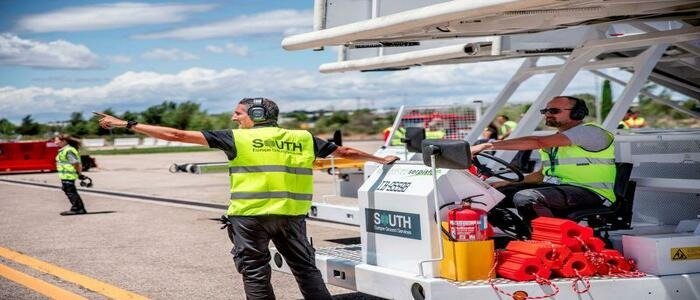
Human factors in aviation are particularly important in airport and ground-handling operations.
Unlike the controlled environment of an aircraft cockpit, airport ramps and operational areas involve multiple vehicles, employees, aircraft, equipment, and service providers working simultaneously.
Every aircraft turnaround requires coordination between different teams.
These may include:
- Ramp operations.
- Passenger handling.
- Baggage handling.
- Load control.
- Aircraft cleaning.
- Catering services.
- Fueling services.
- Maintenance.
- Airport operations.
A breakdown in coordination can create safety hazards, operational delays, and service-quality problems.
Example: Human Factors During Aircraft Turnaround
Imagine an aircraft arriving at an airport during a busy operational period.
The ground-handling supervisor must coordinate several activities, including passenger disembarkation, baggage unloading, aircraft cleaning, catering, refueling, loading, and departure preparation.
During this process, several human factors may influence performance.
Fatigue: Employees working extended shifts may struggle to maintain concentration.
Communication: Incomplete instructions may cause misunderstandings between teams.
Workload: Insufficient manpower may increase pressure on employees.
Situational awareness: Poor monitoring may result in unsafe vehicle movements.
Teamwork: Lack of coordination may delay important operational activities.
Leadership: Weak supervision may allow unsafe practices to continue.
The duty officer or supervisor should monitor the entire operation, ensure that responsibilities are understood, and coordinate with relevant departments.
Importantly, operational targets must never override established safety requirements.
The Dirty Dozen in Ground Handling
The Dirty Dozen is a widely recognized human factors awareness concept used to discuss common contributors to errors in aviation maintenance and other operational environments.
EASA’s ground-handling guidance also refers to these 12 elements as a useful starting point for human factors analysis.
They include:
- Lack of communication.
- Distraction.
- Lack of resources.
- Stress.
- Complacency.
- Lack of teamwork.
- Pressure.
- Lack of awareness.
- Lack of knowledge.
- Fatigue.
- Lack of assertiveness.
- Norms.
These factors can combine and increase the likelihood of operational mistakes.
For example, an employee may recognize an unsafe working condition but hesitate to report it because of workplace pressure or fear of criticism.
This demonstrates why safety culture and effective leadership are essential.
Organizations should train employees to recognize these factors and take appropriate preventive action.
5. The Role of Crew Resource Management (CRM)
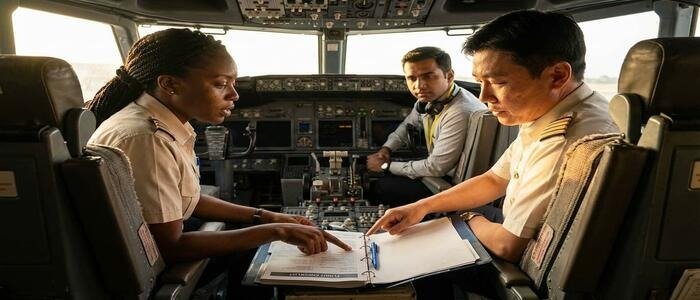
Crew Resource Management (CRM) is an important aviation training approach designed to improve teamwork, communication, leadership, situational awareness, and decision-making.
Although CRM is particularly associated with flight crew operations, its principles are relevant to many other aviation environments.
CRM recognizes that technical knowledge alone is not sufficient for safe operations.
Professionals must also know how to communicate, cooperate, manage workload, and respond effectively to unexpected situations.
Important CRM principles include:
Communication: Sharing accurate and timely information.
Teamwork: Supporting colleagues and coordinating responsibilities.
Leadership: Providing clear direction and maintaining operational discipline.
Decision-making: Evaluating available information before taking action.
Situational awareness: Understanding current conditions and anticipating potential risks.
Workload management: Prioritizing tasks and distributing responsibilities appropriately.
For example, during an unexpected aircraft technical issue, effective teamwork allows flight crew members to share information, assess available options, and follow the applicable procedures.
CRM helps create a professional environment where individuals can contribute to safer decisions.
6. How Aviation Organizations Can Reduce Human Error
Reducing human error requires more than employee awareness.
Organizations must identify operational risks and introduce systems that support reliable human performance.
The following measures can help improve aviation safety.
1. Strengthen Safety Management Systems
A Safety Management System (SMS) provides an organized approach to identifying hazards, assessing risks, and implementing safety controls.
Organizations should integrate human factors considerations into their safety management processes.
2. Improve Standard Operating Procedures
Clear procedures help employees understand how tasks should be completed.
Checklists, operational manuals, and standardized instructions reduce uncertainty and improve consistency.
3. Introduce Continuous Training
Regular training helps employees maintain competency and understand changes in procedures, technology, and operational requirements.
4. Improve Communication Systems
Organizations should establish reliable communication channels between departments and ensure that important information is shared without unnecessary delays.
5. Manage Fatigue and Workload
Appropriate scheduling, sufficient staffing, and effective workload distribution can reduce fatigue-related risks.
6. Encourage Safety Reporting
Employees should feel comfortable reporting hazards, near misses, and mistakes.
A fair reporting culture allows organizations to learn from operational experiences.
7. Strengthen Supervisory Practices
Supervisors should monitor operational activities, provide guidance, identify unsafe conditions, and ensure compliance with approved procedures.
8. Use Technology Responsibly
Automation and digital systems can improve operational efficiency, but employees must understand their limitations and remain capable of responding when technology fails or provides unexpected information.
7. Human Factors Training in Aviation
Human factors training is essential for developing a knowledgeable and safety-conscious aviation workforce.
Training should help employees understand how human behaviour, workplace conditions, and organizational systems influence operational performance.
Different aviation departments may require different training approaches.
Pilot Training
Pilot training should address workload management, communication, fatigue, situational awareness, automation, and decision-making.
Cabin Crew Training
Cabin crew members should understand communication, teamwork, emergency response, passenger management, and human performance under pressure.
Aircraft Maintenance Training
Maintenance personnel should receive training on human error, distraction, fatigue, procedural compliance, communication, and effective shift handovers.
Ground-Handling Training
Ground-handling employees should understand ramp safety, equipment operation, teamwork, communication, fatigue awareness, and aircraft turnaround procedures.
Airport Operations Training
Airport operations professionals should develop skills in coordination, leadership, emergency management, decision-making, and safety reporting.
Effective training should combine theoretical knowledge with practical exercises, scenario-based learning, and competency assessments.
Organizations should also evaluate whether training is improving actual workplace performance.
8. The Future of Human Factors in Aviation
The aviation industry is undergoing significant technological and operational changes.
Automation, artificial intelligence, digital communication, advanced aircraft systems, and smart airport technologies are changing how aviation professionals perform their responsibilities.
However, technology does not remove the importance of human factors.
Instead, it creates new areas that organizations must understand and manage.
Artificial Intelligence and Human Decision-Making
Artificial intelligence can support operational planning, predictive maintenance, passenger processing, and data analysis.
However, employees must understand how to interpret automated recommendations and recognize when human judgment or further verification is necessary.
Increasing Automation
Modern aircraft and airport systems rely heavily on automation.
While automation can reduce certain types of workload, it may also introduce new challenges involving monitoring, system understanding, and manual intervention.
Digital Airport Operations
Smart airport technologies are improving communication, resource management, and operational visibility.
Employees must receive appropriate training to use these systems effectively.
Human-Machine Interaction
As aviation technology becomes more advanced, equipment and software should be designed around human capabilities and limitations.
Clear displays, understandable alerts, and intuitive controls can support better human performance.
Greater Attention to Fatigue Management
Aviation organizations are increasingly recognizing the importance of managing fatigue across different operational departments.
Better scheduling, fatigue reporting, and evidence-based training can help reduce fatigue-related risks.
The future of aviation safety will depend on the effective integration of people, technology, procedures, and organizational systems.
9. Practical Human Factors Checklist for Aviation Supervisors
Aviation supervisors and managers can use the following checklist as a starting point for reviewing everyday operational conditions.
- Have employees received the required training?
- Are all team members aware of their responsibilities?
- Has an operational briefing been completed?
- Are employees fit and alert for their assigned duties?
- Is sufficient manpower available?
- Are communication channels functioning properly?
- Is the required equipment available and serviceable?
- Are employees following approved procedures?
- Have potential operational hazards been identified?
- Are employees comfortable reporting safety concerns?
- Are shift handovers completed accurately?
- Are safety observations and incidents being reviewed?
This checklist is an educational aid, not a replacement for an organization’s approved operational procedures, regulatory requirements, or formal safety assessments.
10. Conclusion: Human Factors Are the Foundation of Aviation Safety
Human factors in aviation are essential to maintaining safe, reliable, and efficient aviation operations.
Although aircraft technology, automation, and safety systems continue to improve, people remain a fundamental part of the aviation environment.
Pilots, cabin crew, maintenance engineers, air traffic controllers, airport managers, and ground-handling employees all contribute to operational safety through their daily decisions and actions.
Understanding fatigue, stress, communication, teamwork, situational awareness, leadership, and human error allows aviation organizations to identify weaknesses and introduce effective preventive measures.
The most successful aviation organizations do not rely exclusively on technology or individual experience. They build systems that support people, encourage communication, promote continuous training, and make safety a shared responsibility.
Ultimately, improving human performance is not just about preventing mistakes. It is about creating an aviation environment in which people can perform their duties safely, confidently, and effectively.
Remember: Aviation safety is not achieved by technology alone. It depends on people, procedures, teamwork, and a strong commitment to continuous improvement.
Frequently Asked Questions (FAQs)
1. What are human factors in aviation?
Human factors in aviation refer to the physical, psychological, behavioural, and organizational elements that influence how aviation professionals perform their duties. These include communication, fatigue, stress, teamwork, decision-making, and situational awareness.
2. Why are human factors important in aviation safety?
Human factors are important because aviation operations depend on people interacting effectively with aircraft, equipment, technology, procedures, and other employees. Understanding these factors helps reduce operational errors and improve safety.
3. What are the 12 Dirty Dozen in aviation?
The Dirty Dozen are 12 common contributors to human error: lack of communication, distraction, lack of resources, stress, complacency, lack of teamwork, pressure, lack of awareness, lack of knowledge, fatigue, lack of assertiveness, and norms.
4. How does fatigue affect aviation professionals?
Fatigue can reduce concentration, alertness, reaction time, memory, and decision-making ability. It can affect pilots, cabin crew, maintenance engineers, air traffic controllers, and ground-handling personnel.
5. What is Crew Resource Management (CRM)?
Crew Resource Management is a training approach that improves communication, teamwork, leadership, workload management, situational awareness, and decision-making among aviation professionals.
Facebook: https://www.facebook.com/rehan.ghauri
