

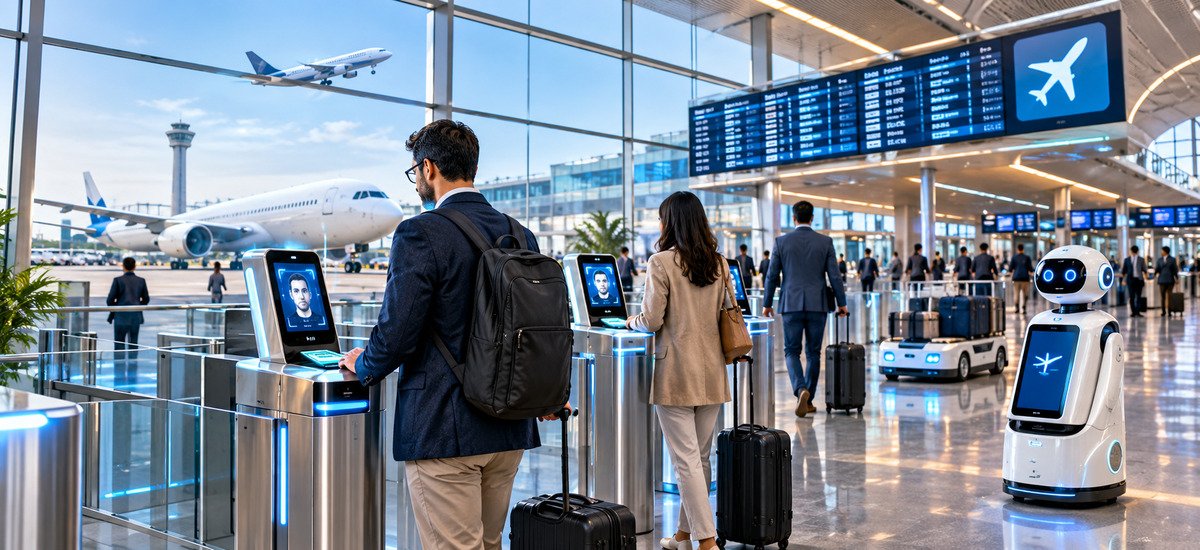
The aviation industry is entering a new era in which technology is changing how airports operate, manage passengers, handle baggage, and coordinate ground operations. From artificial intelligence and biometric identification to autonomous vehicles and robotic assistance, airport automation trends are creating smarter, faster, safer, and more efficient airport environments.
By 2035, many airports are expected to rely more heavily on connected digital systems that can monitor operations, predict disruptions, automate repetitive tasks, and improve passenger experiences. These developments will not simply reduce waiting times; they will also change how airport employees, airlines, ground handlers, security teams, and airport management work together.
This article explores nine major airport automation trends that are expected to transform airports by 2035, explaining how each technology works, its operational benefits, potential challenges, and what airport professionals should expect in the coming years.
Table of Contents
Introduction: Why Are Airport Automation Trends Becoming Essential?
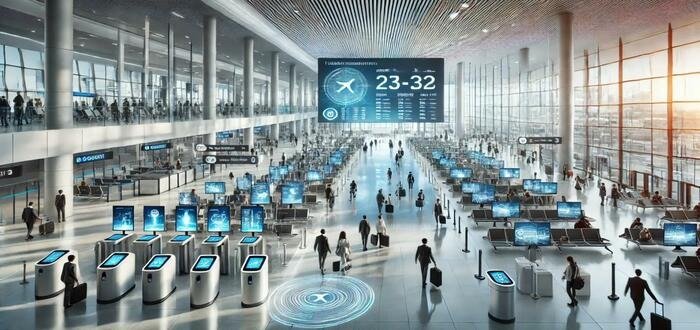
Imagine arriving at an international airport in 2035.
Instead of standing in a long check-in queue, you enter the terminal, complete identity verification through a secure biometric system, and proceed towards baggage drop. Your luggage is automatically identified and tracked throughout its journey. Artificial intelligence monitors passenger movements, while smart systems coordinate boarding gates, flight schedules, security checkpoints, and ground operations.
Meanwhile, autonomous vehicles transport baggage across designated airport areas, robotic assistants help passengers locate facilities, and airport management receives real-time operational information through an integrated digital platform.
Sounds like something from a science-fiction movie?
Not entirely. Many of these technologies are already being introduced, tested, or expanded at airports around the world.
The aviation industry is under increasing pressure to accommodate growing passenger demand, improve operational efficiency, control costs, strengthen security, and reduce environmental impact. Traditional airport processes cannot always meet these expectations, particularly at busy international hubs handling millions of passengers annually.
This is where airport automation trends become increasingly important.
Airport automation trends refers to the use of digital technologies, artificial intelligence, robotics, sensors, connected equipment, and automated systems to perform or support airport activities with greater speed, accuracy, and consistency.
It covers almost every major airport department, including:
- Passenger check-in and boarding.
- Baggage handling and reconciliation.
- Airport security and immigration.
- Aircraft turnaround and ground handling.
- Airport operations control centres.
- Facilities and equipment maintenance.
- Passenger information and customer service.
- Energy management and sustainability.
According to SITA’s 2025 Air Transport IT Insights report, 77% of surveyed airports were using self-service kiosks, while 63% had automated bag-drop systems. Biometric border control was already operational at 54% of airports. These figures demonstrate that automation is no longer simply a future ambition. It is already becoming part of everyday airport operations.
The same report highlights growing investment in artificial intelligence and connected operational data, indicating that airports are moving towards more integrated digital environments.
However, automation does not mean removing every human employee from the airport. Instead, the objective is to allow technology to handle repetitive activities while employees concentrate on safety, supervision, decision-making, problem-solving, and passenger assistance.
Let’s explore the nine airport automation trends that could reshape the aviation industry by 2035.
Artificial Intelligence Will Become the Brain of Airport Automation Trends
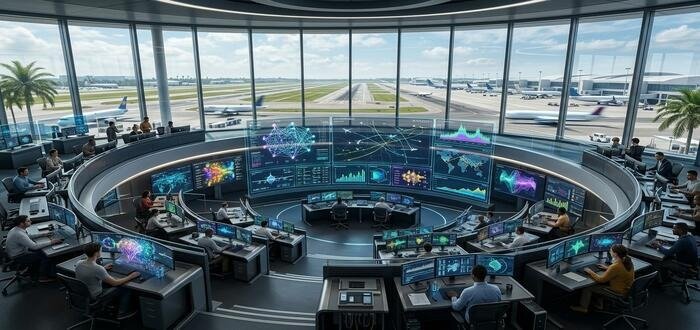
Artificial intelligence (AI) is one of the most influential airport automation trends because it can help airports process enormous amounts of operational information and make faster decisions.
Modern airports generate continuous streams of data from flight schedules, passenger movements, baggage systems, aircraft movements, security checkpoints, weather information, and ground-handling activities.
Managing all this information manually can be difficult, especially during peak operational hours.
AI can analyze these different data sources, identify patterns, predict potential problems, and recommend appropriate actions.
How will AI transform airport operations?
AI-powered systems can support several important airport functions.
1. Passenger flow management
AI can analyze passenger movements using sensors, cameras, and operational data. It can identify crowded areas and help airport management adjust staffing, queue arrangements, and checkpoint capacity.
For example, if a large number of passengers arrive at security within a short period, an intelligent system may identify the developing congestion and recommend opening additional screening lanes.
2. Flight disruption prediction
Flight delays can affect multiple departments, including check-in, baggage handling, boarding, aircraft turnaround, and passenger services.
AI systems can analyze historical flight information, weather conditions, aircraft availability, and operational data to identify potential disruptions.
Airport teams can then prepare alternative arrangements before a minor problem becomes a major operational headache.
3. Resource allocation
AI can help airport managers determine the appropriate number of employees, buses, baggage carts, and ground-support equipment required for scheduled operations.
This can improve workforce planning and reduce unnecessary equipment movements.
4. Customer service
AI-powered virtual assistants can answer common passenger questions about flight information, terminal facilities, baggage procedures, and airport services.
They can provide assistance around the clock without requiring passengers to search through multiple information desks.
Real-world progress
SITA’s 2025 airport technology research reported that 60% of surveyed airports were using AI for passenger-flow management. It also found that 73% planned to invest in AI for prediction and automation.
These figures indicate growing interest in using AI beyond basic customer-service applications.
What can airports expect by 2035?
By 2035, AI could become a central decision-support tool within Airport Operations Control Centers (AOCCs).
Rather than monitoring individual systems separately, operations teams may receive integrated recommendations covering:
- Aircraft turnaround performance.
- Gate and stand allocation.
- Passenger congestion.
- Baggage delivery.
- Ground equipment availability.
- Staff deployment.
- Weather-related operational changes.
However, AI recommendations must remain subject to operational procedures, regulatory requirements, and appropriate human oversight.
The biggest advantage: AI can help airport management identify problems earlier and make better-informed operational decisions.
Biometric Technology Will Create Faster and More Seamless Passenger Journeys
Remember the traditional airport journey?
Present your passport, show your boarding pass, wait for document verification, and repeat the process at different checkpoints.
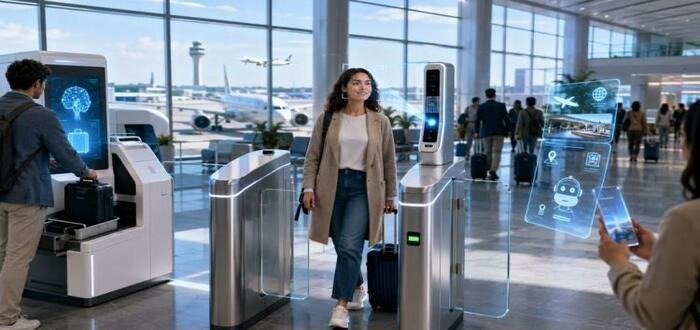
Biometric technology aims to simplify many of these steps.
Biometrics refers to identifying or verifying individuals using unique physical or behavioral characteristics, such as facial features or fingerprints.
In airports, facial recognition is becoming particularly important because it can support identity verification at several stages of the passenger journey.
How does airport biometric automation work?
A biometric airport journey may involve the following stages:
- Passengers provide the required identity information during check-in.
- Their identity is securely linked to an approved travel credential.
- A facial image is captured at designated airport checkpoints.
- The system compares the image against an authorized identity record.
- Successful verification allows the passenger to proceed, subject to applicable security and border-control requirements.
The objective is to reduce repeated manual document checks while maintaining reliable identity verification.
Where will biometric technology be used?
Airport automation trends involving biometrics could expand across:
- Automated check-in.
- Self-service baggage drop.
- Security access points.
- Immigration and border control.
- Boarding gates.
- Lounge access.
- Selected airport services.
The International Air Transport Association (IATA) is actively promoting digital identity solutions that allow passengers to use digital credentials and biometrics across different stages of travel.
Its 2025 Global Passenger Survey reported that 74% of travelers were willing to share biometric information if it allowed them to avoid repeatedly presenting passports or boarding passes at checkpoints.
However, convenience must never come at the expense of privacy.
Airports and their technology partners must provide secure data handling, transparent consent arrangements, appropriate retention policies, and alternative processes for passengers who cannot or do not wish to use biometric verification.
What will happen by 2035?
The airport experience could become increasingly contactless, with passengers completing more identity checks through interconnected digital systems.
Imagine walking through authorized checkpoints without repeatedly searching your pockets for a passport or boarding pass.
That would be a welcome improvement for anyone who has ever discovered their boarding pass hiding somewhere between a phone charger and a packet of biscuits!
Nevertheless, biometric systems will still depend on government regulations, international cooperation, technical compatibility, and passenger trust.
The biggest advantage: Faster identity verification, reduced document handling, and a potentially smoother passenger journey.
Self-Service Technology Will Reduce Airport Queues
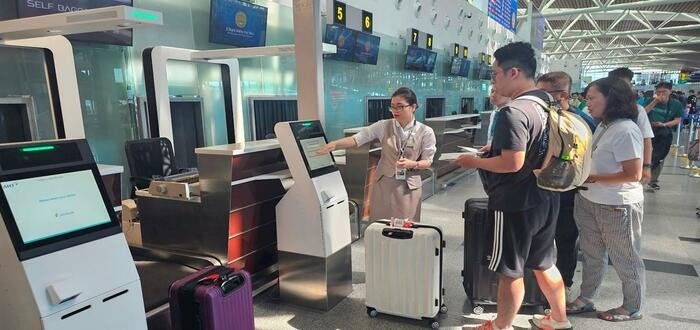
Self-service technology is one of the most established airport automation trends, and its importance is expected to increase significantly by 2035.
Passengers increasingly expect to complete basic travel procedures independently, using digital devices and automated airport equipment.
Airports are responding by introducing systems that allow passengers to manage several stages of their journey without depending entirely on traditional staffed counters.
Major self-service technologies at airports
Self-service check-in kiosks
Passengers can use automated kiosks to retrieve booking information, select available seats, confirm travel details, and print boarding passes where supported.
This can reduce pressure on airline check-in counters.
Automated baggage drop
After completing check-in, passengers can attach or obtain the required baggage identification and place their luggage on an automated bag-drop conveyor.
The system checks relevant information and transfers the baggage into the airport’s handling network.
Self-service boarding gates
Automated boarding gates can scan boarding passes or verify approved digital credentials before allowing eligible passengers to enter the boarding area.
Automated airport payment systems
Self-service payment facilities can simplify parking payments, airport purchases, selected transport services, and other transactions.
Why are airports investing in self-service systems?
The benefits include:
- Reduced passenger waiting times.
- Better use of terminal space.
- Improved check-in efficiency.
- Reduced pressure on airline staff.
- More consistent passenger processing.
- Greater flexibility during peak travel periods.
For airlines and airport operators, self-service systems can also help accommodate increased passenger volumes without expanding every service counter.
Will traditional check-in counters disappear?
Not completely.
Some passengers need additional assistance, including elderly travellers, passengers with disabilities, families with young children, and people travelling with unusual baggage requirements.
International travel documentation problems and complex bookings may also require human intervention.
Therefore, the future airport is more likely to offer a combination of automated services and staffed assistance.
What can we expect by 2035?
Self-service facilities may become more integrated, allowing passengers to complete check-in, baggage drop, identity verification, and boarding through connected systems.
Airports will increasingly focus on making automated services accessible, easy to understand, and available in multiple languages.
The biggest advantage: Passengers gain greater control over routine travel procedures while airport employees can focus on passengers who need personal assistance.
Robotics Will Transform Baggage Handling and Passenger Assistance
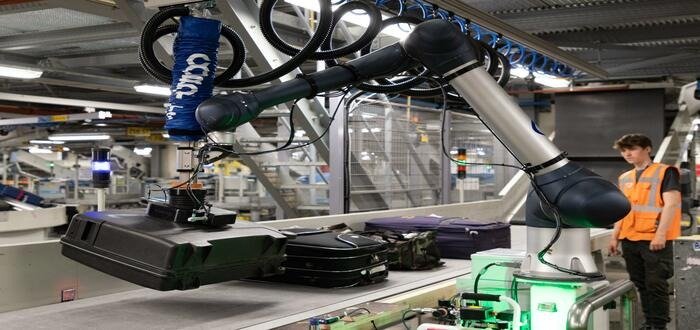
Robotics is another exciting development among airport automation trends.
Airports are large, complicated environments where employees regularly handle repetitive, physically demanding, and time-sensitive activities.
From moving baggage containers to transporting supplies and guiding passengers, robotics could support several airport departments.
Although robots will not replace every human task, they can improve productivity when used for suitable activities.
How will robots be used at airports?
1. Baggage transportation
Autonomous mobile robots can be designed to move baggage containers or other materials between designated operational areas.
This could reduce unnecessary manual transportation and improve the consistency of internal logistics.
2. Passenger assistance
Service robots may help passengers locate check-in areas, boarding gates, restaurants, washrooms, and other facilities.
Some systems can communicate in multiple languages, making them useful in international terminals.
3. Cleaning operations
Automated cleaning robots can operate in selected terminal areas, helping maintain floors and other public spaces.
They can be programmed to follow designated routes and work during quieter periods.
4. Cargo and warehouse activities
Robotic systems can assist with moving, sorting, and positioning materials in controlled cargo and logistics environments.
5. Inspection activities
Robots equipped with cameras and sensors may support inspections in selected areas, helping employees identify equipment or infrastructure problems.
How will robotics improve ground handling?
Ground handling is one of the most demanding parts of airport operations.
It involves baggage loading and unloading, aircraft servicing, passenger boarding assistance, ramp coordination, and the movement of ground-support equipment.
Robotic assistance could improve selected processes by reducing repetitive manual work and helping employees manage physical workloads.
For example, a robotic baggage transport system could move equipment between designated points while ground-handling staff concentrate on baggage reconciliation, operational coordination, and safe aircraft turnaround.
Japan Airlines has also explored the use of humanoid robots for airport cargo-related activities, demonstrating the industry’s interest in robotic assistance.
What are the challenges?
Robots operating in airports must deal with:
- Moving passengers and airport employees.
- Different floor surfaces and environmental conditions.
- Operational safety requirements.
- Equipment failures.
- Communication with existing airport systems.
- Cybersecurity risks.
A robot that stops working in the middle of a busy passenger walkway may create a new problem instead of solving an old one.
Therefore, careful testing, supervision, maintenance, and emergency procedures are essential.
What will happen by 2035?
More airports may use robots for selected baggage, cargo, cleaning, logistics, and passenger-assistance activities.
The most successful implementations will probably be those that support employees rather than attempt to automate every human interaction.
The biggest advantage: Robotics can reduce repetitive workloads, support productivity, and improve the consistency of selected airport services.
Smart Baggage Handling Will Improve Tracking and Reduce Lost Luggage
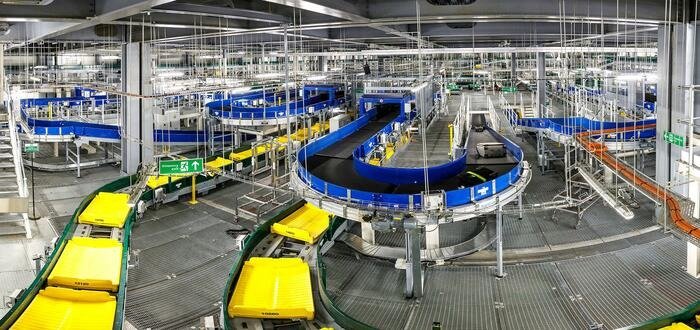
If there is one airport experience that can quickly turn an exciting holiday into a stressful adventure, it is discovering that your suitcase has decided to visit another country without you.
Lost, delayed, or mishandled baggage remains an important concern for passengers and airlines. This is why smart baggage handling is becoming a major part of airport automation trends.
Traditional baggage systems rely on a combination of barcode scanning, conveyor belts, manual handling, reconciliation procedures, and information exchange between airlines and airports.
New technologies are making these processes more connected and easier to monitor.
What is smart baggage handling?
Smart baggage handling combines automated equipment, digital identification, tracking technologies, and integrated information systems to improve the movement of luggage throughout the airport.
Some important technologies include:
RFID baggage tracking
Radio Frequency Identification (RFID) uses electronic tags and readers to identify baggage without requiring every tag to be scanned individually with a traditional barcode reader.
This can improve baggage visibility at different handling points.
Automated baggage sorting
Modern baggage handling systems use automated conveyors, scanners, and sorting equipment to direct luggage towards the correct flight or operational area.
Electronic baggage tags
Electronic baggage tags can display updated baggage information through compatible digital systems, potentially reducing the need for repeatedly printing traditional tags.
Real-time baggage tracking
Passengers and airline employees can receive baggage status information through connected systems, depending on the tracking infrastructure available.
Automated baggage reconciliation
Baggage reconciliation systems compare passenger and baggage information to help ensure that luggage is correctly associated with the relevant flight and authorized loading process.
Why is baggage automation important?
A well-designed baggage system can provide several benefits:
- Better baggage visibility.
- Reduced manual identification errors.
- Improved baggage sorting accuracy.
- Faster baggage transfer processes.
- Better coordination between airlines and ground handlers.
- Improved passenger confidence.
- More effective baggage irregularity management.
The International Air Transport Association launched its Global Baggage Roadmap in May 2025, outlining a ten-year approach to modernising baggage operations.
The roadmap focuses on information standardisation, baggage tracking, automation, and improving baggage-related customer services.
IATA also reported that 81% of surveyed travellers wanted better baggage tracking, while 74% expected real-time mobile updates.
These expectations demonstrate why baggage transparency is becoming increasingly important.
What will baggage handling look like by 2035?
Airports may increasingly use integrated baggage systems that allow airlines, airports, ground handlers, and passengers to access more accurate baggage information.
Automated sorting, improved tracking, electronic identification, and robotic transportation could work together to make baggage operations more efficient.
However, technology alone cannot eliminate every baggage problem. Correct baggage acceptance, loading procedures, reconciliation, staff training, and operational supervision will remain essential.
The biggest advantage: Better baggage visibility, more reliable handling, and fewer avoidable baggage-related service problems.
Autonomous Ground Support Equipment Will Change Aircraft Turnaround Operations
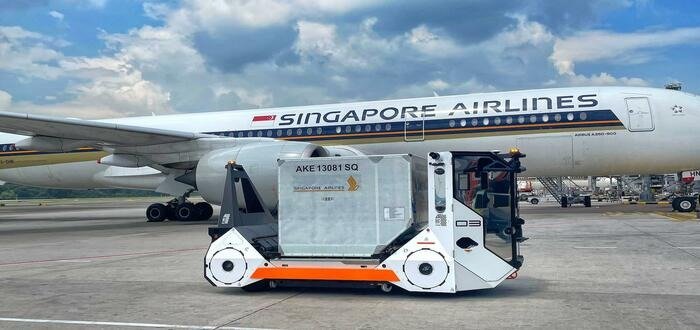
Aircraft turnaround is one of the most time-sensitive activities in airport operations.
Once an aircraft arrives at its parking stand, several activities must be completed before its next departure.
These may include:
- Passenger disembarkation.
- Baggage unloading.
- Cabin cleaning.
- Aircraft catering.
- Refueling.
- Water and lavatory servicing.
- Baggage loading.
- Passenger boarding.
- Final operational checks.
Every activity must be properly coordinated to ensure the aircraft departs safely and on schedule.
Autonomous Ground Support Equipment (GSE) could transform how some of these activities are performed.
What is autonomous ground support equipment?
Autonomous GSE refers to airport equipment capable of performing certain movements or tasks with limited or no direct human control within approved operating environments.
Examples include:
Autonomous baggage tractors
These vehicles can transport baggage carts between designated airport locations using sensors, navigation systems, and predefined routes.
Autonomous cargo transport vehicles
Self-driving transport equipment may help move cargo containers and operational materials within controlled airport environments.
Autonomous passenger buses
Some airports may use automated or semi-autonomous electric vehicles for transporting passengers between terminals and aircraft, subject to local safety and regulatory approval.
Automated aircraft servicing equipment
Selected servicing activities may increasingly use automated positioning, monitoring, or control systems to improve consistency.
How will autonomous GSE improve airport operations?
The benefits could include:
- Improved equipment utilization: Automated vehicles can follow planned routes and schedules.
- Reduced repetitive driving tasks: Employees can concentrate on operational supervision and more complex activities.
- Better operational visibility: Connected equipment can report its location, availability, and selected performance information.
- Potential emissions reduction: Electric autonomous vehicles can reduce local emissions when they replace suitable conventional equipment.
- Improved coordination: Integrated systems can help dispatch equipment according to aircraft arrival and departure requirements.
What challenges must airports overcome?
Airside environments are not simple roads.
Aircraft, service vehicles, pedestrians, baggage carts, fuel vehicles, and maintenance teams operate within shared and highly regulated spaces.
Autonomous equipment must therefore comply with airport traffic rules, operational procedures, safety requirements, and approved operating limitations.
Reliable communications, emergency-stop functions, obstacle detection, maintenance support, and human supervision are also necessary.
The future of aircraft turnaround by 2035
By 2035, selected airports may operate increasingly automated GSE fleets in designated airside zones.
Airport Operations Control Centers and ground-handling departments could monitor equipment availability and movements through connected platforms.
However, the aircraft turnaround process will still require experienced operational staff to coordinate activities, resolve irregularities, and ensure compliance with safety procedures.
The biggest advantage: More efficient equipment deployment, reduced repetitive workloads, and opportunities to improve aircraft turnaround performance.
Digital Twins and Predictive Maintenance Will Make Airports Smarter
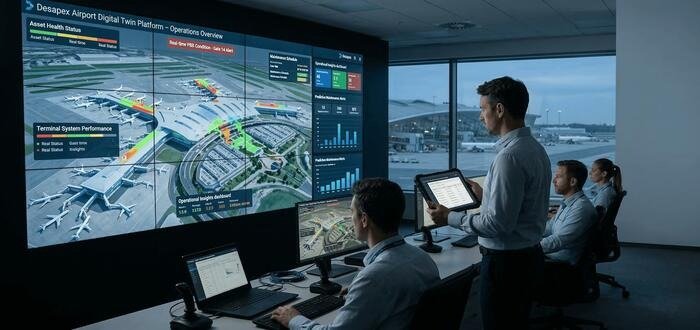
Imagine having a digital version of an entire airport that can show what is happening inside the terminal, on the runway, around aircraft stands, and within critical airport facilities.
This is the basic idea behind digital twin technology.
Digital twins are virtual representations of physical assets, infrastructure, or processes. They use operational information, sensors, and analytical models to help organization understand and monitor real-world conditions.
Among emerging airport automation trends, digital twins could have a major influence on airport planning, maintenance, and operational management.
How do airport digital twins work?
A digital twin can combine information from:
- Airport infrastructure.
- Building management systems.
- Equipment sensors.
- Flight operations.
- Passenger movement data.
- Maintenance records.
- Weather information.
- Energy consumption systems.
This information can be presented through a digital model that helps airport teams understand the condition and performance of physical assets.
For example, airport management could use a digital twin to study how passenger congestion develops when several international flights arrive simultaneously.
The airport could then test different operational arrangements before implementing them in the actual terminal.
What is predictive maintenance?
Predictive maintenance uses equipment condition information and analytical techniques to identify potential failures before they cause major disruptions.
Traditional maintenance often follows fixed schedules or takes place after equipment develops a problem.
Predictive maintenance aims to identify warning signs earlier.
Consider an airport baggage conveyor system.
Sensors may monitor vibration, temperature, operating speed, and other equipment conditions.
If the system identifies unusual changes, maintenance teams can investigate before a serious failure occurs.
This approach may be useful for:
- Passenger boarding bridges.
- Baggage conveyor systems.
- Escalators and elevators.
- Air-conditioning equipment.
- Ground-support equipment.
- Airport lighting systems.
- Electrical infrastructure.
- Security screening equipment.
Why does predictive maintenance matter?
Unexpected equipment failures can disrupt airport operations.
A malfunctioning baggage conveyor may delay baggage delivery, while an unavailable boarding bridge may affect passenger boarding arrangements.
Predictive maintenance can help airport engineering teams plan inspections, prioritize repairs, and reduce unexpected equipment downtime.
What will happen by 2035?
Digital twins may become increasingly useful for airport expansion planning, operational simulation, infrastructure management, and maintenance forecasting.
Instead of waiting for a problem to become visible, airport teams could use connected information to identify developing risks earlier.
Nevertheless, digital twin accuracy depends on reliable data, appropriate modelling, sensor quality, and regular system updates.
The biggest advantage: Better infrastructure planning, improved maintenance decisions, and reduced risk of unexpected equipment failures.
Automated Security Screening Will Improve Airport Safety and Passenger Processing
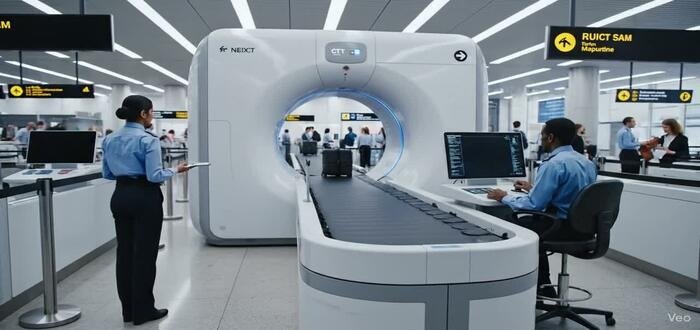
Airport security is one of the most important areas where technology and human expertise must work together.
Security procedures are designed to protect passengers, airport employees, aircraft, and airport infrastructure.
However, traditional screening processes can create queues, particularly during peak departure periods.
Advanced screening technologies are helping airports improve the efficiency of security operations while maintaining required security standards.
What technologies are transforming airport security?
Advanced imaging systems
Modern screening equipment can provide more detailed images of passenger baggage, helping authorized security personnel identify potentially prohibited or dangerous items.
Computed tomography (CT) scanners
CT technology creates detailed three-dimensional images of baggage contents, supporting more effective screening procedures.
Automated threat detection
AI-supported analytical tools can assist trained security personnel by identifying objects or patterns that require additional examination.
Automated access control
Electronic access systems can verify authorized employees and control entry into restricted airport areas.
Smart surveillance systems
Video analytics may help identify unusual activity, monitor selected restricted areas, and support security teams in reviewing incidents.
How can automated screening improve airport operations?
Automation can help security departments manage passenger volumes more effectively.
Potential benefits include:
- More consistent screening procedures.
- Improved image analysis.
- Better monitoring of restricted areas.
- Faster processing where regulations and equipment permit.
- Improved coordination between security teams.
- Better operational information for airport management.
Will airport security become completely automated?
No.
Security is a high-responsibility function that requires professional judgement, regulatory compliance, and human accountability.
Automated systems can support screening activities, but trained security personnel must remain responsible for decisions requiring human assessment.
Airports must also ensure that screening technologies meet applicable national and international requirements.
Airport security in 2035
Future airports may use increasingly integrated screening environments that combine advanced imaging, automated analysis, digital access control, and improved passenger-flow management.
Passengers could experience more efficient screening while security teams benefit from better information and operational support.
The challenge will be balancing passenger convenience with strict security requirements.
The biggest advantage: Improved screening support, stronger monitoring capabilities, and opportunities to reduce unnecessary processing delays.
Smart Airports Automation trends to Improve Sustainability and Energy Management
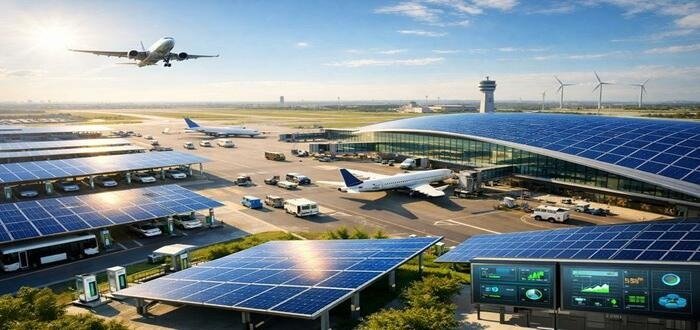
The future airport will not be judged only by how many passengers it can handle or how quickly aircraft can depart.
Energy efficiency, environmental responsibility, and sustainable infrastructure will also play increasingly important roles.
Airports operate large buildings, extensive lighting systems, air-conditioning networks, baggage facilities, transport infrastructure, and ground-support equipment.
These activities consume significant amounts of energy.
Smart automation can help Airport Automation Trends monitor consumption, identify inefficiencies, and improve resource management.
How will Airport Automation Trends support sustainable airports?
1. Smart lighting systems
Automated lighting can adjust brightness according to occupancy, available daylight, and operational requirements.
This helps avoid unnecessary energy consumption in suitable areas.
2. Intelligent heating and cooling
Smart building management systems can monitor temperature, humidity, occupancy, and environmental conditions.
They can automatically adjust heating, ventilation, and air-conditioning settings according to operational needs.
3. Electric ground-support equipment
Electric baggage tractors, passenger buses, service vehicles, and other suitable equipment can reduce local air pollution and noise compared with conventional alternatives.
The overall environmental benefit depends on electricity generation, charging infrastructure, equipment efficiency, and operational conditions.
4. Automated energy monitoring
Connected meters and sensors can help airport management understand electricity consumption across different buildings and departments.
5. Smart water management
Automated monitoring can help identify unusual water consumption, detect possible leaks, and support more efficient water distribution.
6. Intelligent waste management
Smart waste monitoring and automated sorting systems may help airports improve waste collection, recycling, and resource management.
Why are sustainable airport automation trends important?
Airports face increasing expectations to manage their environmental impact while maintaining operational performance.
Automation can support these goals by helping operators:
- Reduce unnecessary energy consumption.
- Improve equipment utilization.
- Monitor building performance.
- Support electric vehicle operations.
- Identify resource wastage.
- Improve environmental reporting.
What will smart airports look like by 2035?
By 2035, more airports could operate connected energy management platforms that monitor buildings, equipment, lighting, and other major energy-consuming systems.
Airport management may receive detailed information about energy consumption and identify areas where operational adjustments can reduce costs.
However, technology is only one part of sustainable airport development. Infrastructure investment, renewable energy, efficient building design, responsible procurement, and cooperation with airlines and other airport partners are equally important.
The biggest advantage: Better Airport Automation Trends, to reduce operating costs, and support for long-term environmental goals.
How Airport Automation Trends Will Change Airport Jobs by 2035
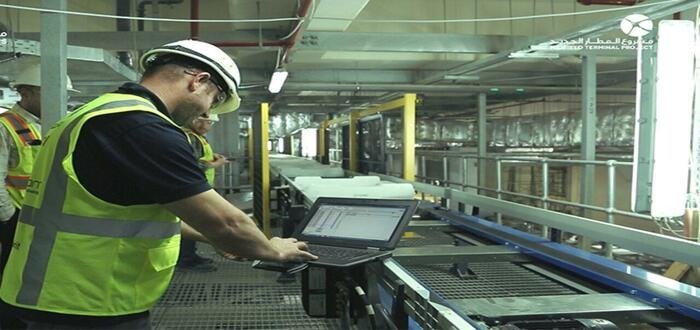
One question deserves special attention:
Will airport automation trends eliminate airport jobs?
It is a reasonable concern, particularly for employees working in ground handling, passenger services, baggage operations, airport administration, and equipment maintenance.
The short answer is that automation will change many airport jobs, but it will not necessarily eliminate the need for experienced airport professionals.
Airports are complicated operational environments. Technology can process information, monitor equipment, and perform repetitive activities, but many situations still require human judgment.
For example, when an aircraft arrives late, the ground-handling team must coordinate with airline representatives, ramp staff, baggage teams, passenger services, and airport authorities.
An automated system may identify the delay and recommend adjustments, but employees still need to manage the operational situation.
Which airport jobs may change?
| Airport department | Expected technological impact |
| Passenger services | More self-service and biometric processing |
| Baggage operations | Automated sorting and tracking |
| Ramp operations | Greater use of connected and autonomous equipment |
| Airport operations control | AI-supported decision-making |
| Security | Advanced screening and surveillance |
| Engineering | Predictive maintenance and digital monitoring |
| Customer service | AI assistants and personalized information |
| Airport administration | Automated reporting and data processing |
Which skills will airport employees need?
Airport professionals should prepare for a workplace where technical knowledge and operational experience become increasingly connected.
Important future skills include:
- Digital airport systems.
- AI-supported operational decision-making.
- Airport safety and security management.
- Ground-handling coordination.
- Data interpretation and reporting.
- Automated baggage system management.
- Equipment monitoring.
- Customer service and communication.
- Cybersecurity awareness.
- Emergency and disruption management.
Why will human experience remain important?
Technology cannot fully replace empathy, leadership, communication, negotiation, and practical operational judgement.
A passenger dealing with a missed connection may need more than an automated message.
An aircraft turnaround affected by an equipment failure may require immediate coordination between several departments.
These situations demonstrate why skilled airport professionals will remain important.
The most successful employees by 2035 may be those who understand both traditional airport operations and modern digital technologies.
Challenges That Could Slow Down Airport Automation trends Before 2035
Although the future of airport automation trends looks promising, introducing new technology is not always straightforward.
Airports are complex environments involving multiple organizations, government authorities, airlines, ground-handling companies, technology providers, and passengers.
Successful automation requires cooperation between all these stakeholders.
Here are some of the major challenges airports must address.
1. High implementation costs
Advanced automation systems require investment in equipment, software, infrastructure, integration, training, and maintenance.
Smaller airports may find it difficult to justify large investments when passenger volumes and available budgets are limited.
Airport management must therefore evaluate the long-term operational benefits before introducing expensive technology.
2. Cybersecurity threats
Connected airport systems create additional opportunities for cyberattacks.
An attack affecting baggage handling, airport communication, flight information, or operational technology could disrupt important airport activities.
Cybersecurity must therefore be included in the planning, installation, and ongoing management of automated systems.
3. Integration with existing systems
Many airports operate equipment and software supplied by different manufacturers.
Some systems may be relatively modern, while others may have been operating for many years.
Connecting these technologies can be challenging because of differences in software, communication standards, and data formats.
4. Employee training and resistance to change
Introducing automation changes working procedures.
Employees must understand how new equipment operates, how to identify system failures, and when manual intervention is required.
Airports should involve employees in technology implementation and provide suitable training before changing established operational processes.
5. Data privacy and regulatory compliance
Biometric identification, passenger monitoring, and digital identity systems involve sensitive information.
Airports must comply with applicable data protection laws and aviation regulations.
Passengers should understand how their information is collected, processed, protected, and retained.
6. Dependence on reliable infrastructure
Automation depends on reliable electricity, communication networks, software, hardware, and technical support.
A system failure should never leave an airport without a safe way to continue essential operations.
Backup arrangements and manual procedures remain important.
How Can Airports Prepare for Automation by 2035?
Airport Automation Trends should not wait until 2035 to start preparing for technological changes.
The transformation is already taking place, and airports that develop clear digital strategies will be better positioned to benefit from future developments.
Here are six practical steps airport operators can consider.
1. Evaluate existing operations: Identify repetitive activities, operational bottlenecks, and areas where automation could improve safety or efficiency.
2. Prioritization investment: Begin with technologies that provide measurable operational benefits rather than purchasing expensive systems simply because they are fashionable.
3. Improve data connectivity: Establish reliable information-sharing arrangements between airlines, airports, ground handlers, and other service providers.
4. Invest in employee development: Train employees to operate, monitor, and supervise automated systems.
5. Strengthen cybersecurity: Protect airport information technology and operational technology through appropriate security policies and controls.
6. Measure performance: Evaluate the impact of automation through indicators such as passenger waiting times, baggage performance, equipment availability, turnaround performance, energy consumption, and operational disruptions.
Most importantly, automation should support the airport’s overall operational strategy.
A modern airport is not simply a building filled with digital screens and robots. It is a coordinated environment where people, technology, infrastructure, and operational procedures work together.
Conclusion: Airport Automation Trends Will Define the Future of Aviation
The aviation industry is approaching a major technological transformation.
By 2035, airport operations could look significantly different from what passengers and employees experience today. Artificial intelligence, biometric identification, robotics, automated baggage systems, autonomous ground-support equipment, and digital twins are expected to play increasingly important roles in airport development.
These airport automation trends will not only improve passenger processing. They could also transform aircraft turnaround operations, baggage management, security screening, equipment maintenance, employee productivity, and environmental performance.
However, successful automation requires more than purchasing advanced equipment. Airports must invest in reliable infrastructure, cybersecurity, employee training, data integration, and effective operational management.
One important point should never be forgotten: technology is most valuable when it supports people rather than simply replacing them.
Experienced airport professionals will continue to play an essential role in maintaining safety, managing irregularities, coordinating operations, and delivering quality passenger services.
The airports that succeed by 2035 will probably be those that combine intelligent technology with skilled employees, strong leadership, and efficient operational procedures.
The future airport is not just automated. It is connected, intelligent, sustainable, and passenger-focused.
What do you think will have the biggest impact on Airport Automation Trends by 2035: artificial intelligence, biometrics, or autonomous ground-handling equipment? Share your thoughts in the comments!
Frequently Asked Questions About Airport Automation Trends
1. What are the most important airport automation trends?
The most important airport automation trends include artificial intelligence, biometric passenger identification, self-service check-in, robotic assistance, smart baggage handling, autonomous ground-support equipment, digital twins, automated security screening, and smart energy management.
These technologies aim to improve airport efficiency, safety, passenger experience, and operational coordination.
2. How will airport automation trends change passenger experiences by 2035?
Airport automation trends could make passenger journeys faster and more convenient through digital identity, biometric verification, self-service facilities, real-time baggage tracking, and AI-powered passenger assistance.
Passengers may spend less time waiting in traditional queues and more time enjoying airport facilities.
However, the actual experience will depend on technology availability, government regulations, and cooperation between airlines and airports.
3. Will robots replace airport ground-handling employees?
Robots and autonomous equipment may perform selected repetitive and physically demanding activities, including baggage transportation, cargo movement, and certain cleaning tasks.
However, ground-handling operations will continue to require trained employees for aircraft turnaround coordination, safety supervision, baggage irregularities, equipment management, and operational decision-making.
Automation is more likely to change job responsibilities than eliminate every ground-handling position.
4. How does artificial intelligence improve airport operations?
Artificial intelligence can analyze operational data, predict passenger congestion, support flight disruption management, improve resource allocation, and assist airport employees in making informed decisions.
It can also support predictive maintenance and customer-service applications.
AI works most effectively when it receives reliable information from connected airport systems and operates under appropriate human supervision.
5. What challenges do airports face when implementing automation?
Major challenges include high investment costs, cybersecurity risks, employee training, data privacy, regulatory compliance, system integration, and infrastructure reliability.
Airports must carefully plan automation projects to ensure that new technologies improve operations without compromising safety, security, or passenger accessibility.
Facebook: https://www.facebook.com/rehan.ghauri
Instagram: https://www.instagram.com/contentflyers0/
Twitter: https://www.twitter.com/contentflyers0/
Pinterest: https://www.pinterest.com/contentflyers0/
