

Airline Analytics: A Complete Guide to Smarter Airline Operations explains how airlines use operational, financial, passenger, and technical data to improve performance and maintain a competitive advantage.
Airlines generate enormous amounts of information every day. Every ticket reservation, passenger check-in, baggage movement, aircraft departure, maintenance inspection, and customer complaint creates valuable data.
However, collecting information is only the beginning. The real opportunity comes from analyzing that information and turning it into practical decisions.
This guide examines 10 important applications of airline analytics, including flight performance monitoring, predictive maintenance, revenue management, fuel optimization, baggage tracking, workforce planning, customer experience, and safety management.
Whether you are an aviation professional, airline manager, student, business analyst, or someone interested in the future of aviation, this article will help you understand why data has become one of the industry’s most valuable operational resources.
Table of Contents
Introduction: Why Is Airline Analytics Becoming Essential for Modern Airlines?
Imagine an airline operating 150 flights in a single day.
Each flight requires aircraft, pilots, cabin crew, ground staff, airport facilities, baggage systems, fuel, catering, security coordination, and hundreds of other operational activities.
Now imagine that three aircraft experience technical problems, two airports face severe weather, several flights are delayed, and passenger connections are at risk.
How should the airline respond?
Should it change aircraft assignments, arrange additional ground staff, adjust passenger connections, or reschedule departures?
Making these decisions based on guesswork would be risky. Even experienced airline managers cannot manually monitor every operational detail across multiple airports.
This is where airline analytics becomes valuable.
Airline analytics involves collecting, processing, examining, and interpreting aviation-related data to support better decisions. It helps airlines understand what is happening, identify why problems occur, predict what may happen next, and determine the most appropriate response.
For example, an airline can analyze historical flight information to identify routes that frequently experience delays. It can examine aircraft fuel consumption to identify opportunities for efficiency improvements. It can also study passenger booking patterns to understand demand and adjust ticket prices.
The idea is simple: instead of waiting for problems to become expensive, airlines can use information to identify risks and opportunities earlier.
And in an industry where a delayed aircraft can affect several subsequent flights, early information can make a significant difference.
Airline analytics is no longer simply a technology project for IT departments. It is increasingly relevant to flight operations, airport management, engineering, finance, commercial planning, customer service, and senior management.
Let’s explore how it works and why it matters.
1. What Is Airline Analytics?
Airline analytics is the systematic use of data, statistical methods, analytical tools, and technology to understand and improve airline performance.
It allows airlines to transform large volumes of operational and commercial information into meaningful insights.
In simple terms, airline analytics helps answer five important questions:
- What is happening in our airline operations?
- Why are certain operational problems occurring?
- What is likely to happen in the future?
- How can we improve our current performance?
- Which decisions will produce the best operational and financial results?
For example, an airline may discover that flights departing from a particular airport frequently experience delays during evening hours.
Instead of simply accepting these delays as part of daily operations, analysts can investigate several factors:
- Aircraft arrival delays from previous sectors.
- Airport congestion and runway capacity.
- Ground-handling turnaround times.
- Passenger boarding efficiency.
- Baggage loading and unloading performance.
- Weather conditions.
- Crew availability and scheduling.
- Air traffic management restrictions.
By identifying the underlying causes, airline management can develop targeted improvements.
Airline Analytics vs. Traditional Airline Management
Traditional airline management often relies heavily on historical reports, operational experience, manual monitoring, and periodic performance reviews.
These methods remain valuable, but airline analytics provides additional capabilities.
| Traditional management | Data-driven airline management |
| Reviews completed flights | Monitors operational performance continuously |
| Identifies problems after they occur | Can identify warning signs earlier |
| Uses periodic performance reports | Uses dashboards and analytical reports |
| Relies heavily on manual comparisons | Uses automated data analysis |
| Reacts to recurring problems | Investigates patterns and potential causes |
| Makes decisions using limited information | Combines multiple data sources |
This does not mean experienced managers are becoming unnecessary.
The best results come when experienced aviation professionals combine operational knowledge with reliable analytical information.
A dashboard might indicate that a flight is delayed, but an experienced airport duty manager understands how that delay affects aircraft turnaround, connecting passengers, baggage transfers, manpower allocation, and subsequent departures.
Technology provides information. People turn that information into responsible operational decisions.
2. How Does Airline Analytics Work?
Airline analytics follows a structured process that transforms raw information into useful business intelligence.
Although the technology can be complex, the basic process is relatively straightforward.
Step 1: Collecting Airline Data
The first stage involves collecting information from different airline departments and operational systems.
Common sources include:
- Passenger reservation systems.
- Departure control systems (DCS).
- Airline operational databases.
- Flight planning systems.
- Aircraft health monitoring systems.
- Maintenance management systems.
- Baggage reconciliation systems.
- Revenue management platforms.
- Customer relationship management systems.
- Airport and ground-handling reports.
For example, a departure control system provides information about passenger check-in, boarding, seat allocation, and flight closure.
Similarly, baggage systems can provide information about baggage acceptance, reconciliation, loading, transfers, and delivery.
When these information sources are integrated appropriately, airlines can develop a broader understanding of their operations.
Step 2: Organizing and Processing Data
Raw information is not always ready for analysis.
Different systems may use different formats, reporting periods, definitions, and identification codes.
An airline must therefore organize its data and address inconsistencies before drawing conclusions.
Important activities include:
- Removing duplicate records.
- Correcting inaccurate entries.
- Standardizing reporting formats.
- Identifying missing information.
- Matching aircraft, flight, airport, and passenger records.
- Establishing consistent performance definitions.
Data quality matters enormously.
If an airline’s departure delay information is inaccurate, its performance reports may identify the wrong operational problem.
A sophisticated analytical system cannot magically turn unreliable information into reliable conclusions.
Step 3: Analyzing the Information
Once the data has been prepared, analysts use different methods to identify patterns, relationships, and performance trends.
For example, an airline may compare:
- Scheduled departure time against actual departure time.
- Planned turnaround time against actual turnaround time.
- Forecast passenger demand against actual bookings.
- Expected fuel consumption against actual consumption.
- Planned maintenance against unscheduled maintenance events.
These comparisons help identify performance gaps and improvement opportunities.
Step 4: Presenting Results Through Dashboards
Airline managers need information that is understandable and useful.
Instead of examining thousands of individual records, they can use dashboards containing important operational indicators.
A typical airline operations dashboard might display:
- Number of flights operated.
- On-time departure performance.
- Arrival punctuality.
- Cancelled flights.
- Aircraft availability.
- Average turnaround time.
- Passenger load factor.
- Baggage mishandling.
- Ground-handling performance.
- Operational disruptions.
The objective is to make important information accessible to the people responsible for taking action.
Step 5: Making Decisions and Monitoring Results
The final stage is where airline analytics creates practical value.
Suppose an airline identifies that baggage loading frequently causes departure delays at one station.
Management can investigate staffing levels, equipment availability, baggage delivery timing, communication procedures, and loading coordination.
After implementing improvements, the airline compares its new performance with previous results.
This creates a continuous improvement cycle:
Collect data → Analyze performance → Identify problems → Take action → Measure results.
Airline analytics is therefore not simply about producing reports. It is about improving actual operational outcomes.
3. Types of Airline Analytics Every Aviation Professional Should Understand
Airline analytics can be divided into four major categories.
Each category answers a different type of business or operational question.
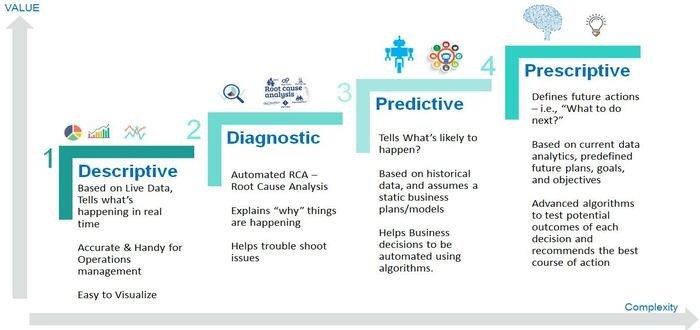
3.1 Descriptive Analytics: What Happened?
Descriptive analytics examines historical information to explain what has already happened.
It is one of the most common forms of airline analytics.
Examples include:
- How many flights operated last month?
- What percentage of flights departed on time?
- Which routes experienced the highest delays?
- How many passengers travelled during a particular period?
- How many baggage complaints were received?
- Which airports recorded the highest operational disruptions?
For example, an airline may review its monthly departure performance and discover that punctuality declined during the summer travel season.
This information gives management a starting point for further investigation.
3.2 Diagnostic Analytics: Why Did It Happen?
Diagnostic analytics goes one step further by investigating the reasons behind an operational result.
Imagine an airline discovers that its on-time departure performance has decreased.
Descriptive analytics identifies the decline.
Diagnostic analytics investigates its causes.
Possible contributing factors include:
- Late aircraft arrival.
- Technical defects.
- Delayed passenger boarding.
- Late baggage delivery.
- Ground equipment unavailability.
- Crew scheduling issues.
- Airport congestion.
- Weather-related restrictions.
The purpose is to identify root causes rather than simply blaming the department where the problem became visible.
This distinction is important in aviation because several departments contribute to a single flight’s successful departure.
3.3 Predictive Analytics: What Is Likely to Happen?
Predictive analytics uses historical information, statistical models, and machine learning techniques to estimate future outcomes.
For example, an airline can analyze previous technical defects to identify patterns that may indicate a higher probability of equipment failure.
Other applications include:
- Forecasting passenger demand.
- Predicting potential flight delays.
- Estimating maintenance requirements.
- Identifying possible baggage handling disruptions.
- Forecasting fuel requirements.
- Predicting seasonal booking patterns.
Predictive analytics does not guarantee that an event will happen.
It provides estimates that help management prepare for possible situations.
A predicted delay is a warning signal, not a confirmed operational event.
3.4 Prescriptive Analytics: What Should We Do Next?
Prescriptive analytics focuses on recommending possible actions based on available information, operational constraints, and defined objectives.
For example, if a flight is expected to experience a delay, an analytical system may evaluate different options:
- Reassigning an available aircraft.
- Adjusting connecting passenger arrangements.
- Allocating additional ground staff.
- Reviewing available departure slots.
- Coordinating alternative baggage transfer arrangements.
The final decision must consider operational feasibility, safety requirements, regulations, and company procedures.
Prescriptive analytics is especially useful when several possible solutions exist and management needs to understand their likely consequences.
Remember: Descriptive analytics explains the past, diagnostic analytics investigates causes, predictive analytics estimates the future, and prescriptive analytics helps identify possible actions.
4. 10 Important Ways Airline Analytics Improves Airline Operations
Airline analytics becomes particularly valuable when it supports real operational activities.
Let’s examine ten major applications that can help airlines improve efficiency, passenger satisfaction, and financial performance.

4.1 Flight Operations and On-Time Performance
Flight punctuality is one of the most visible indicators of airline operational performance.
Passengers expect their flights to depart and arrive according to schedule. Airlines also depend on punctuality to maintain aircraft utilization, crew schedules, connecting flights, and network reliability.
Airline analytics helps monitor flight performance by comparing scheduled and actual operational times.
Important performance indicators include:
- On-time departure percentage.
- On-time arrival percentage.
- Average departure delay.
- Average arrival delay.
- Flight cancellation rate.
- Aircraft turnaround time.
- Delay reasons and distribution.
For example, an airline may discover that a particular route regularly experiences delays because aircraft arrive late from previous sectors.
The airline can examine aircraft rotations, scheduled turnaround buffers, airport congestion, and operational recovery arrangements.
This allows operations teams to investigate the problem before it affects additional flights.
Practical airport example: An airport duty officer monitoring daily operations can use delay reports to identify recurring bottlenecks. If baggage loading consistently takes longer than planned, the ground-handling team can investigate manpower availability, equipment positioning, and coordination procedures.
The result is a more structured approach to improving departure performance.
4.2 Predictive Aircraft Maintenance
Aircraft maintenance is another important application of airline analytics.
Unplanned technical problems can affect aircraft availability, flight schedules, passenger connections, and operating costs.
Traditional maintenance approaches include scheduled inspections, component replacement intervals, and maintenance activities required by approved maintenance programs.
Predictive maintenance adds another layer by analyzing relevant aircraft and maintenance data to identify possible warning signs.

Airlines may examine information such as:
- Aircraft sensor readings.
- Engine performance trends.
- Component operating hours.
- Maintenance history.
- Technical defect reports.
- Repeated fault indications.
- Aircraft health monitoring information.
For example, an unusual trend in engine performance data may require engineering investigation.
Maintenance teams can assess the information and determine whether additional inspections or preventive action are necessary.
Predictive maintenance can help airlines:
- Improve maintenance planning.
- Identify recurring technical problems.
- Reduce unexpected aircraft downtime.
- Improve spare-parts planning.
- Support aircraft availability.
- Manage maintenance resources more effectively.
However, analytics must never replace approved maintenance procedures, engineering assessments, or airworthiness requirements.
Aircraft release decisions remain the responsibility of appropriately authorized personnel.
4.3 Fuel Consumption and Cost Optimization
Fuel is a major airline operating expense.
Even relatively small improvements in fuel efficiency can become financially significant when applied across hundreds or thousands of flights.
Airline analytics helps examine fuel consumption patterns and identify opportunities to improve efficiency.
Relevant information may include:
- Aircraft type.
- Flight distance.
- Payload and aircraft weight.
- Weather conditions.
- Wind information.
- Flight planning data.
- Route selection.
- Taxi time.
- Actual fuel consumption.

For example, analysts can compare planned and actual fuel consumption across different aircraft types and routes.
They may identify recurring differences that require investigation by flight operations, dispatch, engineering, or fuel management teams.
IATA provides dedicated fuel-efficiency analytics through its FuelIS solution, which helps airlines benchmark fuel performance using industry information.
Potential benefits include:
- Better fuel performance monitoring.
- Identification of inefficient operational practices.
- Improved flight planning analysis.
- Reduced unnecessary fuel consumption.
- Support for environmental performance targets.
- More informed operational decisions.
Fuel efficiency should never be pursued at the expense of safety, regulatory compliance, or operational requirements.
4.4 Passenger Experience and Customer Satisfaction
Passengers judge an airline through several interactions, not just the flight itself.
Their experience begins with booking and continues through check-in, baggage acceptance, boarding, flight services, arrival, baggage collection, and customer support.
Airline analytics helps airlines understand these experiences using information collected across different customer touch points.
For example, an airline may examine:
- Customer feedback.
- Passenger complaints.
- Check-in waiting times.
- Boarding delays.
- Baggage delivery performance.
- Call centre response times.
- Online booking behavior.
- Customer satisfaction surveys.
- Repeat booking patterns.

Suppose an airline receives repeated complaints about long check-in queues at a particular airport.
Analytics can help compare passenger arrival patterns, counter opening times, staffing levels, and average service times.
Management can then consider adjusting counter allocation or staff scheduling.
Another example involves baggage delivery.
If passengers frequently report delayed baggage at a particular destination, the airline can investigate baggage transfer processes, ground-handling coordination, and arrival operations.
These improvements can support a more reliable passenger journey.
4.5 Revenue Management and Ticket Pricing
Airlines operate in a highly competitive commercial environment.
Ticket prices change according to demand, seasonality, route popularity, booking behavior, competition, and available seat inventory.
Revenue management uses analytical information to help airlines make informed decisions about pricing and seat availability.
For example, an airline may analyze:
- Historical booking patterns.
- Remaining seat inventory.
- Booking lead times.
- Seasonal passenger demand.
- Competitor pricing information.
- Route profitability.
- Passenger segmentation.
- Cancellation and no-show patterns.
Suppose a flight operating during a holiday period is experiencing strong demand.
The revenue management team can evaluate booking trends and available inventory to determine whether pricing or seat allocation adjustments are appropriate.
Similarly, if a route experiences consistently weak demand, analysts can investigate whether the issue relates to pricing, departure timing, competition, or market conditions.
Airline analytics supports better commercial decisions, but forecasts are not guarantees of future passenger demand.
4.6 Baggage Handling and Operational Coordination
Baggage handling is an important part of airline ground operations.
A passenger may forgive a slightly uncomfortable seat, but discovering that their suitcase has travelled to another country is a different kind of holiday surprise.
Baggage analytics can help airlines and ground-handling companies monitor the movement and performance of baggage throughout the passenger journey.

Useful information includes:
- Baggage acceptance records.
- Baggage reconciliation information.
- Loading and unloading timestamps.
- Transfer baggage movements.
- Delayed baggage reports.
- Mishandled baggage cases.
- Baggage delivery performance.
For example, if an airline identifies repeated baggage transfer delays at a particular station, it can examine transfer connection times, baggage belt availability, staff coordination, and operational procedures.
Analytics may also help identify patterns associated with baggage mishandling.
The information can support improvements in:
- Baggage tracking.
- Loading coordination.
- Transfer operations.
- Staff allocation.
- Equipment utilization.
- Customer communication.
Importantly, baggage analytics should work alongside approved baggage reconciliation and security procedures, not replace them.
4.7 Workforce Planning and Staff Productivity
Airline operations depend on the effective coordination of people across several departments.
A typical airport operation requires check-in agents, boarding staff, ramp personnel, baggage handlers, supervisors, dispatch teams, customer service employees, and operational managers.
Insufficient staffing can create delays, while excessive staffing can increase operating costs.
Airline analytics helps management match workforce requirements with operational demand.
For example, an airline can analyze:
- Daily flight schedules.
- Passenger volumes.
- Aircraft turnaround requirements.
- Historical peak periods.
- Staff availability.
- Average service times.
- Absence patterns.
- Operational workload.
Suppose an airport handles several international departures between 8 PM and midnight.
Historical workload data may indicate that additional check-in and boarding personnel are required during this period.
Managers can use this information when preparing staff rosters.
This approach supports:
- Better manpower distribution.
- Improved shift planning.
- Reduced unnecessary overtime.
- More balanced workloads.
- Improved service delivery.
- Better resource utilization.
Analytics should support fair and practical workforce planning. Staff performance cannot be judged accurately through numbers alone, particularly when employees work under different operational conditions.
4.8 Aircraft Utilization and Fleet Management
Aircraft are among the most valuable assets an airline operates.
Efficient aircraft utilization is therefore an important part of airline financial and operational management.
Airline analytics helps examine how effectively aircraft are being used across the network.
Important indicators include:
- Daily aircraft utilization.
- Block hours.
- Flight cycles.
- Ground time.
- Aircraft availability.
- Technical delays.
- Maintenance downtime.
- Fleet assignment performance.
For example, an airline may discover that certain aircraft regularly spend more time on the ground than expected.
The operations and fleet planning teams can investigate schedule design, maintenance requirements, route assignments, and turnaround arrangements.
Analytics can also support aircraft assignment decisions by examining route suitability, passenger demand, aircraft capacity, and operating requirements.
Better utilization can improve productivity, but aircraft scheduling must always respect maintenance needs, crew limitations, airport restrictions, and operational safety requirements.
4.9 Safety Management and Risk Identification
Safety is the foundation of aviation.
No financial target, punctuality improvement, or passenger satisfaction objective should take priority over safe operations.
Airline analytics can support safety management by helping organizations identify patterns, monitor safety performance, and understand potential operational risks.
Relevant information may include:
- Flight data monitoring information.
- Safety occurrence reports.
- Ground-handling incidents.
- Ramp inspection findings.
- Aircraft technical events.
- Operational hazard reports.
- Bird strike information.
- Runway safety observations.
- Repeated procedural deviations.
For example, if several ramp reports identify similar equipment-related hazards, safety teams can investigate the underlying conditions and introduce appropriate preventive measures.
The International Civil Aviation Organization (ICAO) emphasizes the collection, processing, and analysis of safety data to support proactive safety management.
Airline analytics can therefore help organizations move beyond simply recording incidents toward identifying trends and improving preventive controls.
However, an important distinction must be maintained: analytics supports safety decisions; it does not independently determine whether an operation is safe.
Qualified personnel, approved procedures, regulatory requirements, and the airline’s Safety Management System remain essential.
4.10 Network Planning and Route Performance
Airlines must continually evaluate whether their routes are commercially and operationally successful.
A route may attract many passengers but generate limited financial returns because of high operating costs.
Another route may have moderate passenger demand but perform well because of favorable operating economics.
Airline analytics helps management examine route performance using several types of information.
These may include:
- Passenger demand.
- Seat capacity.
- Load factor.
- Revenue per passenger.
- Operating costs.
- Fuel consumption.
- Competition.
- Seasonal demand.
- Connecting passenger traffic.
For example, an airline may compare two routes operating with similar aircraft.
One route may consistently achieve stronger passenger demand, while the other experiences lower bookings outside peak seasons.
Analysts can help identify whether schedule adjustments, different aircraft assignments, marketing activities, or revised pricing strategies should be considered.
Network planning decisions are complex and should account for commercial, regulatory, operational, and strategic factors.
5. Key Performance Indicators (KPIs) Used in Airline Analytics
Airline analytics becomes more useful when organizations monitor the right key performance indicators.
KPIs help management understand whether operations are meeting defined targets.
However, measuring everything is not necessarily helpful. The most effective approach is to select indicators that connect directly with organizational objectives.
Here are some important airline analytics KPIs.
| KPI | What it measures |
| On-Time Performance (OTP) | Flight punctuality |
| Load Factor | Percentage of available passenger capacity occupied |
| Aircraft Utilization | How effectively aircraft are used |
| Average Turnaround Time | Time spent preparing aircraft between flights |
| Flight Cancellation Rate | Percentage of flights cancelled |
| Baggage Mishandling Rate | Frequency of mishandled baggage |
| Fuel Burn | Fuel consumed during operations |
| Cost per Available Seat Kilometer (CASK) | Operating cost relative to available seat capacity and distance |
| Revenue per Available Seat Kilometer (RASK) | Passenger and other relevant revenue relative to available seat capacity and distance |
| Customer Satisfaction Score | Passenger feedback and experience |
| Technical Dispatch Reliability | Reliability of aircraft dispatch from a technical perspective |
Understanding Airline KPIs Through Practical Examples
On-Time Performance: If an airline operates 100 flights and 85 meet its defined punctuality criteria, its on-time performance is 85%.
The airline must clearly define its measurement standard, including the applicable time threshold.
Load Factor: If an aircraft offers 200 seats and carries 170 revenue passengers, its passenger load factor is 85%.
Aircraft Turnaround Time: If an aircraft arrives at 10:00 AM and departs again at 11:00 AM, the turnaround interval is 60 minutes.
The required turnaround time depends on aircraft type, operating procedures, passenger arrangements, airport facilities, and the airline’s approved operational requirements.
Baggage Mishandling Rate: An airline can compare the number of mishandled bags against total passenger baggage handled over a defined reporting period.
The exact KPI definition should remain consistent so that performance comparisons are meaningful.
Why Should Airlines Monitor KPIs Regularly?
Regular KPI monitoring helps airlines:
- Identify operational weaknesses.
- Compare performance across stations.
- Evaluate improvement initiatives.
- Understand cost trends.
- Monitor service quality.
- Support management decisions.
- Establish measurable departmental targets.
A KPI is useful only when someone understands what it means and can take appropriate action based on the results.
A dashboard full of colourful charts may look impressive, but it is not a substitute for effective operational management.
6. Technologies Powering Modern Airline Analytics
Modern airline analytics depends on several technologies that help airlines collect, process, analyze, and interpret information.

Artificial Intelligence (AI)
Artificial intelligence can help airlines analyze large datasets, recognize patterns, and support certain decision-making processes.
Potential applications include:
- Passenger demand forecasting.
- Customer service automation.
- Operational disruption analysis.
- Maintenance prediction.
- Revenue optimization.
AI-generated recommendations should be monitored because inaccurate or incomplete information can lead to poor decisions.
Machine Learning
Machine learning is a branch of artificial intelligence that allows computer systems to identify patterns from data and improve their predictive performance through training.
Airlines may use machine learning models to examine historical flight delays, booking behaviour, maintenance information, and other operational variables.
For example, a model may estimate the likelihood of a flight delay based on aircraft arrival history, weather, airport congestion, and departure schedules.
The reliability of such predictions depends on the quality of the data, model design, and changing operational conditions.
Big Data Analytics
Airlines generate large amounts of information from different systems.
Big data technologies help organizations store, process, and analyze information at scale.
This is particularly useful for airlines operating large fleets, multiple international stations, and extensive passenger networks.
IATA’s Global Aviation Data Management (GADM) program illustrates how aviation operational, safety, weather, and maintenance information can be brought together to support trend analysis and risk mitigation.
Cloud Computing
Cloud computing allows organizations to access computing resources and data services through cloud-based infrastructure.
Potential benefits include:
- Scalable data storage.
- Easier access to analytical tools.
- Improved collaboration.
- Flexible computing capacity.
- Reduced dependence on some local infrastructure.
However, airlines must carefully assess cybersecurity, availability, data protection, and regulatory requirements before moving operational information to cloud platforms.
Business Intelligence and Visualization Tools
Business intelligence platforms transform information into dashboards, charts, and management reports.
Commonly used tools include:
- Microsoft Power BI.
- Tableau.
- Microsoft Excel.
- Qlik.
- SQL-based reporting systems.
These tools can help airline professionals compare performance, identify trends, and communicate findings.
Internet of Things (IoT)
IoT refers to connected devices that collect and exchange information.
In aviation, connected sensors and monitoring systems can provide information about aircraft components, airport equipment, environmental conditions, and operational assets.
This information can support equipment monitoring and maintenance planning.
However, connected systems must be appropriately secured and integrated with approved operational processes.
7. Challenges Airlines Face When Implementing Airline Analytics
Although airline analytics offers significant opportunities, implementation is not always easy.
Airlines operate in complex environments involving multiple departments, international airports, different service providers, and strict regulatory requirements.
Several challenges must be addressed.
7.1 Poor Data Quality
Incorrect, incomplete, outdated, or inconsistent information can reduce the reliability of analytical results.
For example, if different airport stations record flight delay reasons differently, comparing their performance may produce misleading conclusions.
Possible solution: Establish standardized reporting definitions, data validation procedures, and clear responsibilities for information management.
7.2 Integration of Different Systems
Airlines often use multiple systems for reservations, check-in, maintenance, baggage handling, flight planning, finance, and customer service.
Connecting these systems can be technically challenging.
Possible solution: Develop an appropriate data integration strategy and establish common data definitions across departments.
7.3 High Implementation Costs
Advanced analytical platforms may require investment in software, infrastructure, data engineering, cybersecurity, and employee training.
Smaller airlines may find these investments particularly challenging.
Possible solution: Start with a clearly defined operational problem and introduce analytics gradually. A focused dashboard for flight punctuality may provide more immediate value than purchasing a complex enterprise platform without a clear business objective.
7.4 Shortage of Skilled Professionals
Successful airline analytics requires a combination of technical and aviation knowledge.
A data analyst may understand statistical modelling but lack practical knowledge of aircraft turnaround, baggage handling, airport coordination, or airline regulations.
Similarly, an experienced airport supervisor may understand operational problems but require additional training in data interpretation.
Possible solution: Encourage collaboration between aviation professionals, business analysts, IT teams, engineers, and operational managers.
7.5 Data Privacy and Cybersecurity
Airlines handle sensitive information, including passenger records, employee information, financial transactions, and operational data.
Poor information security can expose organizations to financial, legal, operational, and reputational risks.
Possible solution: Apply appropriate access controls, encryption, cybersecurity monitoring, data retention policies, and privacy protections.
7.6 Resistance to Organizational Change
Employees may resist new analytical systems if they believe the technology is designed to monitor individuals rather than improve processes.
Possible solution: Explain the purpose of the system, involve employees in implementation, provide training, and encourage a fair reporting culture.
7.7 Over dependence on Automated Decisions
Analytical systems can make mistakes, particularly when information is incomplete or operational conditions change.
For example, an automated system may recommend changing an aircraft assignment without fully accounting for maintenance restrictions or crew qualifications.
Possible solution: Establish appropriate human oversight, decision-making authority, and escalation procedures.
The most successful airline analytics programmes do not simply purchase technology. They build an organizational culture that values reliable information, professional judgement, accountability, and continuous improvement.
8. How Can an Airline Build a Successful Analytics Strategy?
Implementing airline analytics requires more than purchasing software or hiring data analysts.
An airline needs a clear strategy that connects analytical capabilities with operational and commercial objectives.
Here is a practical step-by-step approach.
Step 1: Identify the Main Operational Problems
Before investing in technology, management should identify which problems need attention.
For example:
- Frequent flight delays.
- High fuel consumption.
- Increasing maintenance costs.
- Poor baggage delivery performance.
- Low passenger satisfaction.
- Inefficient manpower allocation.
- Weak route profitability.
Starting with a specific problem helps prevent unnecessary investment.
Step 2: Establish Clear Objectives
Every analytics project should have measurable objectives.
For instance, an airline introducing a flight punctuality analytics program may want to:
- Identify the main causes of departure delays.
- Compare performance across airport stations.
- Improve turnaround coordination.
- Monitor recurring operational disruptions.
- Evaluate the results of corrective actions.
Objectives should be realistic and aligned with the airline’s wider business strategy.
Step 3: Select the Right Data Sources
After defining objectives, the airline should identify the information required to support the project.
For a flight delay analysis program, relevant sources might include:
- Flight schedules.
- Actual arrival and departure timestamps.
- Delay codes.
- Aircraft rotation information.
- Ground-handling reports.
- Weather information.
- Airport operational restrictions.
The information should be accurate, relevant, and collected using consistent definitions.
Step 4: Choose Appropriate Analytical Tools
Not every airline needs an expensive artificial intelligence platform.
The appropriate tools depend on the organization’s size, operational complexity, budget, and analytical requirements.
A smaller airline might begin with Excel and Power BI, while a larger international airline may require advanced data platforms and machine learning infrastructure.
The important thing is selecting technology that solves an actual problem.
Step 5: Train Employees and Managers
Airline analytics should not remain limited to IT departments.
Operational managers, airport supervisors, engineering personnel, customer service teams, and commercial departments should understand how to interpret relevant information.
Training should cover:
- Understanding operational KPIs.
- Reading analytical dashboards.
- Identifying performance trends.
- Recognizing inaccurate information.
- Interpreting analytical findings.
- Reporting operational concerns.
Employees should also understand the limitations of predictive models and automated recommendations.
Step 6: Monitor Results and Improve Continuously
An analytics project should be reviewed regularly.
Management should compare actual performance against the original objectives and identify whether the program is producing measurable benefits.
If a particular analytical approach does not produce useful results, the airline should investigate why and make appropriate adjustments.
Continuous improvement is essential because airline operations, passenger expectations, technology, and market conditions keep changing.
9. Real-World Airline Analytics: A Practical Airport Operations Case Study
To understand the practical value of airline analytics, consider a hypothetical example involving an international airline operating at a busy airport.
The airline has noticed that several evening departures are regularly delayed.
Passengers are becoming frustrated, ground-handling staff are working under pressure, and connecting flights are being affected.
Management initially suspects that the problem is caused by insufficient ground staff.
However, instead of immediately increasing manpower, the airline decides to investigate the situation using operational data.

Identifying the Problem
The operations team collects information from:
- Flight departure reports.
- Aircraft arrival records.
- Check-in and boarding systems.
- Baggage handling reports.
- Ground equipment records.
- Staff duty rosters.
- Historical delay information.
The information reveals that delays are concentrated around a particular evening departure period.
Analyzing the Causes
Further investigation identifies several contributing factors:
- Some aircraft arrive later than scheduled.
- Ground equipment is not always positioned before aircraft arrival.
- Passenger boarding begins later than planned on certain flights.
- Baggage loading activities sometimes start behind schedule.
- Staff allocation does not consistently match the evening flight workload.
The investigation shows that insufficient manpower is only one possible contributor, not the complete explanation.
Developing an Improvement Plan
The airline introduces several measures:
- Reviewing aircraft turnaround coordination.
- Improving ground equipment positioning.
- Adjusting staff allocation during peak periods.
- Monitoring passenger boarding milestones.
- Improving communication between airline and ground-handling teams.
- Reviewing baggage delivery and loading performance.
Measuring the Results
After implementation, management compares the new performance with the previous reporting period.
The review examines:
- Average turnaround time.
- Departure punctuality.
- Baggage loading performance.
- Boarding completion time.
- Ground equipment availability.
- Operational disruption frequency.
The airline can then determine whether the changes have improved performance.
Illustrative performance measurement
The following figures are hypothetical examples, not actual airline performance results.
| Performance indicator | Before | After |
| Average turnaround time | 65 min | 55 min |
| On-time departure | 78% | 88% |
| Late baggage loading cases | 12 | 6 |
| Equipment availability | 90% | 97% |
Illustrative improvement: 10 percentage points in on-time departure performance.
This example demonstrates an important principle: airline analytics is most effective when it helps management understand the entire operational process rather than focusing on one department in isolation.
A delayed flight is rarely just a flight problem. It can involve several interconnected activities.
10. The Future of Airline Analytics: What Can We Expect by 2030?
The aviation industry continues to evolve through digital transformation, automation, artificial intelligence, and improved information-sharing capabilities.
Airline analytics is expected to become increasingly integrated into everyday operational and commercial decisions.
Here are seven developments worth watching.

10.1 Greater Use of Artificial Intelligence
AI applications are likely to become more sophisticated in areas such as demand forecasting, disruption management, customer support, and maintenance analysis.
Airlines may increasingly use intelligent systems to evaluate multiple operational factors simultaneously.
However, responsible human oversight will remain essential.
10.2 More Advanced Predictive Maintenance
Aircraft monitoring technologies and analytical models may help maintenance organizations identify developing technical issues earlier.
Better information can support inspection planning, spare-parts availability, and maintenance resource allocation.
The final maintenance decisions will continue to depend on approved procedures and qualified engineering personnel.
10.3 Real-Time Operational Dashboards
Airline managers increasingly need timely information rather than reports that arrive after the operational day has ended.
Future analytics systems may provide more integrated operational views covering aircraft, crew, passengers, baggage, airport restrictions, and flight performance.
This could support faster coordination during irregular operations.
10.4 More Personalized Passenger Experiences
Airlines can use customer preferences and booking information to improve communication, service recommendations, and passenger support.
For example, analytics may help airlines identify passengers who require additional assistance during disruptions.
Such activities must respect passenger privacy and applicable data protection requirements.
10.5 Improved Fuel and Environmental Analytics
Environmental performance is becoming increasingly important across the aviation industry.
Airline analytics can help measure fuel consumption, estimate emissions, compare aircraft performance, and identify operational efficiency opportunities.
IATA’s aviation data initiatives, including Fuel’s and CO2 Connect, illustrate the growing importance of reliable operational information for fuel and environmental analysis.
10.6 Greater Integration Between Airlines and Airports
Airline operations depend on cooperation among airlines, airports, air navigation service providers, ground-handling companies, and other aviation stakeholders.
Improved information exchange can help organizations develop a more coordinated view of airport and flight operations.
IATA’s Flight Operations Data exchange initiative is one example of efforts to combine planning and operational information for improved analysis.
10.7 Stronger Data Security and Governance
As airlines become increasingly dependent on connected information systems, data protection and cybersecurity will become even more important.
Organizations will need clear rules governing:
- Who can access information?
- How should passenger information be protected?
- How long should records be retained?
- How should analytical models be monitored?
- Who is responsible for automated recommendations?
- How should data-sharing arrangements be controlled?
The future of airline analytics will depend not only on more advanced technology but also on responsible information management.
11. Skills Aviation Professionals Need to Understand Airline Analytics
Airline analytics is not exclusively a career for software engineers or professional data scientists.
Aviation professionals working in airport operations, ground handling, customer service, flight operations, maintenance, and management can all benefit from understanding basic analytical concepts.
The combination of operational experience and data literacy can be particularly valuable.
Essential Skills for Aviation Professionals
1. Microsoft Excel
Excel is useful for organizing operational information, preparing reports, calculating KPIs, and identifying trends.
Professionals should understand formulas, filters, pivot tables, and basic charts.
2. Power BI and Data Visualization
Power BI can help professionals convert operational information into interactive dashboards.
It is particularly useful for comparing station performance and presenting management reports.
3. Basic Statistics
Understanding averages, percentages, trends, comparisons, and variations helps aviation professionals interpret reports correctly.
4. Operational Knowledge
Understanding aircraft turnaround, check-in, boarding, baggage handling, ramp safety, and airport coordination helps professionals interpret analytical findings in their correct operational context.
5. Problem-Solving and Root Cause Analysis
Aviation professionals should be able to investigate why performance targets are not being achieved and identify practical improvement opportunities.
6. Communication Skills
Analytical findings must be communicated clearly to supervisors, department managers, senior management, and operational teams.
A report is only valuable when the relevant people understand its implications.
Can Someone Without a Data Science Degree Learn Airline Analytics?
Absolutely.
A person working in airline operations does not need to become a professional programmer to benefit from airline analytics.
A practical learning pathway could include:
- Learn basic Excel.
- Understand airline operational KPIs.
- Practice preparing daily flight performance reports.
- Learn Power BI fundamentals.
- Study basic statistics.
- Understand data quality and reporting standards.
- Practice investigating operational problems using sample datasets.
For example, an airport supervisor could prepare a monthly report comparing departure punctuality, baggage handling performance, aircraft turnaround, and passenger complaints.
This practical approach builds analytical thinking while making use of existing aviation knowledge.
12. Why Airline Analytics Needs Experienced Aviation Professionals
One of the most important aspects of successful airline analytics is understanding the difference between a numerical result and its operational meaning.
Consider a simple example.
An analytical report indicates that one airport station has a lower on-time departure percentage than other stations.
A person unfamiliar with airport operations might immediately conclude that the station’s employees are underperforming.
However, an experienced aviation professional would ask additional questions.
- Are aircraft arriving on schedule?
- Does the airport experience frequent congestion?
- Are ground-handling resources sufficient?
- Are departure procedures different?
- Are weather disruptions affecting the station?
- Are connecting passengers contributing to boarding delays?
- Are technical defects increasing aircraft turnaround time?
- Are delay codes being recorded consistently?
These questions demonstrate why aviation experience matters.
Data provides evidence, but understanding operational relationships is necessary to interpret that evidence correctly.
The International Air Transport Association also highlights the importance of combining aviation operational expertise with data analysis when using industry information to improve safety and operational performance.
For airlines, the ideal approach is to develop teams where operational professionals and analytical specialists work together.
This combination can help organizations move beyond attractive dashboards and achieve meaningful operational improvements.
Conclusion: Airline Analytics Is the Future of Smarter Airline Operations
Airline analytics is changing how airlines understand their operations and make important business decisions.
From monitoring flight punctuality and predicting maintenance requirements to improving passenger experiences and controlling fuel expenses, data-driven insights offer valuable opportunities across the aviation industry.
However, the real value of airline analytics does not come from collecting enormous amounts of information or displaying impressive dashboards.
It comes from understanding that information, identifying operational problems, and taking appropriate action.
Airlines that successfully combine reliable data, modern technology, experienced professionals, and effective management practices can build more efficient and resilient operations.
For aviation professionals, developing analytical skills is also an important opportunity. Understanding operational KPIs, data visualization, reporting, and performance monitoring can strengthen career prospects and support better management decisions.
The aviation industry has always depended on precision, coordination, and teamwork. Airline analytics adds another powerful resource to that combination: the ability to make smarter decisions through data.
After all, a successful airline operation is not simply about getting an aircraft from one airport to another. It is about making every part of that journey safer, more efficient, more reliable, and more rewarding for passengers.
Frequently Asked Questions About Airline Analytics
Here are five common questions readers may have about airline analytics and its role in modern aviation.
1. What Is Airline Analytics?
Airline analytics is the process of collecting, processing, and analyzing aviation-related information to improve airline performance and decision-making.
It helps airlines understand flight operations, passenger demand, aircraft maintenance, fuel consumption, operational costs, and customer satisfaction.
2. Why Is Airline Analytics Important?
Airline analytics is important because it helps airlines make informed decisions using reliable operational and commercial information.
It can support better flight punctuality, improved aircraft utilization, predictive maintenance, fuel efficiency, passenger experience, and financial planning.
3. How Do Airlines Use Data Analytics to Reduce Costs?
Airlines analyze fuel consumption, maintenance expenses, aircraft utilization, workforce requirements, passenger demand, and operational delays.
These insights help management identify inefficiencies and evaluate opportunities to reduce unnecessary expenditure without compromising safety or service quality.
4. What Technologies Are Used in Airline Analytics?
Airlines use several technologies, including:
- Artificial intelligence (AI).
- Machine learning.
- Big data analytics.
- Cloud computing.
- Microsoft Power BI.
- Business intelligence platforms.
- Internet of Things (IoT).
- Predictive analytics systems.
The appropriate technology depends on the airline’s operational requirements and business objectives.
5. What Is the Future of Airline Analytics?
The future of airline analytics will likely involve greater use of artificial intelligence, predictive maintenance, real-time operational monitoring, advanced passenger insights, and integrated airport information systems.
These developments can help airlines improve efficiency, manage operational disruptions, and make more informed decisions.
However, professional judgement, data protection, and aviation safety requirements will remain essential.
Facebook: https://www.facebook.com/rehan.ghauri
Instagram: https://www.instagram.com/contentflyers0/
Twitter: https://www.twitter.com/contentflyers0/
Pinterest: https://www.pinterest.com/contentflyers0/
