


An effective airport wayfinding strategy provides passengers with clear, consistent, and accessible directions throughout their airport journey. From entering the terminal to reaching the departure gate, travelers need accurate information at every important decision point.
This guide examines the key components of airport wayfinding, including directional signage, terminal layouts, digital navigation systems, multilingual communication, accessibility, passenger-flow management, and staff assistance. It also explains how airports can use technology and operational data to identify navigation problems and develop practical improvements.
The central message is simple: when passengers know where they need to go and how to get there, the entire airport experience becomes easier.
Table of Contents
Introduction: Why Airport Wayfinding Strategy Matters
Airports are complex environments. A major international airport may contain several terminals, multiple security checkpoints, hundreds of check-in counters, immigration facilities, departure lounges, retail outlets, transfer corridors, and baggage collection areas.
For airport employees, navigating these facilities becomes part of their daily routine. For passengers, especially first-time visitors, the same environment can be confusing.
Passengers do not always have the luxury of stopping to study a terminal map. They may be traveling with children, assisting elderly relatives, carrying heavy luggage, or trying to catch a connecting flight.
An effective airport wayfinding strategy addresses these challenges by making navigation simple, predictable, and accessible.
It helps passengers answer five important questions:
- Where am I?
- Where do I need to go?
- Which direction should I follow?
- How long or how far is my destination?
- What should I do if I cannot find my way?
When airport navigation systems answer these questions clearly, passengers can move through the terminal with greater confidence.
The importance of airport wayfinding also extends beyond passenger convenience. Poor navigation can contribute to unnecessary walking, congestion around information desks, missed connections, late gate arrivals, and additional pressure on airport employees.
For this reason, airport wayfinding should be treated as an important part of airport management and passenger experience planning rather than simply a signage project.
1. What Is an Airport Wayfinding Strategy?
An airport wayfinding strategy is a coordinated approach to helping passengers, visitors, and airport employees understand their surroundings and navigate airport facilities efficiently.
It combines physical signs, visual symbols, maps, architectural design, digital navigation tools, announcements, and human assistance to guide people toward their destinations.
Unlike ordinary signage, which simply displays information, wayfinding considers the entire navigation experience.
For example, placing a sign showing the direction of Gate A12 is useful. However, an effective wayfinding system also considers whether the passenger can see the sign from a distance, whether the route is accessible, whether the next directional sign appears at the correct location, and whether the gate number is clearly displayed upon arrival.
In other words, successful wayfinding does not simply tell passengers where to go. It helps them understand how to get there.
Airport Wayfinding vs. Airport Signage: What Is the Difference?
These two terms are closely related, but they are not interchangeable.
| Airport signage | Airport wayfinding |
| Displays directions and information | Provides an overall navigation experience |
| Uses physical and digital signs | Combines signs, maps, technology, and design |
| Communicates individual instructions | Connects different stages of a journey |
| Focuses on displaying information | Focuses on helping people reach destinations |
| Usually addresses specific locations | Considers the entire airport environment |
For example, an airport may have hundreds of attractive directional signs but still suffer from poor passenger navigation if the terminal layout is confusing or signs are positioned incorrectly.
An effective airport wayfinding strategy brings all these elements together.
2. Why Is an Effective Airport Wayfinding Strategy Important?
Airport navigation directly influences how passengers experience a terminal.
A confusing airport environment can create uncertainty, frustration, and unnecessary movement. On the other hand, clear navigation helps passengers move confidently and understand what they should do next.
Let’s examine the major benefits.
2.1 Improves Passenger Experience and Satisfaction
Passenger experience begins long before boarding an aircraft.
From arriving at the airport to completing check-in, security screening, immigration, and boarding, travelers interact with different airport facilities and service providers.
If passengers can easily locate each facility, their journey becomes more comfortable.
A good airport wayfinding strategy helps by:
- Making terminal navigation easier.
- Reducing uncertainty among first-time visitors.
- Helping passengers locate essential services.
- Improving confidence during connecting journeys.
- Making airport facilities easier to understand.
- Reducing unnecessary questions at information counters.
Consider an elderly passenger arriving at an unfamiliar international airport. Clear directions to immigration, baggage claim, and ground transportation can make a significant difference to the travel experience.
A passenger who feels comfortable navigating the airport is more likely to remember the journey positively.
2.2 Reduces Passenger Confusion and Navigation Errors
One of the main purposes of airport wayfinding is to prevent passengers from becoming lost.
Confusion often occurs when directional signs are missing, inconsistent, poorly positioned, or difficult to understand.
For example, a passenger may see a sign directing them toward connecting flights but encounter several corridors without additional guidance.
This creates uncertainty.
A well-planned airport wayfinding strategy maintains directional consistency throughout the journey. Passengers should receive the next relevant instruction before reaching a point where they must make a navigation decision.
This is particularly important in large airports where several passenger routes intersect.
2.3 Supports Efficient Passenger Flow
Passenger movement is an important operational consideration for airport management.
During peak departure and arrival periods, terminals may experience heavy passenger traffic around check-in counters, security checkpoints, immigration areas, escalators, and boarding gates.
Poor navigation can contribute to unnecessary stopping, backtracking, and congestion.
A well-designed airport wayfinding strategy helps passengers identify their routes earlier and move toward their destinations with fewer interruptions.
For example:
- Clear check-in zone identification helps passengers approach the correct counters.
- Directional signs can separate departing and arriving passenger routes.
- Connecting-flight signs help passengers locate transit facilities.
- Baggage claim information directs arriving passengers toward the appropriate carousel.
- Ground transportation signs help passengers find taxis, buses, and other transport services.
However, signage alone cannot solve every congestion problem. Terminal capacity, staffing, security processes, passenger volumes, and facility design must also be considered.
2.4 Reduces Pressure on Airport Information Desks
Airport information counters provide essential assistance, but many routine questions can be prevented through better navigation.
Common questions include:
- Where is the check-in counter?
- How can I reach my departure gate?
- Where is the baggage claim area?
- Where can I find the airport taxi service?
- Where is the nearest washroom?
- How do I reach the connecting-flight area?
When passengers can find these facilities independently, information desk employees have more time to assist travelers with complicated requests.
This improves the use of available airport resources.
2.5 Helps Passengers Navigate During Tight Connections
Connecting passengers often face time pressure.
They may need to move between terminals, pass through security screening, complete transfer formalities, or locate a new departure gate within a limited connection window.
Clear transfer signage is particularly important in these situations.
An effective airport wayfinding strategy should provide:
- Clearly identified connecting-flight routes.
- Consistent transfer symbols.
- Directional information at important junctions.
- Accurate gate information.
- Guidance toward transfer security or immigration where applicable.
- Information about terminal transfers and transport connections.
Airports should also ensure that digital flight information displays remain synchronized with operational systems.
A passenger who reaches the wrong terminal because of unclear information may have a much more difficult day than expected.
2.6 Strengthens Airport Brand Image
Airport facilities are part of a country’s wider travel experience.
Passengers often judge an airport through cleanliness, service quality, organization, staff behavior, and ease of navigation.
A consistent airport wayfinding strategy contributes to a professional terminal environment.
Well-designed signs, recognizable symbols, logical layouts, and helpful digital services communicate that the airport takes passenger needs seriously.
This can strengthen the airport’s reputation and support its wider passenger experience objectives.
3. Essential Elements of a Successful Airport Wayfinding Strategy
An effective airport wayfinding strategy requires more than one communication method.
Different passengers have different needs, and airport environments contain multiple operational areas.
The following elements form the foundation of a practical wayfinding system.

3.1 Clear and Consistent Directional Signage
Directional signage is one of the most recognizable components of airport navigation.
These signs guide passengers toward important facilities, including:
- Check-in counters.
- Security checkpoints.
- Immigration.
- Departure gates.
- Connecting flights.
- Baggage claim.
- Airport exits.
- Ground transportation.
- Passenger lounges.
Signs should communicate information clearly and consistently.
For example, if an airport uses the term “Baggage Claim” in one area, it should avoid switching unnecessarily to another term for the same facility elsewhere.
Consistency helps passengers recognize information quickly.
Directional signs should also be installed at appropriate locations, especially before intersections, corridor changes, escalators, and other important decision points.
Practical recommendation: Airport management should conduct regular terminal inspections to identify missing, damaged, obstructed, outdated, or confusing signs.
3.2 Standardized Symbols and Pictograms
Symbols are particularly useful in international airports because passengers arrive from different countries and speak different languages.
A recognizable pictogram can communicate information without requiring travelers to understand a written instruction.
Common airport symbols include:
- Aircraft symbols for departure gates.
- Suitcase symbols for baggage claim.
- Wheelchair symbols for accessible facilities.
- Information symbols for passenger assistance.
- Bus and train symbols for ground transportation.
- Toilet symbols for washroom facilities.
- Passport symbols for immigration-related services.
However, airports should avoid creating unnecessary variations of widely recognized symbols.
Standardization helps passengers recognize information more quickly.
Symbols should also be supported by written labels wherever appropriate, particularly when a facility or instruction could be misunderstood.
3.3 Logical Terminal Layout and Zoning
A successful airport wayfinding strategy begins with the terminal environment itself.
Passengers should be able to understand how different facilities relate to one another.
For example, an airport terminal may divide its facilities into clearly identified zones:
- Departures.
- Arrivals.
- Check-in.
- Security.
- Immigration.
- Domestic departures.
- International departures.
- Baggage reclaim.
- Ground transportation.
Color coding can support this zoning system.
For example, an airport may use different colors for domestic and international passenger areas. However, colors must be applied consistently and should never become the only way to communicate essential directions.
Architectural features, floor markings, lighting, and recognizable landmarks can also help passengers understand their location.
The objective is to make the building itself easier to navigate rather than forcing passengers to depend entirely on signs.
3.4 Accurate Passenger Information Displays
Flight information display systems (FIDS) are essential to airport operations and passenger navigation.
They provide important information such as:
- Flight numbers.
- Airline names.
- Departure times.
- Arrival times.
- Boarding information.
- Gate assignments.
- Flight status.
- Baggage carousel information.
An airport may have excellent directional signage, but outdated flight information can still create confusion.
For example, if a departure gate changes but the information displayed on terminal screens is not updated promptly, passengers may proceed toward the wrong location.
Airport management should ensure that information displays are connected to reliable operational data sources and that changes are communicated consistently across relevant channels.
The airport’s wayfinding strategy should therefore be coordinated with its flight information and operational communication processes.
3.5 Consistent Visual Identity
A consistent visual identity helps passengers recognize official airport information.
This includes:
- Standard fonts.
- Consistent color combinations.
- Recognizable pictograms.
- Uniform sign layouts.
- Appropriate text sizes.
- Clear directional arrows.
- Consistent terminology.
Using different visual styles across terminal areas can make navigation more difficult.
For instance, if one terminal uses yellow directional signs while another uses unrelated colors and symbols, passengers transferring between the two facilities may need additional time to understand the navigation system.
A unified design approach makes the airport environment more predictable.
4. The Role of Airport Wayfinding Strategy in Passenger Journey Management
An airport wayfinding strategy should consider the complete passenger journey rather than treating each terminal facility as an independent location.
Passengers need different information at different stages of their journey.
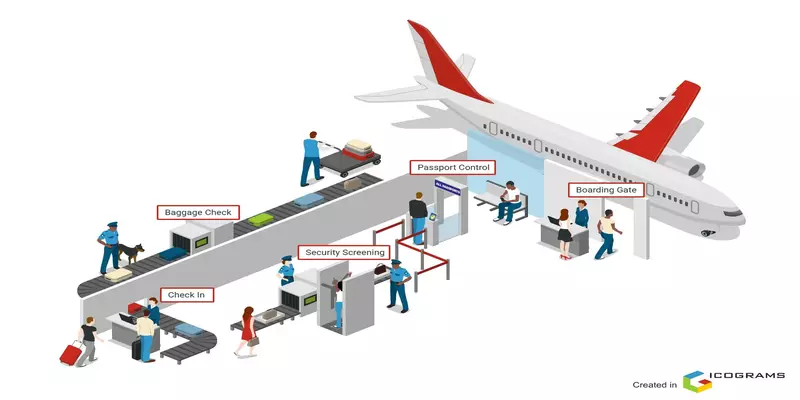
4.1 Airport Arrival and Terminal Entrance
The passenger journey usually begins before entering the terminal building.
Passengers arriving by private vehicle, taxi, bus, or train need clear information about:
- Departure and arrival entrances.
- Terminal identification.
- Airline check-in areas.
- Parking facilities.
- Passenger drop-off zones.
- Accessible entrances.
External signage should be visible early enough for drivers to make safe decisions without sudden lane changes.
Airport roads, parking areas, and terminal entrances should use a coordinated directional system.
4.2 Check-In and Baggage Drop-Off
Check-in is one of the first major operational stages of departure.
Passengers must identify the correct airline counter, check-in zone, or self-service facility.
A good airport wayfinding strategy should provide clear information about:
- Airline check-in locations.
- Counter number ranges.
- Business-class and priority check-in.
- Economy-class check-in.
- Self-service kiosks.
- Baggage drop-off counters.
- Special assistance facilities.
Airports with multiple airlines should ensure that counter allocation information is easy to identify.
For example, instead of displaying only a general check-in message, signs can direct passengers toward clearly numbered counter zones.
Electronic information displays can provide additional information when airline counter allocations change.
4.3 Security Screening and Immigration
After check-in, passengers must locate security screening and, where applicable, immigration facilities.
These areas require particularly clear directions because passenger movement is often controlled and operational procedures may differ according to the journey.
An effective navigation system should identify:
- Security screening entrances.
- Priority or eligible passenger lanes.
- Immigration counters.
- Transit security facilities.
- Restricted access areas.
- Accessible routes.
Airports must also coordinate passenger information with applicable security procedures and local regulations.
Wayfinding signs should never encourage passengers to enter restricted areas or bypass required screening procedures.
4.4 Departure Lounge and Boarding Gates
Once passengers complete the required formalities, they need to reach the departure lounge and their assigned boarding gate.
This is where clear directional information becomes especially important.
A well-planned airport wayfinding strategy should provide:
- Gate numbers and letter identification.
- Directional arrows.
- Estimated walking distances where useful.
- Escalator and lift directions.
- Terminal transfer information.
- Accessible routes.
- Updated gate changes.
Consider a passenger whose gate changes from A5 to C12 shortly before boarding.
If the new information is displayed clearly and consistently across flight information screens and announcements, the passenger can adjust the route without unnecessary confusion.
4.5 Arrival and Baggage Reclaim
Arriving passengers need a different set of navigation instructions.
They should be able to identify the correct route toward:
- Immigration.
- Baggage reclaim.
- Customs.
- Arrivals halls.
- Passenger meeting points.
- Airport exits.
- Ground transportation.
For international arrivals, clear separation between transit passengers and passengers entering the country is particularly important.
Baggage carousel information should also be displayed prominently and updated when operational arrangements change.
4.6 Ground Transportation and Airport Exit
The final stage of the passenger journey is leaving the airport.
Passengers may need to locate taxis, buses, railway stations, hotel shuttles, car rental facilities, or private pickup areas.
A good airport wayfinding strategy should make these facilities easy to identify.
Separate signs for different transportation options can prevent passengers from gathering in the wrong locations.
For example, a traveler looking for a railway station should not have to ask three different employees before discovering that the train entrance is located on another level.
Clear exit and transportation signage creates a smoother final impression of the airport.
5. How Digital Technology Is Transforming Airport Wayfinding Strategy
Technology is changing the way passengers navigate airports.
Traditional signs remain essential, but modern airports increasingly use digital systems to provide more flexible and personalized information.

5.1 Interactive Airport Navigation Kiosks
Interactive kiosks allow passengers to search for facilities and receive directions.
Depending on the system, passengers may search for:
- Departure gates.
- Airline check-in counters.
- Restaurants.
- Washrooms.
- Prayer rooms.
- Airport lounges.
- Retail outlets.
- Baggage claim areas.
Some systems display terminal maps and provide step-by-step walking directions.
These kiosks are particularly helpful for passengers unfamiliar with the airport.
However, airports should place them in visible and accessible locations and ensure that the information remains current.
5.2 Mobile Airport Navigation Applications
Mobile applications can provide passengers with airport information before and during their journey.
A well-developed airport application may include:
- Interactive terminal maps.
- Gate directions.
- Flight status updates.
- Check-in information.
- Security checkpoint guidance.
- Parking information.
- Ground transportation details.
- Restaurant and shopping locations.
Some applications also provide indoor navigation using technologies such as Bluetooth beacons, Wi-Fi positioning, or other location systems.
Indoor positioning can help passengers identify their approximate location inside large terminal buildings.
However, its accuracy depends on the airport infrastructure, device compatibility, environmental conditions, and system configuration.
Airports should also provide alternatives for passengers who do not have smartphones or prefer not to use digital services.
5.3 Real-Time Passenger Navigation
Real-time navigation can make airport wayfinding more responsive.
For example, if a terminal corridor becomes temporarily unavailable because of maintenance, digital systems may direct passengers toward an alternative route.
Similarly, airports can use operational information to communicate:
- Temporary facility closures.
- Changes to passenger access routes.
- Gate changes.
- Terminal transfer arrangements.
- Lift or escalator outages.
- Updated ground transportation locations.
This approach is especially useful in large airports where facilities and passenger routes may change throughout the day.
Real-time systems must be properly maintained and connected to reliable operational information. Incorrect digital directions can be just as frustrating as incorrect physical signs.
5.4 Artificial Intelligence in Airport Wayfinding
Artificial intelligence is creating new opportunities for airport navigation.
AI-powered systems may help passengers find information through conversational interfaces.
For example, a traveler could ask:
“How can I reach Gate B14 from the international departure area?”
A navigation assistant could provide step-by-step instructions based on the airport’s mapped facilities.
Other potential applications include:
- Multilingual passenger assistance.
- Automated responses to common navigation questions.
- Personalized route recommendations.
- Identification of frequently reported navigation problems.
- Analysis of passenger movement patterns.
AI can also help airport management analyze passenger feedback and identify locations where navigation systems may require improvement.
Nevertheless, airports should treat AI as a supporting tool rather than an independent source of operational authority.
Navigation recommendations must be based on accurate maps, current facility information, and approved passenger routes.
5.5 Augmented Reality for Airport Navigation
Augmented reality (AR) combines digital information with a user’s real-world surroundings.
In airport navigation, AR applications may display directional arrows or visual guidance through a smartphone camera.
For example, a passenger could point a mobile device toward a corridor and see an on-screen direction indicating the route to a departure gate.
This technology has potential, particularly in complex terminals.
However, airports should consider practical challenges such as device compatibility, indoor positioning accuracy, lighting conditions, accessibility, and passenger privacy.
AR should complement traditional signs rather than replace essential navigation information.
6. Accessibility and Inclusive Airport Wayfinding
Accessibility is one of the most important parts of an effective airport wayfinding strategy.
Airports serve passengers with different physical abilities, sensory requirements, ages, languages, and levels of familiarity with travel procedures.
A navigation system that works only for passengers who can read small signs, hear announcements, walk long distances, or use smartphones is not truly effective.
6.1 Supporting Passengers with Reduced Mobility
Passengers with reduced mobility may require additional assistance when navigating airport facilities.
Airport wayfinding should clearly identify:
- Accessible entrances.
- Wheelchair routes.
- Elevators.
- Accessible washrooms.
- Priority assistance counters.
- Special assistance points.
- Accessible boarding routes.
Directional signs should lead passengers toward genuinely accessible routes.
For example, directing a wheelchair user toward an escalator without indicating an accessible lift is not helpful navigation.
Airport management should coordinate accessibility information with terminal infrastructure and passenger assistance services.
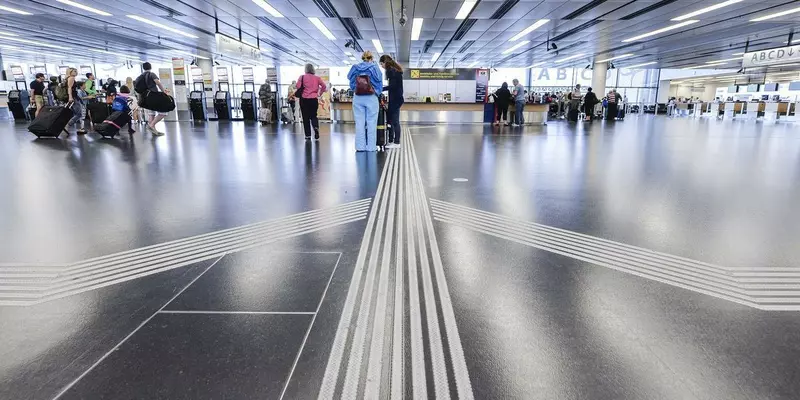
6.2 Helping Passengers with Visual Impairments
Passengers with visual impairments may require alternative navigation methods.
Depending on the applicable accessibility requirements and terminal design, these may include:
- Braille signage.
- Raised or tactile lettering.
- Tactile directional surfaces.
- High-contrast visual information.
- Audio navigation assistance.
- Staff-supported guidance.
Tactile routes should be designed carefully and connected to accessible destinations.
Airports should also ensure that signs and other physical structures do not create unexpected obstacles.
6.3 Supporting Passengers with Hearing Impairments
Passengers with hearing impairments may not receive essential information through audio announcements alone.
Therefore, airport wayfinding should combine audible and visual communication.
Useful features include:
- Visual flight information displays.
- Electronic boarding announcements.
- Written emergency information.
- Clear directional signs.
- Visual alerts where required.
- Staff assistance points.
For example, if a boarding gate changes, passengers should be able to receive the updated information through visual displays rather than relying exclusively on public announcements.
6.4 Multilingual Communication
International airports welcome travelers from different linguistic backgrounds.
Although English is widely used in international aviation, not every passenger understands it comfortably.
A multilingual airport wayfinding strategy may use:
- Recognizable international pictograms.
- Local-language instructions.
- English directional information.
- Additional languages based on passenger demographics.
- Multilingual digital assistance.
However, displaying too much text on a single sign can make information difficult to understand.
The objective should be to provide essential information in a simple, organized format.
6.5 Universal Design Benefits Everyone
Universal design means creating environments that can be used by as many people as possible without requiring unnecessary adaptation.
This approach benefits passengers with disabilities, but it also improves navigation for other travelers.
For example:
- Large, readable signs help elderly passengers and people carrying luggage.
- Step-free routes help wheelchair users and parents with strollers.
- Clear pictograms assist international visitors.
- Tactile guidance supports people with visual impairments.
- Well-lit corridors improve visibility for everyone.
The Canadian Transportation Agency’s airport accessibility guidance also highlights how features such as accessible routes, tactile information, and suitable terminal design can benefit a broad range of travelers.
7. Common Airport Wayfinding Challenges and Their Solutions
Even well-established airports can experience navigation problems.
Some challenges arise from terminal architecture, while others result from outdated information, poor sign placement, passenger behavior, or insufficient coordination between departments.
Understanding these challenges helps airport management develop more effective solutions.
| Common challenge | Practical solution |
| Confusing directional signs | Standardize sign layouts and terminology |
| Poor sign visibility | Review viewing angles, lighting, and placement |
| Inconsistent symbols | Use a coordinated pictogram system |
| Outdated flight information | Improve information-system synchronization |
| Complex terminal layouts | Improve zoning and route identification |
| Language barriers | Introduce multilingual information |
| Accessibility problems | Provide inclusive routes and alternative formats |
| Passenger congestion | Review movement patterns and decision points |
| Temporary route changes | Update digital and physical directions |
| Insufficient staff knowledge | Provide regular wayfinding training |
7.1 Poorly Positioned Signage
A sign may contain accurate information but still fail if passengers cannot see it.
For example, a directional sign placed behind a structural column or above an obstructed corridor may provide little practical value.
Solution: Conduct visibility inspections from actual passenger walking routes. Consider viewing distance, sign height, lighting, glare, and the surrounding architecture.
7.2 Too Much Information on One Sign
Some airports attempt to communicate too many destinations through a single sign.
The result can be a crowded display that passengers struggle to understand.
Solution: Prioritize essential information, use clear visual hierarchy, and divide directions into manageable stages.
Passengers should not need to solve a complicated puzzle just to locate a washroom.
7.3 Inconsistent Directional Information
Different departments may use different terminology for the same destination.
For example, one sign may say “Departures,” another may say “Flight Departure Area,” and a third may use a different expression.
Such inconsistencies can create unnecessary uncertainty.
Solution: Develop an airport-wide signage and terminology policy and ensure that all departments follow it.
7.4 Temporary Changes Without Proper Communication
Airport facilities occasionally change because of maintenance, construction, security requirements, or operational adjustments.
If a corridor is closed but existing signs continue directing passengers toward it, confusion is almost guaranteed.
Solution: Introduce a coordinated process for updating temporary signage, digital displays, staff instructions, and passenger announcements.
7.5 Insufficient Staff Knowledge
Airport employees are often the first people passengers approach when they cannot find their destinations.
However, staff members may work in different operational departments and may not know every terminal facility.
Solution: Conduct regular familiarization sessions and provide employees with updated terminal maps and route information.
Conclusion: Better Airport Navigation Starts with Better Planning
An effective airport wayfinding strategy is an essential part of modern airport management and passenger experience development.
Airports are becoming increasingly complex, and passengers expect more convenient, accessible, and reliable travel experiences. Clear directional signs, logical terminal layouts, accurate flight information, digital navigation tools, and well-trained employees all contribute to achieving these expectations.
However, successful airport wayfinding is not simply about installing more signs or introducing the latest technology. It is about understanding passenger behavior, identifying navigation difficulties, and providing clear information at the right time and place.
Airport operators should focus on developing integrated navigation systems that connect every stage of the passenger journey, from terminal arrival to final departure or airport exit.
They should also remember that technology works best when supported by accurate information, accessible infrastructure, and knowledgeable employees.
Ultimately, passengers should spend their time enjoying their journey rather than searching for their departure gate.
The best airport wayfinding strategy is one that passengers barely notice because everything is exactly where they expect it to be.
Frequently Asked Questions (FAQs) About Airport Wayfinding Strategy
1. What is an airport wayfinding strategy?
An airport wayfinding strategy is a coordinated system designed to help passengers, visitors, and employees navigate airport facilities efficiently. It combines directional signage, maps, symbols, digital navigation tools, terminal design, and staff assistance to guide people toward their destinations.
2. Why is airport wayfinding strategy important for passenger experience?
Airport wayfinding is important because it helps passengers find essential facilities without unnecessary confusion. Clear navigation can improve passenger confidence, support smoother movement, reduce unnecessary inquiries, and contribute to a more comfortable airport experience.
3. What are the main components of an airport wayfinding system?
The main components include:
- Directional and informational signage.
- Standardized pictograms and symbols.
- Terminal maps and floor plans.
- Flight information display systems.
- Digital navigation applications.
- Accessible routes and tactile information.
- Multilingual communication.
- Passenger assistance services.
Together, these elements create a consistent navigation experience throughout the airport.
4. How does technology improve airport wayfinding strategy?
Technology improves airport wayfinding through interactive kiosks, mobile applications, indoor positioning, real-time information displays, and AI-powered passenger assistance.
These solutions can provide location-specific directions, communicate operational changes, and help passengers locate airport facilities more efficiently. However, physical signage and human assistance remain essential.
5. How can airports improve their wayfinding systems?
Airports can improve their wayfinding systems by assessing existing signage, identifying passenger navigation problems, standardizing directional information, improving terminal maps, introducing accessible navigation solutions, and training frontline employees.
Regular passenger feedback and operational performance assessments can help airport management identify areas that require further improvement.
Facebook: https://www.facebook.com/rehan.ghauri
