

Emergency response drills are structured exercises that prepare employees, emergency teams, and organizations to handle unexpected incidents safely and efficiently. This guide explores their importance, different exercise formats, planning procedures, airport-specific scenarios, employee responsibilities, performance evaluation, common mistakes, and emerging technologies.
Readers will also learn how to develop an emergency response drill program, measure its effectiveness, and turn lessons from exercises into practical safety improvements.
Table of Contents
Introduction: Why Emergency Response Drills Matter More Than Ever in 2026
Imagine a busy international airport during the afternoon rush. Hundreds of passengers are checking in, aircraft are arriving and departing, ground-handling teams are managing baggage, and airport operations staff are coordinating multiple activities.
Suddenly, an emergency alarm sounds.
A fire has been reported near an airport facility, and several departments must respond immediately.
Airport fire and rescue services need accurate information. Security personnel must control access to the affected area. Airport operations must coordinate the response, while airline representatives need to account for potentially affected passengers and employees.
What happens next?
If everyone understands their responsibilities, communication channels work properly, and emergency procedures have been practiced, the response is more likely to be organized.
However, if employees are unfamiliar with their duties, confusion can quickly develop.
This is precisely why emergency response drills are essential.
An emergency response drill is a planned activity designed to test how individuals, teams, and organizations react to a simulated emergency. These exercises help identify operational weaknesses, improve communication, strengthen coordination, and prepare personnel for situations where every second matters.
In aviation, emergency preparedness is particularly important because airports bring together multiple organizations with different responsibilities. Airlines, airport authorities, ground handlers, security agencies, air traffic services, medical teams, and rescue organizations must often work together during critical incidents.
The objective is not simply to demonstrate that an organization can conduct a successful exercise. It is to establish whether its people, procedures, equipment, and communication systems can work together when an actual emergency occurs.
The best emergency response drill is not necessarily the one that looks perfect. It is the one that identifies problems and helps the organization correct them.
1. What Are Emergency Response Drills?
Emergency response drills are organized training exercises that simulate potential emergencies to evaluate how effectively people and organizations respond to unexpected situations.
These exercises allow participants to practice emergency procedures in a controlled environment without exposing people to the dangers of a real incident.
The scenarios may involve:
- Aircraft accidents and emergency landings.
- Fire outbreaks in airport terminals or operational buildings.
- Passenger evacuation situations.
- Medical emergencies and mass-casualty incidents.
- Security threats and suspicious packages.
- Chemical spills and hazardous material incidents.
- Severe weather conditions.
- Power failures and critical infrastructure disruptions.
- Natural disasters, including earthquakes and floods.
- Communication failures and operational disruptions.
The complexity of emergency response drills depends on the organization’s size, operational risks, available resources, and regulatory requirements.
For example, a small office may conduct a straightforward evacuation exercise, while an international airport may organize a large-scale emergency simulation involving aircraft rescue and firefighting services, police, ambulance teams, airport management, airlines, and other agencies.
Emergency Response Drills vs. Emergency Response Training
Although these terms are closely related, they are not exactly the same.
Emergency response training generally provides employees with the knowledge and skills required to perform emergency responsibilities.
Emergency response drills allow participants to apply those skills in simulated situations.
Consider an airport employee who has attended fire safety training and understands how to operate an emergency alarm.
During an actual drill, the employee must demonstrate whether they can recognize the alarm, follow the correct procedure, communicate with supervisors, and evacuate safely.
The difference is simple:
- Training teaches employees what to do.
- Drills allow employees to practice what they have learned.
- Evaluations determine whether the procedures are effective.
Organizations need all three elements to establish a meaningful emergency preparedness program.
2. Why Are Emergency Response Drills Important?
Emergency response drills are not simply administrative activities or exercises conducted to satisfy inspection requirements. They are essential tools for protecting people, facilities, equipment, and business operations.
A well-organized drill can reveal problems that might otherwise remain unnoticed until an actual emergency occurs.
Let’s explore their major benefits.
2.1 Improve Employee Readiness
Employees are often the first people to recognize an emergency.
A passenger service agent may notice smoke near a boarding gate. A baggage handler may identify an unusual incident on the ramp. A security officer may discover an unattended suspicious package.
These employees must understand how to report the situation and follow the appropriate emergency procedures.
Regular emergency response drills help employees:
- Recognize emergency alarms and warning signals.
- Understand evacuation routes and assembly points.
- Identify their responsibilities during different incidents.
- Communicate accurate information to supervisors.
- Avoid unsafe actions and unnecessary risks.
- Respond calmly under pressure.
Employees who have practiced emergency procedures are generally better prepared to respond than those who have only read instructions in a manual.
2.2 Strengthen Communication and Coordination
Communication failures can seriously affect emergency response operations.
Imagine an airport incident where the fire and rescue team receives one location, airport security receives another, and the operations control center is working with outdated information.
Even experienced emergency responders may struggle if information is incomplete or inconsistent.
Emergency response drills help test communication arrangements between departments and external agencies.
They can evaluate:
- Radio communication systems.
- Emergency telephone numbers.
- Incident reporting procedures.
- Command-center communication.
- Information-sharing protocols.
- Escalation procedures.
- Coordination between internal and external response teams.
For airport operations managers, this is particularly important because emergency response usually involves several departments working simultaneously.
2.3 Identify Weaknesses Before a Real Emergency
One of the greatest benefits of emergency response drills is identifying operational gaps before they become serious problems.
For example, a fire evacuation drill may reveal that:
- An emergency exit is obstructed.
- Employees are unfamiliar with the nearest assembly point.
- An alarm cannot be heard in certain areas.
- Evacuation wardens do not understand their responsibilities.
- Employee headcounts take longer than expected.
- Emergency responders cannot access a designated area.
These findings provide opportunities to improve procedures, equipment, and employee awareness.
Identifying a problem during a controlled exercise is far better than discovering it during an actual emergency.
2.4 Protect Passengers, Employees, and Visitors
Passenger safety is a major responsibility of airport management.
During an emergency, passengers may become confused, frightened, or unable to understand instructions. Some may require additional assistance because of disabilities, injuries, language barriers, or medical conditions.
Emergency response drills help employees practice providing clear instructions and supporting passengers during evacuations.
They also help organizations evaluate arrangements for:
- Children traveling without accompanying adults.
- Elderly passengers.
- Passengers with reduced mobility.
- Individuals requiring medical assistance.
- Visitors unfamiliar with airport facilities.
- Passengers who do not understand the local language.
Emergency preparedness should never assume that everyone can evacuate independently at the same speed.
2.5 Maintain Operational Continuity
An emergency may interrupt airport operations even when the incident is limited to one terminal, building, or operational area.
Airport managers must understand how to protect unaffected operations while emergency teams manage the incident.
Emergency response drills help organizations practice:
- Activating business continuity arrangements.
- Relocating essential personnel.
- Protecting critical operational information.
- Managing temporary facility closures.
- Coordinating with airlines and airport stakeholders.
- Restoring affected services.
- Communicating operational changes.
Effective emergency management is not limited to controlling an incident. It also includes preparing the organization to recover safely.
2.6 Support Regulatory Compliance
Many industries operate under regulatory requirements that address emergency planning, employee responsibilities, training, and exercise frequency.
However, requirements differ according to the country, industry, facility, and applicable regulatory framework.
For example, the International Civil Aviation Organization (ICAO) addresses aerodrome emergency planning through Annex 14, Volume I.
ICAO’s framework includes provisions for testing aerodrome emergency plans through full-scale exercises and partial exercises or an alternative modular testing approach, with specific intervals.
In the United States, OSHA’s emergency preparedness guidance explains the importance of workplace evacuation procedures, trained personnel, designated assembly locations, and periodic evacuation drills.
Organizations should always verify the current requirements applicable to their location instead of assuming that one international guideline automatically applies everywhere.
3. Different Types of Emergency Response Drills
Not every emergency requires the same exercise format.
Some situations can be evaluated through a meeting-room discussion, while others require practical demonstrations involving emergency equipment, employees, and external response agencies.
Emergency response drills are generally organized into discussion-based and operations-based exercises.
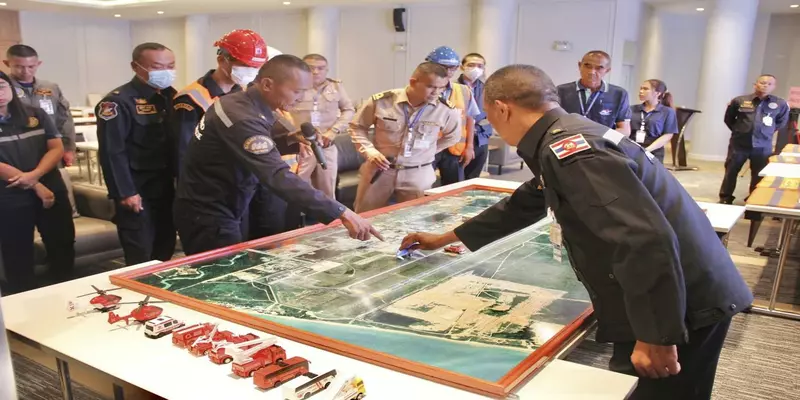
3.1 Tabletop Exercises
A tabletop exercise is a discussion-based activity in which participants review a simulated emergency scenario and explain how they would respond.
It usually takes place in a meeting room, where a facilitator introduces different developments in the scenario.
For example, airport managers may receive the following situation:
An aircraft reports a technical problem shortly before landing. The airport must prepare emergency services while coordinating with air traffic services, airline representatives, medical teams, and airport security.
Participants discuss their responsibilities and explain the actions they would take.
What does a tabletop exercise evaluate?
- Understanding of emergency procedures.
- Decision-making responsibilities.
- Communication arrangements.
- Coordination between departments.
- Leadership and incident management.
- Knowledge of emergency escalation procedures.
Tabletop exercises are relatively inexpensive and useful for testing policies, plans, and decision-making processes.
They are particularly suitable when an organization introduces a new emergency plan or wants to familiarize senior management with incident responsibilities.
3.2 Functional Exercises
A functional exercise tests specific emergency management functions without necessarily involving a complete physical simulation.
For example, an airport may activate its emergency operations center to simulate an aircraft accident.
Participants communicate using designated channels, exchange information, allocate resources, and coordinate response activities.
However, the aircraft rescue operation itself may not physically take place.
Functional exercises are useful for evaluating:
- Emergency operations center activation.
- Incident reporting.
- Command and control arrangements.
- Resource allocation.
- Information management.
- Coordination between departments.
- Management decision-making.
These exercises are particularly valuable for organizations that want to test operational systems without the cost and complexity of a full-scale simulation.
3.3 Full-Scale Emergency Response Drills
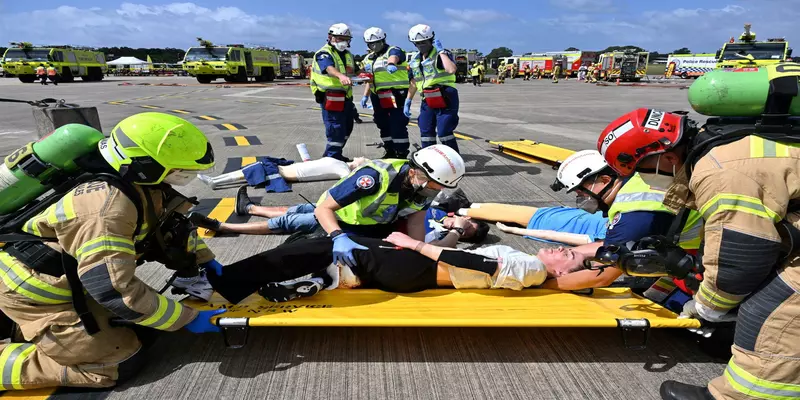
A full-scale exercise is one of the most comprehensive forms of emergency response drills.
It involves realistic simulated emergency activities, personnel deployment, equipment, and coordination between participating agencies.
At an airport, a full-scale exercise may simulate an aircraft accident involving:
- Airport fire and rescue services.
- Airport operations personnel.
- Police and security agencies.
- Ambulance and medical services.
- Airline representatives.
- Ground-handling companies.
- Emergency management authorities.
- Other relevant airport stakeholders.
Participants may practice responding to the simulated incident, establishing command arrangements, managing casualties, controlling access, and coordinating recovery activities.
Full-scale exercises help evaluate the overall effectiveness of an airport emergency plan.
However, they require detailed planning, risk assessment, safety controls, stakeholder coordination, and appropriate authorization.
3.4 Partial Emergency Response Drills
Partial exercises focus on specific components of an emergency response plan.
For example, an airport may conduct an exercise that tests only the communication arrangements between the airport operations center and emergency services.
Other examples include:
- Testing emergency alarm systems.
- Practicing passenger evacuation.
- Evaluating medical response arrangements.
- Testing emergency access routes.
- Checking the availability of emergency equipment.
- Practicing incident notification procedures.
Partial exercises are useful because organizations can concentrate on areas that require improvement without organizing a large-scale event every time.
3.5 Evacuation Drills

Evacuation drills prepare people to leave buildings or designated areas safely during emergencies.
These exercises may involve airport terminals, offices, warehouses, maintenance facilities, aircraft-related facilities, and other workplaces.
An effective evacuation drill should evaluate:
- How quickly an emergency alarm is recognized.
- Whether evacuation instructions are understood.
- Whether designated routes are accessible.
- Whether employees assist passengers requiring additional support.
- Whether assembly points are suitable.
- Whether headcounts and accountability procedures work.
- Whether emergency responders can access the affected area.
Evacuation drills should be designed around actual building layouts and potential hazards.
Employees should not be encouraged to use unsafe shortcuts or elevators where the emergency procedure prohibits their use.
3.6 Fire Emergency Drills
Fire drills prepare employees to respond to fire-related incidents.
Depending on the organization’s emergency plan, participants may practice:
- Recognizing fire alarms.
- Reporting smoke or fire.
- Activating emergency notification systems.
- Evacuating affected areas.
- Contacting fire and rescue services.
- Maintaining safe access routes.
- Supporting evacuation wardens.
- Reporting missing or unaccounted-for individuals.
Only appropriately trained and authorized personnel should operate firefighting equipment or attempt fire suppression, and only when conditions and procedures permit.
The primary objective for ordinary employees is usually to raise the alarm, follow evacuation instructions, and protect themselves and others.
3.7 Medical Emergency Drills
Medical emergency exercises prepare personnel to respond when someone experiences a serious medical problem.
For example, a passenger may collapse inside an airport terminal, requiring immediate assistance.
The exercise may test:
- How the incident is reported.
- Whether trained first-aid personnel are available.
- How medical responders are contacted.
- Whether the location is communicated accurately.
- How access is maintained for medical teams.
- How the affected person is supported.
- Whether the incident is documented appropriately.
Medical drills should be designed with qualified healthcare professionals and follow applicable clinical protocols.
3.8 Security Emergency Drills
Security-related emergency response drills prepare employees for incidents such as suspicious packages, unauthorized access, security breaches, and credible threats.
Depending on the approved security program, exercises may evaluate:
- Incident reporting.
- Access control.
- Communication with security authorities.
- Safe isolation of affected areas.
- Crowd management.
- Coordination with law enforcement.
- Protection of passengers and employees.
Sensitive security procedures should be handled through authorized airport security channels rather than publicly disclosed exercise material.
4. Emergency Response Drills in Airport Operations
Airports are among the most complex operational environments because they involve multiple organizations, interconnected systems, and large numbers of passengers.
An emergency in one operational area can affect other departments within minutes.
For example, an incident on the apron may require immediate coordination between airport operations, airline representatives, ground-handling teams, air traffic services, security personnel, and emergency responders.
This makes airport emergency response drills especially important.
4.1 Aircraft Accident Simulation
Aircraft accident exercises are among the most significant emergency preparedness activities at airports.
A simulated accident may involve an aircraft experiencing an emergency during landing, an incident on the runway, or another scenario identified through airport risk assessments.
The exercise may evaluate:
- Emergency notification procedures.
- Activation of the airport emergency plan.
- Fire and rescue mobilization.
- Medical response coordination.
- Incident command arrangements.
- Casualty management.
- Airport access control.
- Communication with airlines and other agencies.
The main objective is to establish whether the participating organizations can work together under realistic operational conditions.
4.2 Airport Terminal Fire Simulation
A terminal fire scenario can test the ability of airport employees to manage passenger safety while coordinating emergency services.
During this exercise:
- The simulated fire is reported.
- Emergency notification procedures are activated.
- Relevant personnel follow evacuation arrangements.
- Airport security manages access as directed.
- Emergency services respond.
- Passenger accountability procedures are tested.
- Airport management evaluates operational disruption.
A particularly important element is communication with passengers.
Clear instructions can reduce confusion and help prevent unnecessary crowd movement.
4.3 Aircraft Emergency Landing Preparation
An aircraft may declare an emergency because of a technical malfunction, medical issue, or another operational concern.
Airport emergency response drills can test how departments prepare for such an event.
The exercise may involve:
- Receiving the emergency notification.
- Activating relevant emergency procedures.
- Coordinating with air traffic services.
- Preparing airport rescue and firefighting services.
- Notifying medical and security teams.
- Coordinating with airline representatives.
- Preparing relevant operational resources.
The response must follow the airport’s approved emergency plan and the instructions of the appropriate authorities.
4.4 Ground-Handling Emergency Scenarios
Ground-handling operations involve aircraft turnaround activities, passenger services, baggage handling, ramp operations, and coordination with multiple stakeholders.
An emergency involving ground-handling activities can create safety risks and operational disruption.
Examples include:
- Ground support equipment incidents.
- Personnel injuries on the apron.
- Fuel-related emergencies.
- Baggage-area fires.
- Vehicle collisions.
- Equipment malfunctions.
- Aircraft damage discovered during ground operations.
Emergency response drills help ground-handling supervisors and employees understand how to report incidents, stop unsafe activities, coordinate with airport authorities, and support emergency responders.
For example, if a ground-handling employee identifies a serious incident involving equipment near an aircraft, the employee should follow the relevant reporting and emergency procedures rather than attempting an unauthorized intervention.
4.5 Emergency Coordination Between Airport Departments
An airport emergency response depends on effective coordination.
Different departments have different responsibilities, but their activities must support one common objective: protecting lives and managing the incident safely.
| Department | Typical emergency responsibilities |
| Airport Operations | Operational coordination and emergency plan activation as assigned |
| Fire and Rescue | Firefighting and rescue operations |
| Airport Security | Access control and security coordination |
| Airline Representatives | Aircraft and passenger-related information |
| Ground Handling | Ground operations support and incident reporting |
| Medical Services | Medical assessment and emergency treatment |
| Air Traffic Services | Relevant aviation operational coordination |
| Emergency Operations Center | Information management and coordination |
| Public Relations | Authorized public and media communication |
Actual responsibilities must be defined in the airport emergency plan and applicable procedures.
A successful exercise ensures that participants understand where their responsibilities begin and where coordination with other agencies becomes necessary.
5. How to Plan Effective Emergency Response Drills
Conducting an emergency exercise without proper planning can create confusion, unnecessary operational disruption, and even safety risks.
An effective emergency response drill requires clear objectives, appropriate participants, realistic scenarios, suitable resources, and a structured evaluation process.
Here is a practical approach organizations can follow.
Step 1: Conduct an Emergency Risk Assessment
Before designing emergency response drills, organizations should identify the hazards that could affect their operations.
A risk assessment helps determine which emergencies deserve attention and what capabilities need testing.
For an airport, potential hazards may include:
- Aircraft accidents.
- Terminal fires.
- Dangerous goods incidents.
- Severe weather.
- Medical emergencies.
- Security-related incidents.
- Utility failures.
- Infrastructure damage.
- Ground-handling accidents.
Risk assessments should consider the likelihood of an incident, its potential consequences, existing safety controls, and the organization’s ability to respond.
The results should guide exercise priorities.
For example, an airport with significant exposure to severe weather may prioritize exercises involving weather-related operational disruptions and emergency coordination.
Step 2: Establish Clear Exercise Objectives
Every emergency response drill should have measurable objectives.
Without clear objectives, participants may complete an exercise without knowing what they were expected to demonstrate.
Objectives should explain exactly what the exercise intends to evaluate.
Examples include:
- Test emergency notification procedures.
- Evaluate the activation of the emergency operations center.
- Assess communication between airport departments.
- Examine passenger evacuation arrangements.
- Evaluate the availability of emergency resources.
- Test coordination with external response agencies.
- Assess incident reporting and information management.
A useful objective should be specific enough to evaluate.
For instance, instead of writing “improve communication,” an organization could establish the objective of evaluating whether designated departments receive, acknowledge, and correctly communicate emergency notifications through approved channels.
Step 3: Develop a Realistic Emergency Scenario
The scenario should reflect the organization’s actual risks and operating environment.
For an airport, planners might select an aircraft emergency, terminal fire, medical incident, or ground-handling accident.
A realistic scenario should include:
- A clearly defined starting situation.
- The location and nature of the simulated incident.
- Participating departments.
- Expected response activities.
- Possible developments during the exercise.
- Safety arrangements.
- Evaluation criteria.
Scenarios should be challenging enough to test capabilities without introducing unnecessary hazards.
The exercise should test the emergency plan rather than simply encourage participants to guess what the exercise organizers want to see.
Step 4: Identify Participants and Assign Responsibilities
An effective exercise requires participation from the people and organizations responsible for emergency response.
Depending on the scenario, participants may include:
- Airport management.
- Airport operations officers.
- Fire and rescue personnel.
- Airport security.
- Airline representatives.
- Ground-handling supervisors.
- Medical response teams.
- Maintenance personnel.
- External emergency services.
- Communications representatives.
Each participant should understand their responsibilities before the exercise begins.
Organizers should also identify exercise controllers, observers, evaluators, and safety officers.
These roles should be clearly separated where necessary so that exercise management does not interfere with real emergency response responsibilities.
Step 5: Prepare Equipment and Communication Systems
Emergency response drills should evaluate whether the resources required for an effective response are available and functional.
Depending on the exercise, these may include:
- Emergency communication equipment.
- Radios and approved telephone systems.
- First-aid supplies.
- Emergency lighting.
- Evacuation equipment.
- Personal protective equipment.
- Emergency vehicles.
- Warning and notification systems.
- Incident reporting documents.
Equipment should be inspected and used only by authorized personnel.
Any exercise involving operational equipment, vehicles, aircraft facilities, or restricted areas must have suitable controls and approvals.
Step 6: Conduct a Safety Briefing
Safety must remain the highest priority throughout the exercise.
Before starting, organizers should explain:
- The purpose and scope of the exercise.
- The simulated nature of the incident.
- Areas included in the exercise.
- Participant responsibilities.
- Emergency stop procedures.
- Communication arrangements.
- Real-world emergency reporting procedures.
- Restrictions on equipment and vehicle movement.
All participants must understand how to distinguish an exercise-related message from an actual emergency notification.
If a real emergency occurs, exercise activities must be stopped or managed according to the organization’s approved procedures.
Step 7: Conduct the Exercise
Once the planning and safety arrangements are complete, the exercise can begin.
Exercise controllers introduce the scenario, while participants respond according to their assigned responsibilities.
Observers should monitor actual performance rather than relying on assumptions.
For example, during an airport evacuation drill, evaluators may examine whether employees recognize the alarm, follow designated routes, assist passengers, and report missing individuals.
The purpose is to understand how the emergency plan works in practice.
Step 8: Evaluate Performance and Record Findings
An emergency response drill should never end simply because the simulated incident has been completed.
The evaluation process is where organizations identify what worked, what failed, and what needs improvement.
Evaluators should document:
- Effective practices.
- Communication problems.
- Delayed response activities.
- Resource shortages.
- Unclear responsibilities.
- Equipment deficiencies.
- Training gaps.
- Procedural weaknesses.
These findings should be supported by observations and evidence wherever possible.
Step 9: Develop and Implement an Improvement Plan
The final step is converting exercise findings into corrective actions.
Each identified weakness should have:
- A clear description.
- An assigned responsible person or department.
- A proposed corrective action.
- A priority level.
- A target completion date.
- A verification method.
For example, if an exercise reveals that employees are unfamiliar with an emergency assembly point, the organization may update its communication material and conduct additional training.
The responsible department should then verify whether the corrective action has solved the problem.
This creates a continuous improvement cycle instead of treating every drill as a one-day event.
FEMA’s Homeland Security Exercise and Evaluation Program (HSEEP) provides a useful framework for exercise design, conduct, evaluation, and improvement planning.
6. Ten Important Emergency Response Drill Scenarios for 2026
Organizations should select scenarios according to their specific hazards and operational responsibilities.
The following examples provide a practical starting point for airport and workplace emergency preparedness programs.
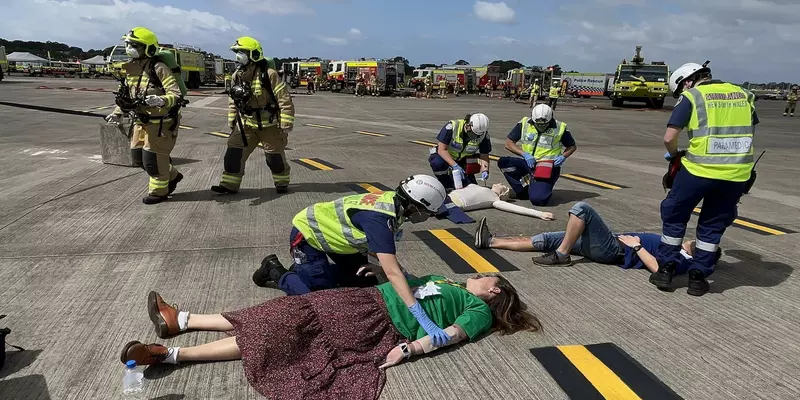
1. Aircraft Accident Response Drill
Simulate an aircraft accident to evaluate airport emergency plan activation, rescue coordination, medical response, and communication between participating agencies.
2. Airport Terminal Fire Drill
Practice emergency notification, evacuation, passenger assistance, fire-service coordination, and accountability procedures.
3. Medical Emergency Response Drill
Simulate a passenger or employee experiencing a medical emergency to evaluate reporting, access for medical responders, and coordination with trained first-aid personnel.
4. Passenger Evacuation Drill
Evaluate whether passengers and employees can follow designated evacuation arrangements safely and reach the appropriate assembly areas.
5. Ground-Handling Equipment Accident Drill
Simulate an incident involving ground support equipment to test reporting procedures, operational coordination, and employee safety arrangements.
6. Hazardous Materials Response Drill
Practice the reporting, isolation, notification, and coordination arrangements for a simulated hazardous materials incident. Specialized response must be handled by appropriately trained and authorized teams.
7. Severe Weather Emergency Drill
Test how airport departments coordinate during severe weather conditions, including emergency notifications, resource readiness, and operational continuity.
8. Security Incident Response Drill
Evaluate reporting, access control, coordination with authorized security agencies, and protection of passengers and employees.
9. Power Failure Response Drill
Simulate a failure affecting essential airport facilities to assess backup arrangements, emergency communication, and continuity procedures.
10. Mass-Casualty Incident Drill
Simulate an incident involving multiple casualties to evaluate coordination between medical teams, emergency responders, airport management, and relevant external agencies.
These scenarios should not be copied without modification. Every organization should adapt them to its facilities, risk assessment, emergency plan, and regulatory obligations.
7. How Often Should Emergency Response Drills Be Conducted?
There is no single exercise frequency that applies to every organization.
The appropriate schedule depends on applicable regulations, operational risks, facility requirements, employee responsibilities, and the complexity of the emergency plan.
However, certain aviation frameworks provide specific exercise intervals.
ICAO Aerodrome Emergency Exercise Framework
ICAO Annex 14, Volume I, addresses aerodrome emergency plan testing through two approaches:
Approach A:
- A full-scale aerodrome emergency exercise at intervals not exceeding two years.
- Partial emergency exercises in the intervening year to ensure that deficiencies identified during the full-scale exercise have been corrected.
Approach B:
- A series of modular tests beginning in the first year.
- Completion with a full-scale aerodrome emergency exercise at intervals not exceeding three years.
The emergency plan should also be reviewed following exercises and actual emergencies to correct identified deficiencies.
The European Union Aviation Safety Agency’s March 2026 Easy Access Rules for Aerodromes also describe full-scale exercises at intervals not exceeding two years and partial exercises in the intervening year.
These aviation provisions should not be confused with general workplace evacuation drill requirements.
A Practical Emergency Drill Schedule
Organizations can use the following example as an internal planning framework, subject to applicable regulatory requirements.
| Exercise | Suggested planning frequency |
| Emergency evacuation | According to workplace requirements and risk assessment |
| Fire emergency exercise | According to applicable fire safety rules |
| Medical emergency exercise | Based on medical response risks |
| Communication testing | At planned intervals and after system changes |
| Tabletop exercise | Annually or when significant changes occur |
| Partial airport exercise | According to the approved airport emergency plan |
| Full-scale airport exercise | According to applicable aviation requirements |
| Corrective action verification | Following identified deficiencies |
The important point is consistency.
An organization should not wait until the next major inspection to discover that its emergency preparedness program has become outdated.
8. Roles and Responsibilities During Emergency Response Drills
Successful emergency response drills depend on people understanding their responsibilities.
Even a well-written emergency plan can fail when employees do not know who should make decisions, who should communicate information, or who should coordinate specific activities.
Emergency Response Coordinator
The emergency response coordinator generally helps organize the exercise and ensures that activities follow the approved exercise plan.
Typical responsibilities include:
- Coordinating exercise preparations.
- Confirming participant involvement.
- Reviewing exercise objectives.
- Arranging briefings.
- Coordinating with relevant departments.
- Ensuring exercise documentation is available.
Airport Operations Manager
Airport operations managers play an important role in maintaining operational coordination.
Depending on the airport emergency plan, their responsibilities may include:
- Coordinating airport operational information.
- Supporting emergency plan activation.
- Communicating with relevant departments.
- Monitoring operational disruptions.
- Coordinating resources.
- Supporting recovery arrangements.
Emergency Response Teams
Emergency response personnel perform specialist duties according to their training, authorization, and operational procedures.
These may include firefighting, rescue, medical response, security support, and incident management.
Ground-Handling Supervisors
Ground-handling supervisors must ensure their teams understand the applicable emergency procedures.
Their responsibilities may include:
- Briefing employees.
- Reporting incidents.
- Supporting operational safety arrangements.
- Coordinating with airport operations.
- Ensuring staff follow authorized instructions.
- Identifying equipment or manpower issues.
General Employees
Employees should understand how to recognize emergencies, raise alarms, report incidents, and follow the instructions relevant to their roles.
They should never assume that emergency response is exclusively the responsibility of specialist teams.
9. Common Mistakes Organizations Make During Emergency Response Drills
Not every exercise produces meaningful improvements.
Sometimes organizations focus too much on completing the activity and too little on evaluating actual performance.
Here are some common mistakes that reduce the effectiveness of emergency response drills.
Mistake 1: Conducting Drills Only for Inspection Purposes
An organization may conduct an exercise simply because an inspection or audit is approaching.
This approach misses the real purpose of emergency preparedness.
Better approach: Develop a regular exercise program based on actual operational risks and measurable safety objectives.
Mistake 2: Repeating the Same Scenario Every Time
If employees practice only one type of emergency, they may become familiar with that particular scenario without developing broader emergency awareness.
Better approach: Introduce different scenarios based on risk assessments, previous incidents, and identified weaknesses.
Mistake 3: Ignoring Communication Problems
Organizations sometimes concentrate on physical response activities while overlooking communication failures.
Better approach: Include communication systems, notification arrangements, escalation procedures, and information-sharing responsibilities in exercise objectives.
Mistake 4: Failing to Involve Relevant Departments
An exercise may appear successful because one department performs well, even though other participating organizations have not been properly tested.
Better approach: Involve relevant internal departments and external agencies according to the scenario and emergency plan.
Mistake 5: Not Recording Exercise Findings
Verbal discussions are useful, but they are not enough to establish accountability.
Better approach: Record observations, assign corrective actions, and monitor progress.
Mistake 6: Neglecting New Employees
New employees may have little knowledge of emergency arrangements.
Better approach: Include emergency awareness in induction training and provide role-specific instruction when responsibilities change.
Mistake 7: Ignoring Passengers with Special Assistance Requirements
Evacuation arrangements may not adequately consider people who need additional assistance.
Better approach: Include accessibility considerations, assistance responsibilities, and suitable evacuation arrangements in planning and evaluation.
Mistake 8: Treating the Exercise as Complete Without Follow-Up
A drill may reveal several weaknesses, but those problems remain unresolved if nobody takes responsibility for correcting them.
Better approach: Use a documented improvement plan and verify corrective actions through follow-up exercises or inspections.
10. Measuring the Effectiveness of Emergency Response Drills
How can an organization determine whether its emergency response drills are successful?
The answer should not depend entirely on how quickly the exercise finishes.
Speed is important in emergency management, but a fast response that creates additional risks is not necessarily a successful response.
Organizations should evaluate several performance indicators.
Important Emergency Drill Performance Indicators
| Performance indicator | What it measures |
| Alarm recognition | Whether personnel recognize emergency notifications |
| Notification effectiveness | Whether the correct people receive relevant information |
| Communication accuracy | Whether information is clear and consistent |
| Response coordination | Whether departments work together effectively |
| Procedure compliance | Whether participants follow approved procedures |
| Resource availability | Whether required equipment and personnel are available |
| Accountability | Whether affected individuals can be accounted for |
| Decision-making | Whether responsible personnel make appropriate decisions |
| Corrective action completion | Whether identified weaknesses are addressed |
Establishing Meaningful Performance Targets
Organizations may establish internal targets for specific exercise objectives.
For example:
- All designated departments receive the exercise notification.
- Emergency communication procedures are followed correctly.
- Employees use approved evacuation routes.
- Missing-person information is reported accurately.
- Relevant response resources are available.
- Exercise observations are documented.
- Corrective actions are assigned to responsible departments.
Targets should be based on applicable standards, operational requirements, and realistic performance expectations.
Avoid inventing universal response-time targets. A suitable target for one airport or building may be inappropriate for another.
The Importance of After-Action Reports
An After-Action Report (AAR) summarizes what happened during an exercise and evaluates performance against established objectives.
A useful report generally includes:
- Exercise background and objectives.
- Participating departments and organizations.
- Description of the scenario.
- Key observations.
- Strengths and successful practices.
- Areas requiring improvement.
- Corrective actions.
- Responsible departments and follow-up arrangements.
FEMA’s HSEEP approach emphasizes evaluation and improvement planning as essential parts of the exercise cycle.
The report should be constructive and evidence-based.
The objective is to improve organizational performance, not to create a document for blaming individual employees.
11. The Role of Technology in Emergency Response Drills in 2026
Technology is changing how organizations prepare for emergencies.
Modern emergency preparedness programs can use digital systems to improve communication, scenario development, performance monitoring, and training.
11.1 Virtual Reality Training
Virtual reality can create simulated environments where participants practice recognizing hazards and making decisions.
For example, airport employees may experience a simulated terminal evacuation or emergency reporting scenario.
VR training can be particularly useful for familiarization and repetitive learning without requiring a full-scale exercise each time.
However, virtual simulations cannot replace practical exercises where physical equipment, evacuation routes, and interagency coordination must be tested.
11.2 Digital Emergency Management Systems
Digital emergency management systems can help organizations manage incident information, contact lists, resource allocation, and response coordination.
Depending on the system, they may support:
- Emergency notifications.
- Incident reporting.
- Personnel accountability.
- Resource tracking.
- Documentation.
- Operational status updates.
Organizations must ensure that digital systems have suitable backup arrangements and cybersecurity protections.
A system that becomes unavailable during a power or network failure should not be the organization’s only means of emergency communication.
11.3 Artificial Intelligence and Scenario Development
Artificial intelligence can support exercise planners by helping generate alternative scenarios, identify possible decision points, and organize evaluation information.
For example, planners could use AI-assisted tools to create different versions of a simulated airport disruption.
However, AI-generated scenarios and recommendations must be reviewed by qualified personnel.
They should never replace approved emergency plans, specialist judgment, or regulatory requirements.
11.4 Real-Time Communication Tools
Modern communication platforms can support information sharing between authorized emergency response personnel.
They may improve the distribution of notifications, operational updates, and exercise instructions.
However, organizations must define approved communication channels and ensure that sensitive information is handled appropriately.
11.5 Data-Based Performance Evaluation
Digital records can help organizations identify recurring problems across multiple exercises.
For example, if several exercises reveal delays in emergency notification, managers can investigate the underlying communication arrangements.
This allows emergency response drills to become part of a measurable safety improvement program.
12. How to Build a Strong Emergency Preparedness Culture
Emergency preparedness should not be limited to safety officers or emergency response teams.
It should become part of everyday organizational culture.
In an airport environment, employees from different departments may encounter hazards during routine activities. Their ability to recognize and report those hazards can make a significant difference.
Organizations can strengthen preparedness through the following practices.
Make Emergency Awareness Part of Employee Induction
New employees should receive information about relevant alarms, reporting procedures, evacuation arrangements, and their assigned responsibilities.
Conduct Regular Safety Briefings
Supervisors should include emergency preparedness topics in appropriate departmental briefings.
Encourage Employees to Report Hazards
Employees should feel comfortable reporting unsafe conditions, blocked exits, damaged equipment, and other potential risks.
Keep Emergency Procedures Updated
Emergency plans should reflect changes in facilities, staffing, equipment, operational arrangements, and applicable regulations.
Encourage Management Participation
Senior managers should demonstrate that emergency preparedness is an operational priority rather than an administrative formality.
Recognize Improvements
When employees identify weaknesses or contribute to better emergency arrangements, their efforts should be acknowledged.
A strong safety culture develops when people understand that emergency preparedness is everyone’s responsibility.
13. Emergency Response Drills: Practical Checklist for Airport and Workplace Managers
A practical checklist helps managers ensure that important exercise requirements are not overlooked.
The following checklist can be adapted to an organization’s emergency management system.
Before the Exercise
- Review the emergency plan.
- Conduct a risk assessment.
- Define exercise objectives.
- Select an appropriate scenario.
- Identify participating departments.
- Assign exercise controllers and evaluators.
- Arrange required equipment and resources.
- Confirm communication arrangements.
- Establish safety controls.
- Brief participants.
During the Exercise
- Activate the exercise according to the approved plan.
- Monitor participant performance.
- Evaluate communication effectiveness.
- Observe coordination between departments.
- Record operational delays and difficulties.
- Monitor compliance with safety procedures.
- Stop or modify the exercise if a real emergency or unsafe condition arises.
After the Exercise
- Conduct a debriefing.
- Collect feedback from participants.
- Review evaluator observations.
- Prepare an After-Action Report.
- Identify areas requiring improvement.
- Assign corrective actions.
- Establish completion deadlines.
- Verify that corrective actions are effective.
- Update emergency procedures where necessary.
- Plan follow-up exercises.
Managers should maintain appropriate records of exercises, findings, and corrective actions as required by their organization’s procedures and applicable regulations.
14. The Future of Emergency Response Drills: What Organizations Should Expect
Emergency preparedness will continue evolving as airports and workplaces become more technologically advanced and operationally interconnected.
In 2026 and beyond, organizations should consider several developments when designing their emergency response programs.
More integrated emergency exercises: Airports will continue to benefit from exercises that test coordination between airport operators, airlines, emergency services, security agencies, and ground-handling organizations.
Greater use of digital simulations: Virtual training and digital exercise platforms can help employees practice decision-making and emergency awareness.
Increased attention to cyber-related disruptions: Organizations should consider how digital infrastructure failures may affect communications, access systems, operational information, and business continuity.
More realistic climate-related scenarios: Severe weather, flooding, extreme temperatures, and other environmental hazards deserve attention according to local risk assessments.
Improved accessibility planning: Emergency exercises should increasingly evaluate how organizations assist passengers and employees with different mobility, communication, and medical requirements.
Stronger performance monitoring: Organizations will benefit from using exercise findings, incident records, and corrective action tracking to identify recurring weaknesses.
The future of emergency preparedness is not simply about conducting more drills. It is about conducting better exercises that produce measurable improvements.
Conclusion: Preparedness Today Can Protect Lives Tomorrow
Emergency response drills are an essential part of effective safety management, particularly in complex environments such as international airports.
They provide organizations with opportunities to test emergency procedures, improve employee readiness, strengthen communication, and identify weaknesses before an actual incident occurs.
For airport operators, airlines, ground-handling companies, and other aviation stakeholders, effective emergency preparedness requires cooperation between departments and external agencies.
However, conducting an exercise is only the beginning.
The real value comes from evaluating performance, documenting lessons, correcting weaknesses, and ensuring that improvements are implemented.
Organizations should remember that emergency response drills are not competitions to see which department can finish first. They are opportunities to build confidence, improve coordination, and protect human lives.
A well-prepared organization does not assume that everything will go according to plan. It prepares its people to respond when things do not.
Remember: You cannot schedule an emergency, but you can prepare for one.
Frequently Asked Questions About Emergency Response Drills
Here are five common questions about emergency response drills, their importance, planning, and implementation.
1. What is the main purpose of emergency response drills?
The main purpose of emergency response drills is to prepare employees and organizations to respond effectively to unexpected incidents. They allow participants to practice emergency procedures, test communication systems, evaluate coordination, identify weaknesses, and improve overall preparedness before an actual emergency occurs.
2. What are the four main types of emergency response drills?
Four commonly used exercise formats are tabletop exercises, functional exercises, full-scale exercises, and partial exercises.
- Tabletop exercises evaluate decision-making through guided discussions.
- Functional exercises test specific emergency management functions.
- Full-scale exercises simulate realistic emergency response activities involving personnel and resources.
- Partial exercises focus on individual components of an emergency plan.
Organizations may also conduct specific activities such as fire, medical, and evacuation drills.
3. How often should emergency response drills be conducted at airports?
The frequency depends on the applicable aviation regulations and approved airport emergency plan. Under the ICAO Annex 14 framework, airports can use a full-scale exercise at intervals not exceeding two years with partial exercises in intervening years, or a modular testing approach concluding with a full-scale exercise at intervals not exceeding three years. Local regulatory requirements must always be checked.
4. What should be included in an effective emergency response drill?
An effective emergency response drill should include clear objectives, a realistic scenario, defined participant responsibilities, communication arrangements, appropriate resources, safety controls, performance evaluation, and documented corrective actions. Organizations should also conduct post-exercise reviews to identify weaknesses and improve their emergency procedures.
5. How do emergency response drills improve airport safety?
Emergency response drills improve airport safety by preparing employees and emergency teams to coordinate during critical incidents. They test communication systems, emergency procedures, evacuation arrangements, rescue coordination, and resource availability. They also help identify operational weaknesses and improve cooperation between airport authorities, airlines, ground handlers, security agencies, and emergency services.
Facebook: https://www.facebook.com/rehan.ghauri
