

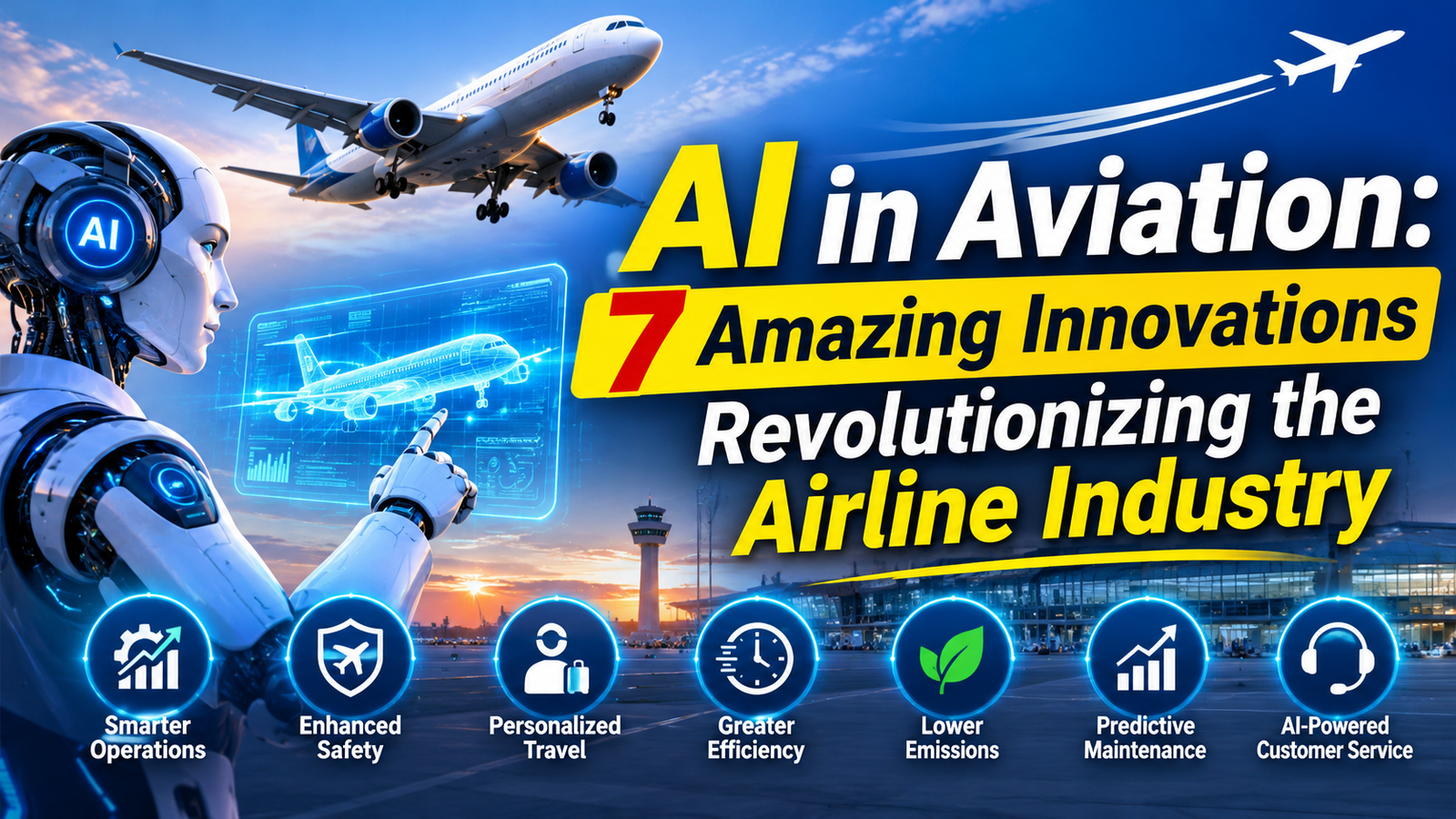
Artificial intelligence is changing the aviation industry in ways that were once considered science fiction. From predicting aircraft maintenance problems before they become expensive disruptions to improving passenger experiences and optimizing flight operations, AI in aviation is becoming an increasingly important part of modern air transport.
This article explores seven remarkable innovations transforming the airline industry, explains how airlines and airports are using AI, examines its benefits and challenges, and considers what the future may hold for aviation professionals and passengers.
Table of Contents
Introduction: How AI in Aviation Is Changing the Way We Fly
Imagine arriving at an airport and discovering that your flight is already being monitored for possible delays, your baggage is being tracked intelligently, your airline has predicted a maintenance issue before it becomes a problem, and the airport has adjusted passenger flows to reduce congestion.
Sounds like something from a futuristic Hollywood movie? Not anymore!
Artificial intelligence (AI) is becoming an important part of the modern aviation industry. From aircraft maintenance and flight planning to airport security and customer service, AI-powered technologies are changing how airlines and airports manage their daily operations.
The aviation industry has always depended on technology. Radar, computerized reservation systems, automated check-in kiosks, flight management systems, and electronic baggage tracking have already transformed air travel. However, AI takes things a step further by enabling computer systems to analyze large amounts of information, recognize patterns, make predictions, and support faster decisions.
The growing importance of AI in aviation is not simply about replacing traditional processes with machines. It is about helping aviation professionals make better decisions, improve safety, reduce unnecessary costs, and provide passengers with a smoother travel experience.
According to SITA’s 2025 Air Transport IT Insights research, 63% of surveyed airlines were using AI in operations control to help manage disruptions, aircraft assignments, and crew availability. This demonstrates that AI is already moving beyond experimentation and into practical airline operations.
But what exactly is changing?
Let’s explore seven amazing innovations that are revolutionizing the airline industry and discover why artificial intelligence could become one of aviation’s most important technologies.
What Is AI in Aviation?
AI in aviation refers to the use of artificial intelligence technologies to analyze information, identify patterns, predict potential problems, and support decisions across the aviation industry.
These technologies include:
- Machine learning: Systems learn from historical and real-time data to identify patterns and make predictions.
- Deep learning: Advanced machine-learning techniques that can analyze complex information, including images, sounds, and sensor data.
- Natural language processing: Technology that enables computers to understand and respond to human language.
- Computer vision: Systems that analyze images and video to identify objects, irregularities, and activities.
- Generative AI: Technology that can produce text, summaries, reports, and other content based on user instructions.
- Predictive analytics: Tools that use historical and current information to estimate what may happen in the future.
In practical terms, AI can help an airline predict passenger demand, identify aircraft maintenance concerns, optimize flight schedules, and support airport staff during busy operational periods.
However, AI does not automatically make every decision correctly. Its performance depends on data quality, system design, testing, cybersecurity, and appropriate human supervision.
Now, let’s examine the seven major innovations.
1. Predictive Aircraft Maintenance: Finding Problems Before They Become Expensive
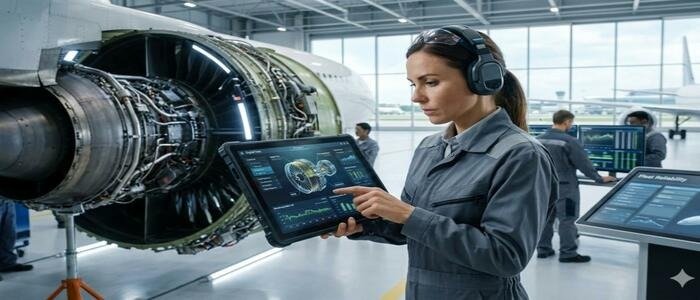
Imagine an aircraft arriving at the airport after a long flight. Engineers inspect the aircraft, review technical information, and prepare it for its next journey.
Traditionally, aircraft maintenance relies on scheduled inspections, manufacturer-approved maintenance programs, troubleshooting, and reports from pilots and engineers.
These processes remain essential. However, artificial intelligence is helping maintenance teams gain additional insights from aircraft data.
How Does AI Predict Aircraft Maintenance Problems?
Modern aircraft contain numerous sensors that monitor different systems and components. Depending on the aircraft and available systems, these sensors can collect information about:
- Engine temperature and performance.
- Oil pressure and other fluid-related parameters.
- Vibration levels.
- Fuel-system performance.
- Electrical-system conditions.
- Environmental control systems.
- Component operating hours and cycles.
AI-powered analytics can examine this information and compare it with historical performance patterns.
For example, if an engine component begins showing unusual vibration patterns, an AI-supported monitoring system may identify the change and flag it for engineering review.
This does not mean the system independently declares the aircraft unsafe or decides that a component must be replaced. Qualified maintenance professionals must assess the information using approved maintenance procedures.
Benefits of Predictive Maintenance in Aviation
AI-supported predictive maintenance can offer several advantages:
1. Early problem identification
Maintenance teams may receive warnings about developing technical issues before they result in unexpected operational disruptions.
2. Better maintenance planning
Airlines can use predictive information to plan inspections, coordinate engineering resources, and manage spare parts.
3. Reduced operational disruption
Identifying potential problems earlier may reduce last-minute aircraft changes and avoidable delays.
4. Improved aircraft availability
Better planning can help airlines use their fleets more efficiently while maintaining required safety standards.
5. More informed maintenance decisions
Engineers can combine AI-generated insights with technical documentation, inspection results, and their professional experience.
Real-World Application
Aircraft manufacturers and engine companies have developed digital monitoring and analytics services that use aircraft and engine data to support maintenance planning and performance monitoring.
The important point is that AI can help engineers move from simply reacting to certain problems toward identifying warning signs earlier.
Aviation example: Consider an airline operating several daily flights between international destinations. If a particular aircraft repeatedly generates unusual technical alerts, an analytics system may help identify a developing pattern. The engineering team can investigate the issue and determine the appropriate maintenance action before the situation becomes a larger operational problem.
That is a much better scenario than discovering an unexpected technical issue just before boarding begins!
2. AI-Powered Flight Operations and Route Optimization
Flight operations involve much more than getting an aircraft from one airport to another.
Airlines must consider weather conditions, aircraft performance, airspace restrictions, airport congestion, fuel requirements, crew duty limitations, and operational costs.
A small disruption can affect several connecting flights. This is why efficient flight planning is essential.
AI in aviation is helping airlines analyze complex operational information and evaluate different solutions more quickly.
How AI Improves Flight Planning
AI-supported systems can process different information sources, including:
- Weather forecasts.
- Wind conditions.
- Aircraft performance information.
- Air traffic restrictions.
- Airport congestion.
- Fuel consumption data.
- Flight schedules.
- Historical route performance.
Based on available information, these systems can help identify alternative routes, estimate operational impacts, and support decisions about flight planning.
For example, if severe weather affects a particular route, an AI-supported planning tool may help compare alternative routes based on fuel consumption, estimated flight time, and operational restrictions.
The final operational decision remains subject to approved procedures, air traffic control requirements, and the authority of the relevant aviation professionals.
AI and Fuel Efficiency
Fuel is one of the largest operating expenses for many airlines.
Even relatively small improvements in fuel efficiency can have a significant impact when multiplied across thousands of flights.
AI-supported flight optimization can help airlines:
- Identify more fuel-efficient routing opportunities.
- Analyze aircraft performance patterns.
- Improve flight planning.
- Estimate the effects of changing weather conditions.
- Support more efficient operational decisions.
However, fuel optimization must never compromise safety, aircraft limitations, or regulatory requirements.
How AI Helps During Flight Disruptions
Consider a situation where an aircraft cannot land at its planned destination because of severe weather.
The airline may need to consider:
- An alternative destination.
- Aircraft availability.
- Crew duty-time limitations.
- Connecting passengers.
- Airport capacity.
- Ground handling arrangements.
- Passenger accommodation and onward travel.
This is a complicated operational puzzle.
AI can help operations control teams evaluate possible recovery options and understand the consequences of different decisions.
The goal is not to allow a computer to run an airline independently. The goal is to give operations professionals better information when every minute matters.
3. Smart Airports: AI Transforming Ground Handling and Airport Operations
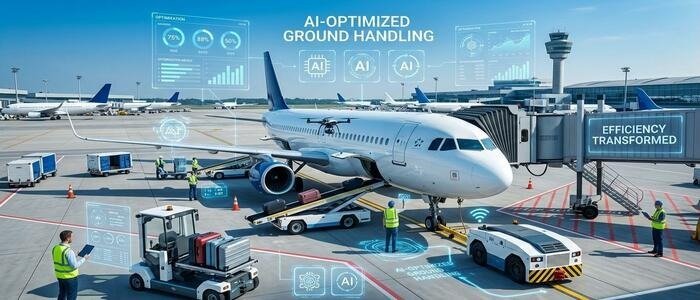
Airports are among the most complicated working environments in the world.
A single aircraft turnaround may involve airline representatives, ground handling teams, ramp supervisors, baggage handlers, security personnel, catering companies, fueling teams, maintenance staff, airport authorities, and many other service providers.
Everyone has a responsibility, and everyone is working against the departure clock.
If one activity is delayed, the entire operation can be affected.
This is where AI in aviation can make a significant difference.
AI-Powered Aircraft Turnaround Management
Aircraft turnaround refers to the activities performed between an aircraft’s arrival and its next departure.
These activities may include:
- Passenger disembarkation.
- Baggage unloading.
- Aircraft cleaning.
- Catering.
- Refueling.
- Cabin preparation.
- Baggage loading.
- Passenger boarding.
- Documentation and operational coordination.
AI-supported airport systems can analyze operational information to identify potential delays and support better coordination.
For example, if baggage unloading is taking longer than expected, an operational dashboard may highlight the delay and help supervisors assess its effect on the planned departure time.
Similarly, if fueling, catering, or cleaning activities are behind schedule, the system may provide early alerts.
SITA’s 2025 research highlighted the growing use of AI in airport turnaround activities, with 53% of surveyed airports applying AI to aircraft turnaround, compared with 36% in 2024.
AI and Baggage Handling
Lost or delayed baggage is one of the most frustrating experiences for passengers.
AI can support baggage operations through technologies such as computer vision, automated tracking, and predictive analytics.
These technologies can help:
- Identify baggage movement patterns.
- Detect unusual handling activity.
- Improve baggage sorting.
- Support baggage reconciliation.
- Identify possible loading errors.
- Predict congestion in baggage handling systems.
For instance, computer vision can help monitor baggage handling areas and identify operational irregularities.
However, baggage reconciliation and loading must continue to follow applicable security requirements and airline procedures.
AI and Ground Staff Management
AI can also support workforce planning.
Airports experience different passenger and flight volumes throughout the day. A morning departure wave may require more check-in agents, while an evening arrival wave may create additional baggage-handling requirements.
AI-powered forecasting can help managers estimate staffing requirements using:
- Flight schedules.
- Historical passenger volumes.
- Seasonal demand.
- Expected passenger arrival patterns.
- Staff availability.
- Operational workload.
This can help supervisors allocate resources more efficiently.
Why This Matters to Ground Handling Professionals
For airport duty officers, flight supervisors, and operations managers, AI could become a valuable operational assistant.
Instead of manually checking multiple systems, supervisors may receive a consolidated operational picture showing:
- Flights at risk of delay.
- Aircraft turnaround progress.
- Baggage handling status.
- Staff availability.
- Equipment allocation.
- Service delivery exceptions.
The supervisor still needs experience, communication skills, and sound judgment.
After all, an AI dashboard may identify a delay, but someone still needs to coordinate the baggage team, speak with the airline representative, and get the operation moving safely.
Technology is useful, but it cannot replace effective teamwork.
4. AI-Powered Passenger Experience: Making Air Travel More Personal
Passengers want a smooth journey.
They want accurate flight information, convenient check-in, quick answers, reliable baggage handling, and assistance when something goes wrong.
Unfortunately, airport operations do not always follow the perfect schedule shown on a travel itinerary.
Flights get delayed, gates change, baggage arrives late, and passengers occasionally arrive at the wrong terminal. It happens!
AI in aviation is helping airlines improve communication and deliver more personalized customer experiences.
Intelligent Airline Chatbots and Virtual Assistants
Airline websites and mobile applications increasingly use automated assistants to answer common passenger questions.
Depending on their capabilities, AI-powered assistants can help passengers:
- Check flight status.
- Find baggage information.
- Understand baggage allowances.
- Review travel policies.
- Locate check-in information.
- Request assistance.
- Understand booking procedures.
- Find information about flight disruptions.
Natural language processing allows these systems to understand questions written in ordinary language.
For example, a passenger might ask:
“Is my flight from Karachi to Jeddah delayed?”
An AI-powered assistant connected to reliable airline information systems may provide the latest available flight status.
However, passengers should be directed to official airline channels for important booking changes, refunds, and sensitive travel matters.
Personalized Passenger Services
AI can also help airlines understand passenger preferences and travel patterns.
For example, with appropriate consent and data protection, airlines may use customer information to provide more relevant services.
These may include:
- Personalized travel recommendations.
- Relevant travel notifications.
- Tailored loyalty offers.
- Assistance based on declared accessibility requirements.
- More relevant customer communications.
The objective is to make the passenger journey more convenient rather than overwhelming customers with unnecessary marketing messages.
AI and Disruption Management
One of the most important customer service applications is disruption management.
Imagine a passenger arriving at the airport and discovering that their connecting flight has been affected by a delay.
An AI-supported airline system may help identify alternative connections, assess available seats, and support customer service agents with relevant options.
This can reduce the time needed to investigate possible solutions.
However, the airline must still apply its ticketing conditions, passenger rights obligations, operational procedures, and applicable regulations.
Does AI Replace Airline Customer Service Agents?
No. At least, it should not be treated as a complete replacement.
AI can handle repetitive questions and provide quick information, but human customer service agents remain essential when dealing with:
- Angry or distressed passengers.
- Complex booking problems.
- Special assistance requests.
- Medical or emergency situations.
- Sensitive complaints.
- Unusual operational disruptions.
A chatbot may explain a baggage policy, but a trained airline representative is often better equipped to handle a passenger whose luggage has disappeared during an international connection.
The best approach combines AI efficiency with human empathy.
5. AI in Aviation Safety and Security: Detecting Risks Earlier
Safety is the foundation of aviation.
No matter how advanced an airline’s technology becomes, safety must remain the industry’s highest priority.
AI is creating new opportunities to analyze safety information, identify unusual patterns, and support risk management.
However, aviation safety is a highly regulated field, and AI systems must be carefully tested and appropriately supervised.
AI-Powered Safety Monitoring
Airlines and aviation organizations collect significant amounts of safety-related information.
This may include:
- Flight data monitoring information.
- Maintenance reports.
- Operational incident reports.
- Safety observations.
- Weather-related information.
- Equipment performance records.
- Ground handling incidents.
AI can help analyze these large datasets and identify patterns that might be difficult to recognize through manual review alone.
For example, if several reports identify recurring equipment-related incidents in a particular operational area, AI-supported analytics may help safety teams recognize the trend and investigate its underlying causes.
This can support proactive safety management.
AI in Airport Security Screening
Computer vision and machine-learning technologies can also support airport security operations.
Depending on regulatory approval and system capabilities, AI may assist with:
- Identifying potentially prohibited items in screening images.
- Highlighting unusual patterns.
- Supporting image analysis.
- Detecting access-control irregularities.
- Monitoring restricted operational areas.
These systems are decision-support tools and must operate within applicable security procedures.
Human security professionals remain responsible for following approved screening and response procedures.
AI and Ground Safety
Ground operations involve several potential hazards, including:
- Aircraft and vehicle movements.
- Ground support equipment positioning.
- Baggage loading activities.
- Aircraft servicing.
- Personnel working near aircraft engines.
- Foreign object debris (FOD).
- Aircraft damage risks.
AI-powered cameras and monitoring systems may help identify unsafe conditions and alert responsible teams.
For example, computer vision may help detect an unauthorized vehicle entering a restricted area or identify equipment positioned too close to an aircraft.
However, these systems must be reliable, properly calibrated, and integrated into existing safety management processes.
Can AI Prevent Aviation Accidents?
AI may help identify hazards and support better safety decisions, but it cannot guarantee accident prevention.
The International Air Transport Association emphasizes that artificial intelligence can help identify hazards and emerging threats, while human intelligence and professional expertise remain essential to safe aviation operations.
This is an important distinction.
Aviation safety depends on people, procedures, training, maintenance, operational discipline, and reliable technology working together.
AI is an additional resource, not a replacement for the safety culture that keeps aviation operating.
6. AI in Air Traffic Management: Helping Manage Increasing Air Traffic
Air traffic management is another area where artificial intelligence has considerable potential.
As global air traffic grows, air navigation service providers must manage increasing numbers of aircraft while maintaining safe separation and efficient traffic flows.
Air traffic controllers work in demanding environments where decisions must be made accurately and at the right time.
AI can support this work by analyzing complex information and identifying possible traffic-management challenges.
How AI Supports Air Traffic Management
AI-supported systems may help analyze:
- Aircraft positions and flight trajectories.
- Weather conditions.
- Traffic density.
- Airport capacity.
- Airspace restrictions.
- Historical traffic patterns.
- Potential congestion.
Based on available information, these systems may help predict traffic bottlenecks and support more efficient planning.
Predicting Air Traffic Congestion
Consider a busy international airport handling several arriving flights within a short period.
Weather conditions, runway availability, and airspace restrictions can create congestion.
AI-powered prediction tools may help identify periods of high traffic demand and support planning for alternative traffic flows.
This can help air navigation service providers make better-informed decisions.
AI and Flight Trajectory Optimization
AI may also support the analysis of aircraft trajectories.
For example, a system could compare different flight paths and assess their potential impact on fuel consumption, flight time, and airspace capacity.
Any operational changes must remain subject to approved air traffic management procedures and the authority of qualified controllers.
Important Safety Consideration
AI in air traffic management must meet demanding reliability, safety, and certification requirements.
An incorrect recommendation in a safety-critical environment can have serious consequences.
Therefore, AI should be introduced through appropriate testing, validation, oversight, and regulatory approval.
The objective is to support air traffic professionals, not to remove the human responsibility that underpins safe airspace management.
7. AI and Aviation Sustainability: Reducing Fuel Consumption and Environmental Impact
Sustainability has become an increasingly important subject for airlines, airports, aircraft manufacturers, and aviation regulators.
The industry faces pressure to improve environmental performance while continuing to provide reliable air transport services.
AI in aviation can support sustainability efforts by helping airlines identify operational inefficiencies and make better use of available resources.
AI for Fuel-Efficient Flight Operations
Aircraft fuel consumption depends on several factors, including aircraft weight, flight distance, weather, altitude, routing, and operational conditions.
AI-supported analytics can help evaluate these factors and identify opportunities to improve efficiency.
Possible applications include:
- Flight route optimization.
- Fuel consumption forecasting.
- Aircraft performance monitoring.
- Better flight planning.
- Weather-related operational analysis.
- Identification of unnecessary operational inefficiencies.
Even small improvements can become meaningful when applied across a large airline network.
AI and Airport Energy Management
Airports consume significant amounts of energy.
Terminal buildings, lighting, heating, ventilation, cooling systems, baggage infrastructure, and other facilities all require energy.
AI-supported building management systems can analyze energy consumption and identify opportunities to optimize heating, ventilation, air conditioning, and lighting.
For example, a smart airport system may adjust cooling requirements based on passenger occupancy and environmental conditions, subject to building safety and operational requirements.
Reducing Ground Handling Waste
Ground handling also provides opportunities for improved sustainability.
AI may help airport operators optimize:
- Ground support equipment allocation.
- Vehicle movements.
- Equipment utilization.
- Staff deployment.
- Aircraft turnaround activities.
More efficient ground operations can reduce unnecessary equipment movements and idle time.
However, sustainability improvements must be measured rather than assumed. Airlines and airports need reliable data to determine whether a particular AI application actually reduces fuel consumption, energy use, or emissions.
Can AI Make Aviation Completely Green?
No. AI is a supporting technology, not a magic solution to aviation’s environmental challenges.
It can help improve operational efficiency, but the industry’s wider sustainability progress also depends on aircraft technology, sustainable aviation fuel availability, infrastructure investment, energy systems, and effective environmental policies.
AI can help make aviation smarter, but it cannot independently eliminate the environmental impact of flying.
How AI in Aviation Is Transforming Different Aviation Departments
The impact of artificial intelligence extends beyond flight operations.
Different departments across airlines and airports can benefit from AI-supported tools.
Here is a practical overview:
| Aviation department | Possible AI application |
| Flight operations | Route and schedule optimization |
| Engineering and maintenance | Predictive maintenance |
| Ground handling | Aircraft turnaround monitoring |
| Baggage services | Baggage tracking and anomaly detection |
| Customer service | Intelligent virtual assistants |
| Airport security | Image analysis and threat detection support |
| Operations control | Disruption management |
| Human resources | Workforce demand forecasting |
| Commercial departments | Passenger demand and revenue analysis |
| Airport management | Passenger flow and resource optimization |
The greatest benefits are likely to come when these departments share reliable information rather than operating separate systems that cannot communicate effectively.
Benefits of AI in Aviation: Why Are Airlines Investing in It?
AI offers several potential benefits to the aviation industry.
1. Improved Operational Efficiency
AI can process large amounts of operational information and identify potential inefficiencies.
This can help airlines coordinate activities and use resources more effectively.
2. Better Predictive Capabilities
Instead of relying exclusively on historical reports, AI systems can analyze changing conditions and identify potential problems earlier.
3. Improved Passenger Experience
Intelligent customer service tools can provide faster answers and help airlines deliver more relevant passenger information.
4. Better Resource Management
AI can support aircraft allocation, crew scheduling, equipment planning, and workforce forecasting.
5. Support for Safety Management
AI-supported analysis can help identify unusual patterns and potential hazards that deserve further investigation.
6. Improved Decision-Making
AI can help managers compare different operational scenarios before selecting an appropriate response.
7. Potential Cost Savings
Better maintenance planning, improved operational efficiency, and reduced disruption may help airlines manage costs.
However, financial benefits depend on implementation costs, data quality, system reliability, and the actual performance of the technology.
Challenges of Implementing AI in Aviation
Although AI has enormous potential, introducing it into aviation is not as simple as purchasing software and switching it on.
The aviation industry operates under strict safety, security, and regulatory requirements.
Several important challenges must be addressed.
1. Data Quality and Integration
AI systems depend on reliable information.
If an airline’s maintenance, flight operations, baggage, and crew systems contain incomplete or inconsistent information, AI recommendations may become unreliable.
Integrating information from airlines, airports, ground handlers, and external service providers can also be difficult.
2. Cybersecurity Risks
AI systems depend on digital infrastructure and data.
This creates potential cybersecurity risks, including unauthorized access, data manipulation, and system disruption.
Aviation organizations must implement appropriate cybersecurity controls, access management, monitoring, and incident-response procedures.
3. High Implementation Costs
Developing and implementing AI systems can require significant investment.
Costs may include:
- Software development.
- Hardware and infrastructure.
- Data integration.
- Staff training.
- Cybersecurity.
- System testing.
- Regulatory and assurance activities.
Smaller airlines and airports may find these investments particularly challenging.
4. Human Oversight and Accountability
One of the most important challenges is determining who remains responsible when AI supports operational decisions.
Aviation organizations need clear policies defining system limitations, human responsibilities, escalation procedures, and accountability.
An AI recommendation should never become an excuse for ignoring established safety procedures.
5. Staff Training and Resistance to Change
Employees may feel uncertain about new technology, particularly if they believe it will replace their jobs.
Airlines should communicate the purpose of AI clearly and provide suitable training.
The objective should be to help employees develop new skills and use technology effectively.
6. Bias and Unreliable Recommendations
AI systems can produce inaccurate or biased results when trained on incomplete, outdated, or unrepresentative information.
Aviation organizations must evaluate systems carefully and monitor their performance after deployment.
7. Regulatory and Certification Requirements
Safety-critical aviation applications require appropriate assurance, validation, and regulatory oversight.
The European Union Aviation Safety Agency (EASA) has been developing guidance on trustworthy AI for aviation, including human factors, ethics, and AI assurance.
This demonstrates that technological innovation must develop alongside aviation safety standards.
Will AI Replace Aviation Professionals?
This is probably one of the biggest questions aviation employees are asking.
Will AI replace airline customer service agents, ground handling supervisors, operations managers, maintenance engineers, or even pilots?
The realistic answer is that AI is more likely to change many aviation jobs than eliminate the need for aviation professionals altogether.
Some repetitive tasks may become automated, while other roles will require employees to work alongside intelligent systems.
Consider the following examples:
Ground handling supervisors: AI may monitor turnaround performance and highlight delays, while supervisors coordinate teams and resolve operational issues.
Customer service agents: Chatbots may answer routine questions, while human agents handle complicated complaints and sensitive situations.
Maintenance engineers: AI may identify unusual performance patterns, while engineers inspect equipment and determine appropriate maintenance actions.
Operations control officers: AI may evaluate alternative recovery options, while experienced officers coordinate decisions across operational departments.
Airport managers: AI may forecast passenger demand and resource requirements, while managers lead teams and maintain operational standards.
The aviation professionals who understand both technology and operational procedures may have an advantage in the changing job market.
Skills Aviation Professionals Should Develop
To remain competitive, aviation employees should consider developing:
- Digital literacy.
- Data interpretation.
- AI awareness.
- Operational decision-making.
- Safety management.
- Cybersecurity awareness.
- Communication and leadership.
- Problem-solving.
- Change management.
Remember, technology can provide information, but people must know how to interpret it and act responsibly.
What Does the Future of AI in Aviation Look Like?
The future of AI in aviation will probably involve greater integration between airlines, airports, aircraft manufacturers, maintenance providers, and air navigation service providers.
Rather than using separate systems for individual activities, the industry is moving toward more connected operational environments.
Several developments deserve attention.
1. More Intelligent Operations Control Centres
Future operations control centers may use advanced AI assistants to analyze flight schedules, weather, aircraft availability, crew requirements, and airport restrictions.
These tools could help operations teams evaluate complex disruption scenarios more quickly.
2. Advanced Digital Twins
A digital twin is a virtual representation of a physical asset or process.
In aviation, digital twins may represent aircraft components, airport infrastructure, or operational processes.
Combined with AI, these models can help organizations simulate different scenarios and assess potential performance improvements.
3. More Connected Smart Airports
Airports may increasingly use integrated systems to monitor passenger flows, aircraft turnaround activities, baggage movements, and ground equipment.
This could help airport managers identify congestion and improve resource coordination.
4. More Personalized Passenger Services
AI assistants may become better at understanding passenger requests and providing relevant information throughout the journey.
However, passenger privacy, data protection, and transparency will remain essential.
5. Greater Human-AI Collaboration
The future of aviation will likely depend on effective cooperation between people and intelligent systems.
AI may become a standard decision-support tool across many departments, but professional judgment, accountability, and safety leadership will remain important.
Conclusion: AI in Aviation Is Building a Smarter Future for Air Travel
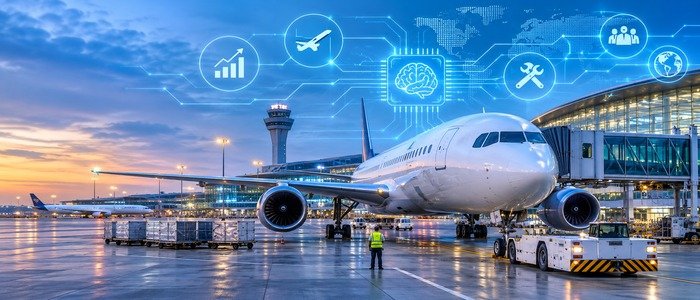
Artificial intelligence is changing the aviation industry, from the aircraft maintenance hangar to the airport terminal and the airline operations control center.
The seven innovations discussed in this article demonstrate how AI in aviation can support predictive maintenance, flight optimization, smart airport operations, passenger services, aviation safety, air traffic management, and sustainability.
However, successful implementation requires more than advanced software.
Airlines and airports need reliable data, trained employees, effective cybersecurity, appropriate regulatory oversight, and a strong commitment to operational safety.
Most importantly, aviation must maintain the right balance between artificial intelligence and human intelligence.
AI can analyze millions of data points, but an experienced airport supervisor understands the importance of coordinating people, communicating with airline representatives, and responding calmly when an unexpected operational problem occurs.
The future of aviation will not simply belong to machines. It will belong to organizations that know how to combine intelligent technology with human expertise.
One thing is certain: the next generation of aviation will be smarter, more connected, and increasingly data-driven. And AI will be an important part of that journey.
Frequently Asked Questions About AI in Aviation
1. What is AI in aviation?
AI in aviation refers to the use of artificial intelligence technologies to analyze data, recognize patterns, predict potential problems, and support decisions across airlines, airports, aircraft maintenance, flight operations, and air traffic management.
2. How is artificial intelligence used in the airline industry?
Airlines use or are exploring AI for predictive maintenance, flight planning, fuel optimization, passenger services, demand forecasting, crew scheduling, baggage operations, and disruption management.
The level of adoption varies between airlines and applications.
3. Can AI improve aviation safety?
Yes. AI can support aviation safety by analyzing operational information, identifying unusual patterns, assisting with maintenance predictions, and highlighting potential risks.
However, AI cannot guarantee accident prevention and must operate under appropriate safety controls and human oversight.
4. Will AI replace pilots and airport ground staff?
AI may automate certain repetitive tasks and change how aviation professionals work. However, pilots, engineers, ground handling staff, airport supervisors, and other professionals continue to perform important duties requiring expertise, judgment, communication, and accountability.
5. What is the future of AI in aviation?
The future may include more advanced predictive maintenance, connected smart airports, intelligent operations control centers, digital twins, improved air traffic management support, and personalized passenger services.
Facebook: https://www.facebook.com/rehan.ghauri
Linkedin: https://www.linkedin.com/in/rehan-ghauri/
https://www.sita.aero/globalassets/docs/surveys–reports/sita-2025-it-insights-report-combined-digital.pdf?
